It can move. It can multiply. It can survive assault from gardening tools. Sometimes it pulses like a slimy heart. You’d be forgiven for thinking it’s extraterrestrial. (In fact, in 1973 a blob of it was reported in Texas as an alien life form.)
In truth, it’s slime mold and it’s one of the most mysterious and fascinating things you may encounter on trail. It’s in the kingdom Protozoa, the least understood of the five kingdoms of life, so it’s worth slowing down to examine it. You’ve probably seen one, but you might not have known what it was.
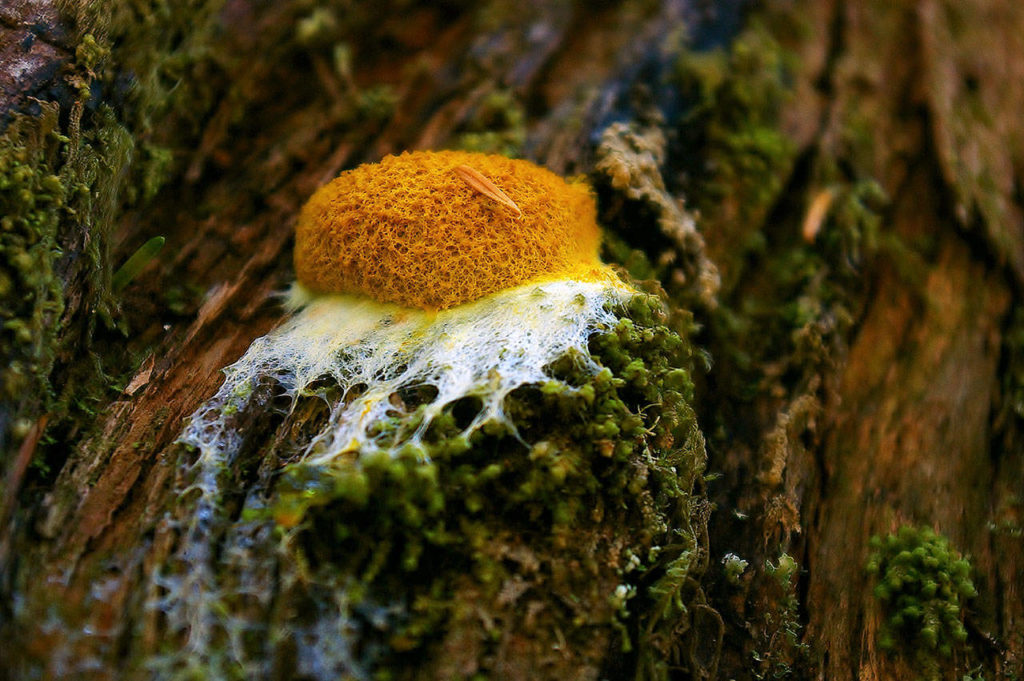
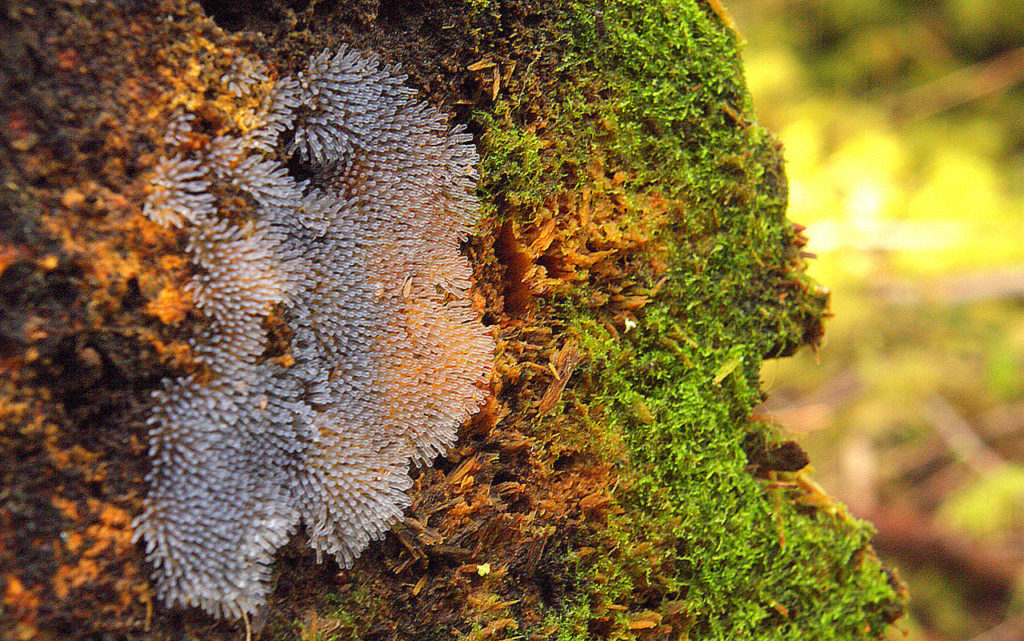
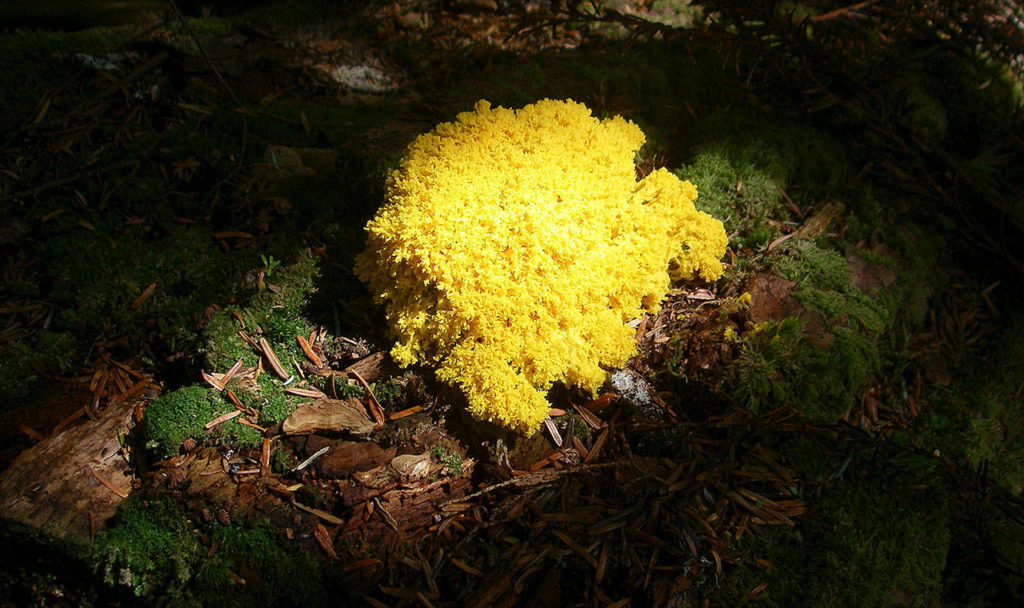
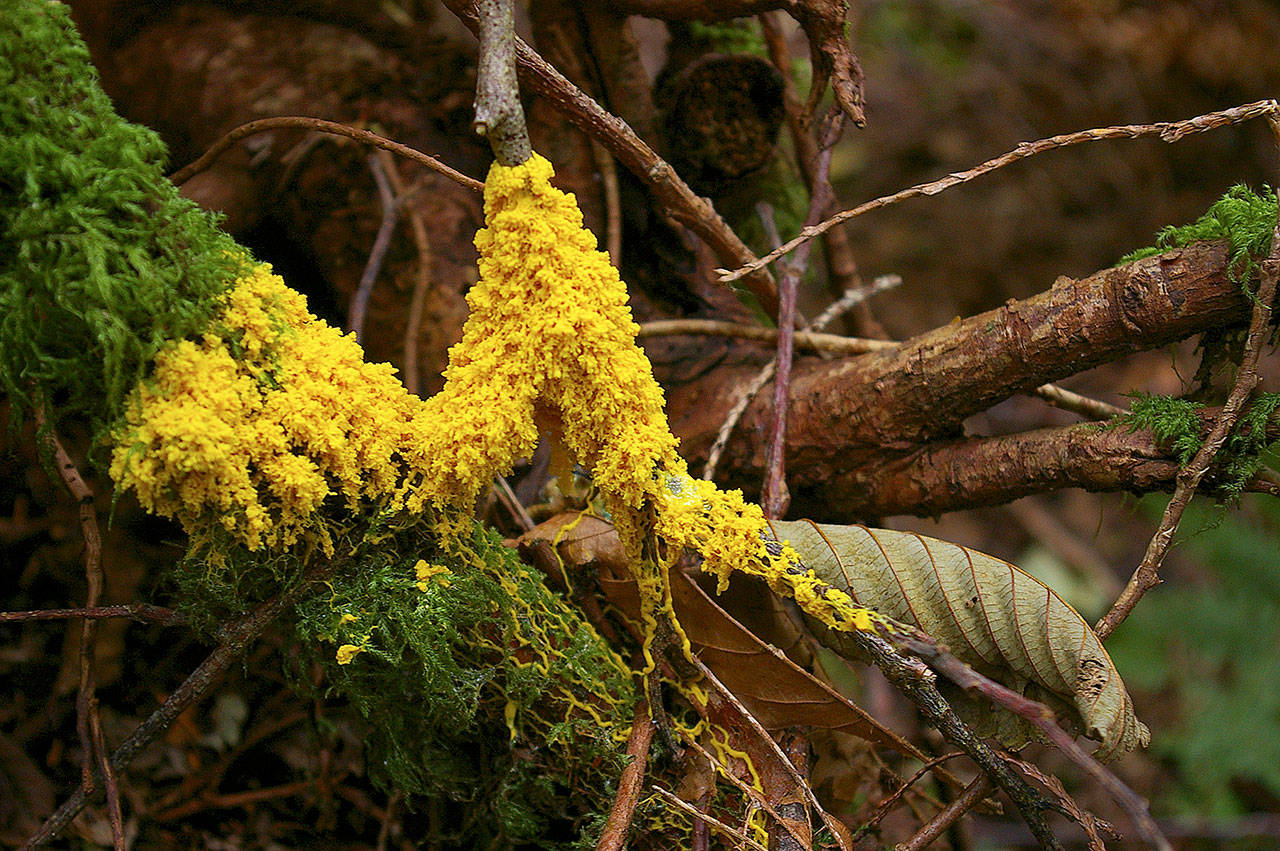
Slime mold comes in many forms. Perhaps the one that hikers notice most is Fulgio septica, or the aptly named dog vomit, a foamy-looking yellow/white slime. Others may appear as a white-gray blur, white globs, orange globes or bright orange tentacle-like tubes. Though visible with the naked eye in late summer and fall, a magnifying glass or loupe will better reveal the beauty of slime molds — the fruiting bodies of slimes come in a variety of shapes and colors. Once you see your first slime mold, you’ll notice them more often.
There are two kinds of slime molds: cellular, which cannot be seen with the naked eye, and plasmodium, which is a visible delight. A plasmodium is a mass of protoplasm, the complex soup within a cell that makes it tick. Plasmodium slime molds live as single-cell, amoeba-like organisms.
Unlike most visible organisms, which are created by cellular division, slime mold cells merge, dissolving their individual cell walls to create one giant, multi-nucleated cell. This attribute makes it suitable for cancer research.
A lack of food puts multiple slime mold cells into action.
Once its cells merge, the mold is ready to move. It can pulse along at ripping speeds up to 4 centimeters per hour. The slime mold can steer itself away from toxins, and nudge toward food and nutrients. It can tear itself into separate pieces and then put itself together again. If I didn’t know better, I’d report one as an alien, too.
You’ll find slime molds draped over logs or hanging from bark, leaf litter or low plants on the forest floor. They are not picky; you’ll find them in drier areas, as well as moist forest. Peek under the bark of a downed log and see if a slime is underneath. Look closely at a dog vomit slime to see the tracks left behind as it moves.
I enjoy lowland river hikes and have been finding slime molds on the trails for many years — except all I knew until more recently was that these things are slime molds.
Three years ago, while on the Surprise Lake Trail off the Highway 2 corridor as a volunteer ranger for the Mount Baker-Snoqualmie National Forest, some hikers asked me what that weird yellow thing was a few switchback down.
Though I knew what it was, I felt silly not knowing anything about slime mold. So I did some very basic research; enough to share a few nifty factoids about them so that the next time a hiker asks, I can provide them with more than just “slime mold.”
The prospect of seeing slime mold may slow your pace on the trail. Slime molds live confusing lives and are difficult to identify (many look similar in early stage growth), so most hikers are satisfied just to know that what they’ve found is a slime mold.
Pro tip: If it’s weird and slimy and all your friends are accounted for, it’s probably a slime mold.
Washington Trails Association is the nation’s largest state-based hiking advocacy nonprofit. WTA promotes hiking as a way to inspire a people to protect Washington’s natural places through collaboration, education, advocacy and volunteer trail maintenance. Get inspired to go hiking and learn how you can help protect trails at www.wta.org.
Trail mysteries
Kim Brown, of Shoreline, is an aficionado of the weird and the wild. If it’s bizarre, she wants to know about it. All year long, she’ll be demystifying trail mysteries as a volunteer ranger for the Mount Baker Snoqualmie National Forest. Do you have a trail mystery to solve? Contact her at brownk3@uw.edu.
Learn more
To help you enjoy your slime mold journey, and get an idea of how cool slime molds are, check out the book “Myxomycetes: A Handbook of Slime Molds” by Steven L. Stephenson and Henry Stempen. There is a Slime Mold Identification Appreciation Facebook page. Or find lots of beautiful photos, videos and articles via a simple internet search.
Talk to us
> Give us your news tips.
> Send us a letter to the editor.
> More Herald contact information.
Gallery