
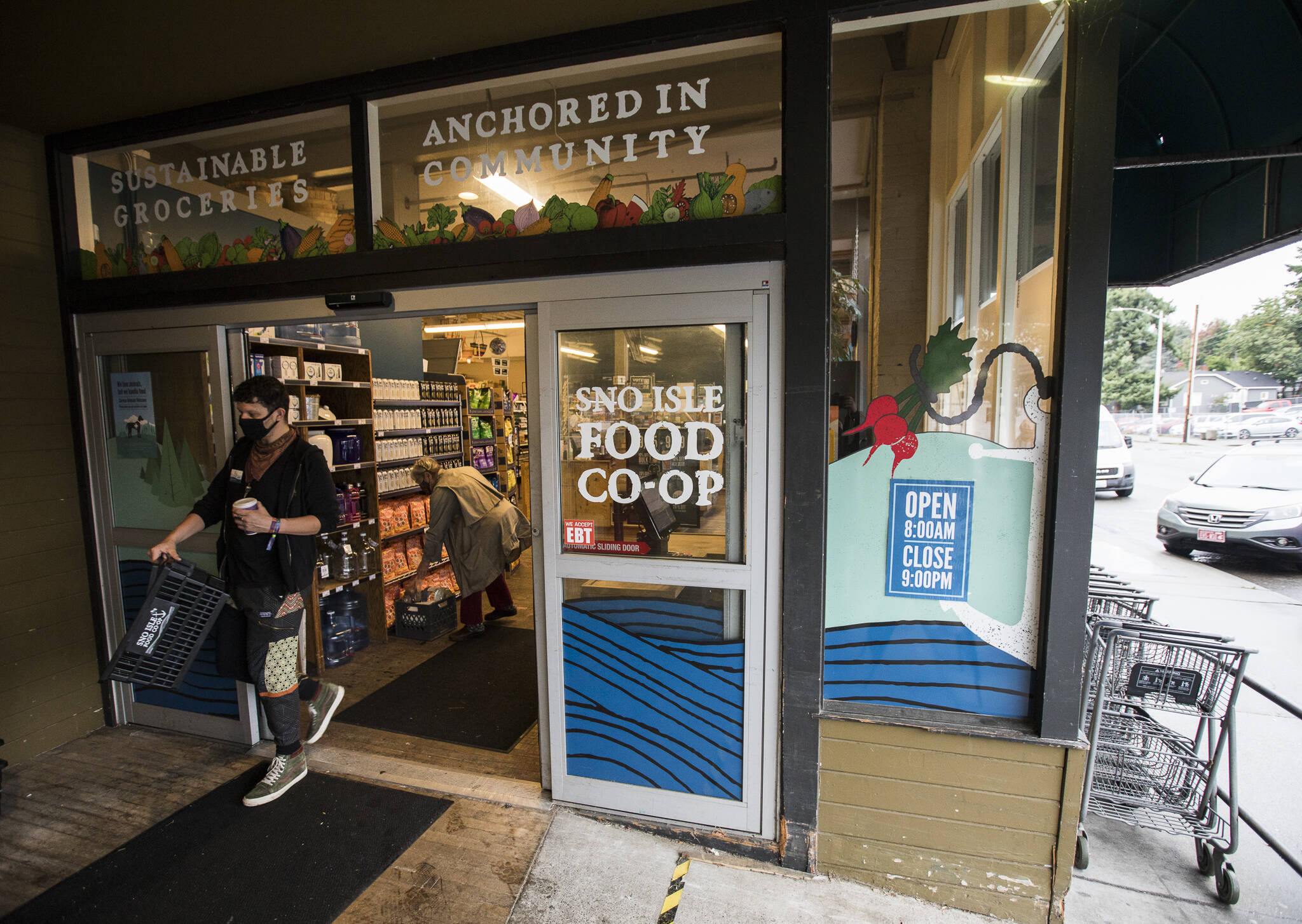
EVERETT — Amid an ongoing lawsuit, a community-owned grocery store in Everett filed counterclaims against its landlord in court last week, alleging that the grocer has taken significant steps to remedy a number of complaints from the building owner over the past year.
In the document, filed in court on Dec. 3, the Sno-Isle Food Co-op — a collectively-owned grocery store governed by a board of trustees — accused the owner and manager of the Everett Public Market building, Tami Agassi, of making unreasonable demands, unjustly benefiting from the co-op’s investment in the building without reimbursing it and damaging the grocer’s reputation.
Tye Ferrell, the president of the co-op’s board of trustees, wrote in a statement Tuesday that the grocery store has “consistently acted in good faith with the current building owner, responding to concerns as they were raised and making substantial, and at times even unnecessary, investments to accommodate escalating demands.”
“We are disappointed by the landlord’s escalation of these issues to the courts, but our focus remains on working toward a fair and constructive resolution so that we can keep our doors open, support the community, and continue providing wholesome, local, and natural foods to Everett and the surrounding area,” Ferrell wrote.
In a statement Tuesday, Agassi wrote that her priority “has always been protecting this 130-year-old building and the tenants who rely on it.” She stated that the co-op’s refrigeration system needed replacing as it was causing damage to the building’s rooftop, and that they relied on the co-op’s expertise in designing HVAC systems.
“We believe the filings speak for themselves and look forward to the facts being evaluated in court,” Agassi wrote.
The counterclaims come after Agassi sued the grocer in November, alleging that improperly installed condensers and compressors — vital parts of the co-op’s refrigeration equipment — were damaging a ground-floor unit, Unit 102, in the century-old Everett Public Market building it occupies. The lawsuit, an unlawful detainer, is part of the eviction process in Washington.
Agassi also alleged that recurring leaks at the co-op had damaged the building’s hardwood floors and leaked into other areas of the building.
In a Nov. 17 statement published on its website, the co-op’s board of trustees said the grocery store has “cared for the space and consistently worked in good faith with the building owners to address concerns as they arise,” the board wrote.
“Over the past year, we have taken multiple steps to respond to requests made of us — including investing in upgraded equipment, engaging licensed professionals, and communicating openly and proactively,” the board wrote. “We remain committed to collaborating on solutions that preserve the integrity of this historic building and ensure a safe environment for everyone.”
In the Dec. 3 legal filing, the co-op stated that since 2019, the landlord began making demands on Sno-Isle, initially mundane and generally fair, which began to escalate. In May 2024, Agassi told the store manager that she was concerned about the effect of the co-op’s condensers, alleging that the use of sprinklers with the rooftop condensers would damage the roof, according to the filing. She “demanded” that Sno-Isle move the condensers from the roof, the filing read.
Agassi denied, however, that she insisted on moving the compressors to Unit 102.
“Show me one place in writing where I would say that,” Agassi said in a previous interview with The Daily Herald. “They don’t have it because I didn’t. I didn’t demand that be put in there, I demanded they get a new one, OK? Because the old one they had was dangerously freezing the refrigeration pipes to where they could crack.”
Agassi said she trusted the advice of the contractor hired by the co-op when she approved the installation of compressors and condensers indoors.
Sno-Isle also said it trusted the advice of contractors when installing the equipment, and that once the issues were discovered, that the landlord had “refused to work with Sno-Isle to develop a solution,” the co-op’s filing read. Moving the condensers and compressors again would cost hundreds of thousands of dollars, the co-op wrote, on top of the more than $100,000 it paid to move the equipment to the unit underneath the grocery store.
In regard to the building’s flooring, the co-op wrote that it had not known of any alleged water damage to the hardwood floor until the landlord filed a notice of default in July 2024.
“Sno-Isle was not aware of any meaningful spillage or leakage issues that would affect the wood flooring of the 130-year-old building, much less damage to such flooring sufficient to constitute a default of its lease or to cause any structural damage to the building,” the document read.
In a letter to the co-op’s attorneys after the notice of default was sent in 2024, an attorney for Agassi wrote that Sno-Isle “should not have been surprised to receive the notice” as the landlord had expressed concerns with water damage to the floors.
The co-op’s Dec. 3 filing also alleged that the landlord hasn’t presented any evidence of structural damage to the building, mold, or insect infestation as she alleged in the July 2024 notice of default.
“Sno-Isle is a functioning grocery store, and some minor spillage is expected in the regular course of business,” the filing reads. “Moreover, the Everett Public Market Building is over 130-years old and still has its original wood floors intact—there is a necessary and expected amount of wear and tear.”
The co-op said it spent $26,000 on repairs for three coolers that were experiencing minor, typical issues.
The co-op alleged the efforts to evict the grocer from the ground-floor unit also amount to a constructive eviction, which occurs when a landlord does not physically evict a tenant but takes actions that interfere with the tenant’s use of the property, according to Cornell University. In this case, evicting the co-op from Unit 102 would prevent it from operating the grocery store, the filing stated.
The company requested judgments from the court due to the value of its improvements to the building, as well as compensation from the landlord for alleged damages.
The Sno-Isle Food Co-op opened in 1997 and has been located in the Everett Public Market building since it began operating. Over 11,000 people are member-owners of the popular grocery store, the closest to the city’s downtown core.
A previously scheduled hearing for Dec. 8 was canceled. A hearing on the case is now planned for Jan. 6, 2026.
Will Geschke: 425-339-3443; william.geschke@heraldnet.com; X: @willgeschke.
Talk to us
> Give us your news tips.
> Send us a letter to the editor.
> More Herald contact information.
























