
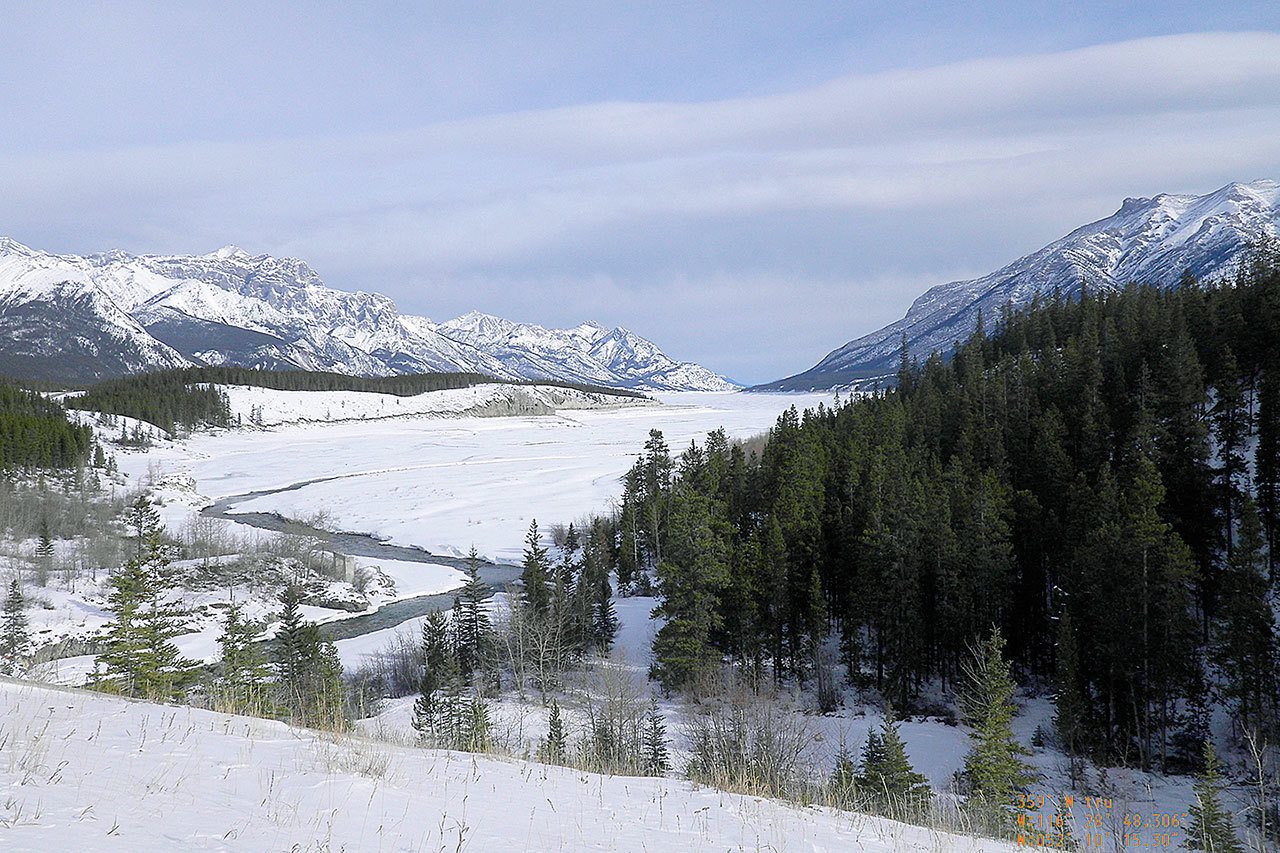
This February 2012 shows a southward view down Cline River in Alberta, Canada, where retreating ice sheets created an ice-free corridor more than 13,000 years ago. This is part of the ice-free corridor which was ruled out for migration by the first people to colonize the Americas, since no evidence of plants or animals were found along this route until about 12,600 years ago. (Mikkel Winther Pedersen via AP)

This February 2012 shows a southward view down Cline River in Alberta, Canada, where retreating ice sheets created an ice-free corridor more than 13,000 years ago. This is part of the ice-free corridor which was ruled out for migration by the first people to colonize the Americas, since no evidence of plants or animals were found along this route until about 12,600 years ago. (Mikkel Winther Pedersen via AP)

Study: Pacific coast was route for colonizing the Americas

By MALCOLM RITTER, Associated Press

NEW YORK — Researchers have found new evidence that the first Americans migrated south from Alaska via the Pacific coast, rather than a route hundreds of miles inland along the Rocky Mountains.

The colonization of the Americas began after people arrived from Siberia, crossing an ancient land bridge called Beringia into Alaska. Huge ice sheets largely blocked the way south, but a gap in western Canada was long thought to provide an ice-free corridor for migration into the continent.

That idea ran into a problem as archaeologists documented human presence in the Americas at earlier and earlier times. The corridor appeared some 15,000 to 14,000 years ago as the ice sheets retreated, but studies suggest that people had reached South America by at least 14,700 years ago. Even if one accepts the earliest date for the corridor, it’s hard to believe the migration could have gone so far south, so fast.

So in recent years, many scientists have concluded that the first southward migrants traveled along the Pacific coast instead, either in boats or on land.

The new research, released Wednesday by the journal Nature, casts further doubt on the inland corridor. It suggests that even after the corridor appeared, it wasn’t suitable for migration until about 12,600 years ago.

That’s because it lacked plants and game that people would need to sustain themselves on the long journey, researchers concluded.

The paper, by Eske Willerslev of Cambridge University and others, analyzed pollen and traces of animal DNA from ancient sediments of two lakes near Fort St. John in northeastern British Columbia. That general area is where the corridor last opened.

The paper follows another recent study of the corridor that also concluded it became habitable too late for the first migration south.

The earlier paper used a different method to assess habitability, and one of its authors, Beth Shapiro of the University of California, Santa Cruz, said in an email that “it’s great when two different (approaches) agree on an issue that has been unresolved for such a long time.”

Talk to us

> Give us your news tips.

> Send us a letter to the editor.

> More Herald contact information.

More in Local News

Darryl Dyck file photo
Mohammed Asif, an Indian national, conspired with others to bill Medicare for COVID-19 and other respiratory tests that hadn’t been ordered or performed, according to a U.S. Department of Justice press release.
Man sentenced to 2 years in prison for $1 million health care fraud scheme

Mohammed Asif, 35, owned an Everett-based testing laboratory and billed Medicare for COVID-19 tests that patients never received.

Snohomish County Fire District No. 4 and Snohomish Regional Fire and Rescue responded to a two-vehicle head-on collision on U.S. 2 on Feb. 21, 2024, in Snohomish. (Snohomish County Fire District #4)
Family of Monroe woman killed in U.S. 2 crash sues WSDOT for $50 million

The wrongful death lawsuit filed in Snohomish County Superior Court on Nov. 24 alleges the agency’s negligence led to Tu Lam’s death.

Judy Tuohy, the executive director of the Schack Art Center, in 2024. (Olivia Vanni / The Herald)
Director of Everett’s Schack Art Center announces retirement

Judy Tuohy, also a city council member, will step down from the executive director role next year after 32 years in the position.

Human trafficking probe nets arrest of Calif. man, rescue of 17-year-old girl

The investigation by multiple agencies culminated with the arrest of a California man in Snohomish County.

A Flock Safety camera on the corner of 64th Avenue West and 196th Street Southwest on Oct. 28, 2025 in Lynnwood, Washington. (Olivia Vanni / The Herald)
Everett seeks SnoCo judgment that Flock footage is not public record

The filing comes after a Skagit County judge ruled Flock footage is subject to records requests. That ruling is under appeal.

Information panels on display as a part of the national exhibit being showcased at Edmonds College on Nov. 19, 2025 in Lynnwood, Washington. (Olivia Vanni / The Herald)
Edmonds College hosts new climate change and community resilience exhibit

Through Jan. 21, visit the school library in Lynnwood to learn about how climate change is affecting weather patterns and landscapes and how communities are adapting.

Lynnwood City Council members gather for a meeting on Monday, March 17, 2025 in Lynnwood, Washington. (Olivia Vanni / The Herald)
Lynnwood raises property, utility taxes amid budget shortfall

The council approved a 24% property tax increase, lower than the 53% it was allowed to enact without voter approval.

Lynnwood
Lynnwood hygiene center requires community support to remain open

The Jean Kim Foundation needs to raise $500,000 by the end of the year. The center provides showers to people experiencing homelessness.

Logo for news use featuring Snohomish County, Washington. 220118
Vending machines offer hope in Snohomish County in time for the holidays.

Mariners’ radio announcer Rick Rizzs will help launch a Light The World Giving Machine Tuesday in Lynnwood. A second will be available in Arlington on Dec. 13.

UW student from Mukilteo receives Rhodes Scholarship

Shubham Bansal, who grew up in Mukilteo, is the first UW student to receive the prestigous scholarship since 2012.

Roger Sharp looks over memorabilia from the USS Belknap in his home in Marysville on Nov. 14, 2025. (Will Geschke / The Herald)
‘A gigantic inferno’: 50 years later, Marysville vet recalls warship collision

The USS Belknap ran into the USS John F. Kennedy on Nov. 22, 1975. The ensuing events were unforgettable.

Kelsey Olson, the owner of the Rustic Cork Wine Bar, is introduced by Port of Everett Executive Director Lisa Lefebar on Dec. 2, 2025 in Everett, Washington. (Olivia Vanni / The Herald)
Rustic Cork Wine Bar opens its doors at the Port of Everett

It’s the first of five new restaurants opening on the waterfront, which is becoming a hotspot for diners.

Support local journalism

If you value local news, make a gift now to support the trusted journalism you get in The Daily Herald. Donations processed in this system are not tax deductible.



















