Why can’t the street simply look like a street?
Published 10:11 pm Monday, August 16, 2010
Brian Laine of Arlington asks: I see that as they are doing the road improvement work on Smokey Point Boulevard between 116th Street NE and Smokey Point, they have been pouring curbs for in-street planting areas in the median.
Is there some justification for this? It seems like they did the same on 67th Avenue NE between 172nd and 192nd in Arlington and it has led to a rework to allow trucks to be able to turn; the cost of installing landscaping; the cost and danger of a crew maintaining the landscaping; reduced road space available for traffic, and a reduction of safety. The curbs can easily cause a car, truck or motorcycle to lose control if they hit the curb.
Can’t roads just be roads and not a decorative element as well? In these hard times it seems like we should focus on the basics.
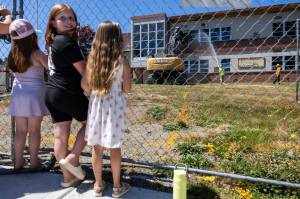
Tonya Miranda, business office supervisor of the Marysville public works department, responds: As you note, three landscaped islands are currently being constructed along the median of the roadway, extending approximately one-third of a mile to the north of 136th Street NE. While we certainly value and appreciate your comments, we honestly believe the islands will provide the city and the traveling public with a net positive, on balance.
Median islands are a time-proven, effective means of managing access and restricting turning movements on roadways such as Smokey Point Boulevard. As a result, medians actually serve to increase the overall level of safety by greatly reducing the likelihood of “head-on” and “at-angle” collisions — typically some of the most severe and injury-inducing traffic accidents.
The effectiveness of median islands for safety has been recognized by a wide variety of municipalities and agencies throughout the region and elsewhere. The list of local agencies that rely on and recognize the positive benefits of islands is very long.
The city’s work on Smokey Point Boulevard is now very nearly complete, and we look forward enthusiastically to the day, very soon, when the new five-lane roadway will be open to traffic. As compared with the scenario that was in place prior to the project — with narrow shoulders, no turn lanes and an absence of pedestrian facilities — we are convinced that the new roadway will prove over time to be a very positive improvement to those who use it.
Jan M. Howard of Everett asks: I live up just off of Federal Avenue on Rucker Hill.
Why can’t I turn left during certain hours off of Mukilteo Boulevard onto 42nd Street which then continues up to Federal but I can turn left off of Mukilteo Boulevard (41st Street) onto Grandview and go up the hill to Federal?
Would the city consider either (a) installing a traffic light at 42nd and Mukilteo that would be tripped only when there is someone waiting to turn left at the intersection or (b) could people who live up here get some sort of sticker (maybe for a fee) from the city that would allow them to turn left from Mukilteo onto 42nd whenever they needed to and thereby avoid tickets? This would at least alleviate half of the issue up here.
Dongho Chang, Everett traffic engineer, responds: The left turn from Mukilteo Boulevard onto 42nd Street is prohibited during morning and evening commute times for safety. The restriction began in the early 1990s based on community safety concern and request. We do not prohibit the left turns onto Grandview because we have not seen much usage of this turn, but will reassess if we see a need to do so for safety in the future. The volumes at 42nd Street do not meet the threshold for a traffic light at this time. Traffic restriction applies to all passenger vehicles and cannot be selectively enforced.
E-mail Street Smarts at stsmarts@heraldnet.com. Please include your city of residence.