Editorial: MLB needn’t play hardball with minor league teams
Published 1:30 am Friday, January 24, 2020


By The Herald Editorial Board
Normally, talking about baseball in general and the Everett AquaSox in particular this time of year would be a welcome respite from thoughts of the gloomy January weather, the nation’s continuing and all-consuming political struggles and a Seahawks post-season that arrived two games too soon.
We could be enjoying hot-stove league discussions of spring training (Mariners pitchers and catchers report Feb. 12), coaching staff announcements (Louis Boyd returns as AquaSox manager) and the results of Hall of Fame voting (still hope for former Mariner “Little O” Omar Vizquel).
Threatening to rain on all that, however, was the announcement late last year that Major League Baseball — in agreement renewal talks with Minor League Baseball — has proposed cutting the number of affiliates, which develop players for “The Bigs,” from the current 160 teams across the nation down to 118, meaning 42 communities now face losing teams or seeing their stature diminished to independent status as soon as the 2021 season.
Everett is not one of those slated for contraction, but two teams the AquaSox regularly play each season — Oregon’s Salem-Keizer Volcanoes and Washington’s Tri-City Dust Devils — are on the list.
Among Major League Baseball’s justifications for benching 42 teams are complaints of sub-par amenities for players at some minor league stadiums and desires to cut travel time for players and winnow the number of players under minor league contracts as cost savings.
Addressing those issues aren’t necessarily a problem, but there are doubts that such a severe contraction of the minor leagues are the best path toward their resolution, especially when a minor league team is often seen as a major league part of a city’s culture and quality of life.
The threat of contraction could be an attempt by MLB to leverage concessions from its little brother, but Minor League Baseball may have a ringer on its side: Congress.
Shortly after the contraction proposal was announced, more than 100 members of Congress — most of them representing communities that could lose a team — wrote a letter to Major League Baseball, urging it to reconsider. Among those signing on to the letter were Washington’s 1st and 2nd Congressional District Reps. Suzan DelBene and Rick Larsen.
“Reducing the number of Minor League Baseball clubs and overhauling a century-old system that has been consistently safeguarded by Congress is not in the best interest of the overall game of baseball, especially when Major League Baseball’s revenues are at all-time highs,” the letter reads in part.
Congress may hold its own leverage over Major League Baseball; just two years ago, Congress granted concessions to the Fair Labor Standards Act by classifying minor league players as seasonal workers, exempting them from the act’s protections on minimum wage and overtime pay.
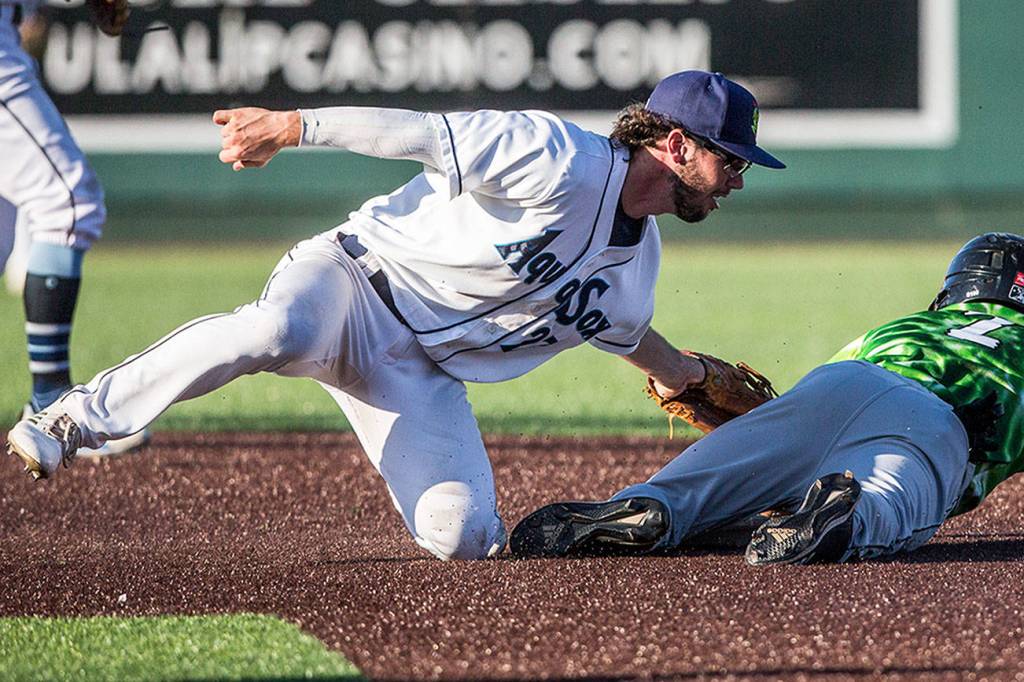
Emphasizing that support for Minor League Baseball, Larsen visited the AquaSox front offices on Tuesday, talking with General Manager Danny Tetzlaff and assistant GM Rick Maddox, as Herald sports reporter Joshua Horton reported Wednesday.
“I want to be sure that Major League Baseball knows that here in the Pacific Northwest, we love our baseball, we want to keep our baseball, and to keep our baseball here, we have to keep baseball everywhere,” Larsen told AquaSox management.
As Horton explains in his story, while the Everett team isn’t on the contraction list, it faces another potential threat under a related proposal. Major League Baseball also wants to shrink league levels to eliminate the short-season Single-A league — for which the AquaSox Northwest League plays — assigning the league to a full season.
The proposal is intriguing, offering a longer season for the AquaSox and the rest of the Northwest League, but it’s also problematic. Like other teams, Everett shares Funko Field with other teams, including the semi-pro Everett Merchants and the Everett School District, which owns Everett Memorial Stadium. And while a new turf field has helped make the field ready to play sooner after a rain, weather would remain a problem for a season that begins in early April and ends in September.
Everett’s close proximity to Seattle has made it an ideal location for a franchise affiliate because of the ease in sending a major league player here for an injury rehab assignment, but difficulties in playing a full season in Everett could force Seattle to consider other locations for a Single-A affiliate.
Tetzlaff, in sizing up what the proposal could mean for Everett, said losing Salem-Keizer and the Tri-Cities would be a loss for the AquaSox, cutting the league to six teams from eight and eliminating two teams that have provided good competition in recent years.
“I don’t know if it’s a terrible thing,” to play fewer teams, Tetzlaff said. “But it’s kind of discouraging for the players to play the same teams over and over.”
And the loss of teams in the minor leagues also could be discouraging even for those that remain, making each wonder if they could face contraction the next time the agreement is negotiated.
Major League Baseball has other solutions to consider that would be less drastic than eliminating baseball in 42 communities across the country. The MLB shouldn’t have to play hardball to resolve its concerns.
The major and minor leagues need each other, as much as American still needs baseball.