Ken White: What a divided America might learn from ‘Belfast’
Published 1:30 am Saturday, February 26, 2022
By Ken White / Herald Forum
Among the contenders for best picture, during the 94th Academy Awards on March 27, is the British movie “Belfast,” nominated for seven Oscars.
“Belfast” is a story about a working-class Protestant family from the perspective of a 9-year-boy named Buddy during “The Troubles” in Northern Ireland. In 1969, Protestant rioters attacked Catholic homes and businesses on Buddy’s street, where Catholic and Protestant families lived together.
As a chronicle of the intrastate war between the Irish Republican Army (IRA), the Royal Ulster Constabulary (RUC) and British forces within Northern Ireland, “Belfast” has a timely message for American democracy. But what is that message? Is it that the United States is moving toward civil war?
To some Americans, “Belfast” may symbolize present-day United States barreling toward civil war. The movie is often stark, filmed mostly in black and white. It can be viewed as what the journalist Stephen Marche’s book “The Next Civil War” predicts for the U.S., a dark future that many Americans see before their eyes. Or it can be seen as one possible outcome for the United States, what Barbara F. Walter calls the “danger zone” of more political violence.
“Belfast” accurately portrays rising polarization and violence in Northern Ireland. The RUC and the IRA were in an intensely violent struggle. RUC policemen routinely carried sub-machine guns and assault rifles on the streets, travelled in armored vehicles and served in heavily fortified stations.
I was in Belfast in 1982 when it was hotly in the Troubles and it raised deadly possibilities that frighten many Americans today. The IRA had just killed three British soldiers, which further divided people into two clans fixated on each other. Like in post-Trump America, citizens openly expressed prejudices that amplified hate and hostilities.
The power of Belfast is its acute visualization of the challenges of Northern Ireland and its feasible application to our own issues, including threats to individual freedoms.
Similar to Florida’s current crackdown on protest and public dissent, “Belfast” shows a political environment where it was not clear what conduct or speech would subject a person to liability. At one point, I took a photo of an armored vehicle. I was immediately confronted by a RUC officer and detained for hours. I then attempted to go to “the Falls,” a Catholic neighborhood that played a significant part in Belfast’s modern history. When I hailed a Black Cab (buses were often bombed and not available), an armored vehicle pulled up and out jumped four RUC soldiers. I was escorted to a ferry to Scotland.
The movie might raise ultra-sensitivity in Americans to the idea of civil war. It is understandable. Americans should be sensitive to the possibility. History repeatedly teaches us that lesson.
But history also teaches us not to take comparisons too far. The conjecture that “Belfast” puts forward that civil war is ever inevitable is a disservice to the movie’s fuller message and to our own national resolve. Belfast also implies hope. In its opening, there are images of a beautiful, modern Belfast in living color. Not without serious challenges, contemporary Belfast also reminds us that a people can rise up and transcend their politics given time, good faith, and determination.
Fintan O’Toole agrees. In The Atlantic, he recognizes that conditions for civil war did exist at the time in Belfast — horrible, cruel and atrocious — yet the conflict never rose to the level of civil war. However, he is not without a warning for Americans. He points out that the belief that there was going to be a civil war in Ireland made everything worse for a while. “Premonitions of civil war served not as portents to be heeded, but as a warrant for carnage.”
And so it goes with the United States in 2022.
“Belfast” proposes some existential questions for Americans: Do we have the resolve to rise up and transcend our politics? Can we overcome our polarization? Do we have good faith? Are we determined?
Ultimately, “Belfast” asks all Americans: Do we still have hope?
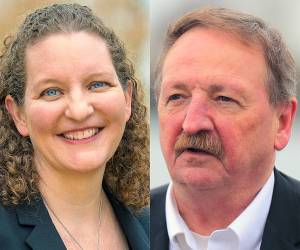
Ken White lives in Marysville.