Who will the Seahawks select in the NFL Draft?
Published 10:30 am Wednesday, April 22, 2026
When the Seattle Seahawks construct their draft board, they assess the talent of each prospect relative to their current roster makeup. After all, it’s a Seahawks-centric board, general manager John Schneider says, “not necessarily the National Football League.”
“So, there are players that are at a certain level on the board that might be a little bit lower — and that we still really like — but maybe the vision’s not quite as clear as people taken higher,” Schneider said during a pre-draft news conference Monday afternoon at the Virginia Mason Athletic Center.
For example, a cornerback prospect spot on the draft board is adjusted to account for the presence of Devon Witherspoon and Josh Jobe. Witherspoon is a three-time Pro Bowler coming off an All-Pro season. Jobe just signed a three-year, $24 million contract.
“How do they compete with those guys? What’s the fit?” Schneider said. “If you’re doing it correctly, need should just pop in there naturally.”
The same thought process can be applied across Seattle’s roster. Schneider did not share revelatory information in that regard, but it is important to keep in mind ahead of the NFL Draft, which begins Thursday night. Seattle has made notable investments in young, talented players, and those decisions shape the board.
Of course, that doesn’t mean the Seahawks won’t draft players at positions they already have talent. They’re the reigning Super Bowl champions, and they’re returning most of their roster from last season. They have talent everywhere. Plus, one of the reasons they won the Super Bowl is the trade up for 2025 second-round pick Nick Emmanwori, a decision they made despite rostering a talented cornerback trio of Witherspoon, Jobe and Riq Woolen this time last year.
The selection of Emmanwori is instructive also because it is a reminder that Seattle is planning for future seasons, especially with picks outside the first round. Position groups with players on expiring contracts shape the board, too. Defensive tackle Leonard Williams and outside linebackers Uchenna Nwosu and Derick Hall are scheduled to be free agents after 2026. Defensive tackle Jarran Reed is 33, and outside linebacker DeMarcus Lawrence turns 34 on Tuesday. Julian Love is the only safety signed through 2027 (if considering Emmanwori a slot cornerback).
Seattle is bringing back its entire starting offensive line, but center Jalen Sundell and right guard Anthony Bradford are on expiring contracts. None of Seattle’s running backs is under contract beyond this season.
Much of this context will shape this Seahawks-specific big board below, which is broken into three sections. The first section is not exclusive to the first round, because Schneider acknowledged the team would like to trade out of the 32nd pick. Seattle’s remaining picks are, at the moment, Nos. 64, 96 and 188. Ideally, Schneider would like to make more than four selections this weekend.
Candidates for the top pick
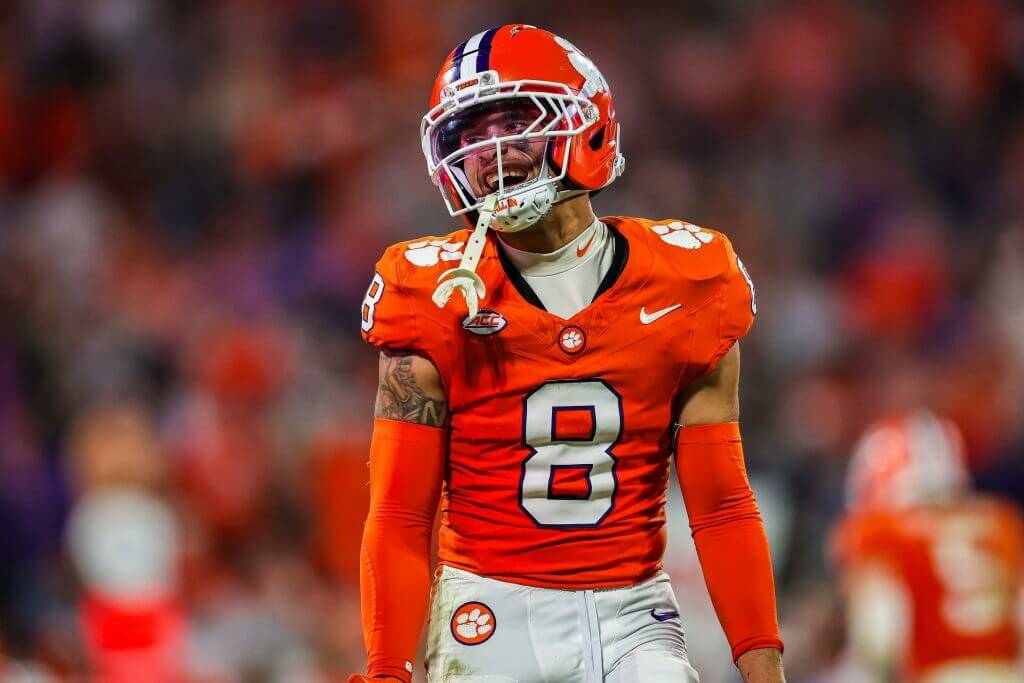
• Avieon Terrell, CB, Clemson
• Emmanuel McNeil-Warren, S, Toledo
• Kayden McDonald, DT, Ohio State
• Colton Hood, CB, Tennessee
• Zion Young, edge, Missouri
• Chris Johnson, CB, San Diego State
• CJ Allen, LB, Georgia
• Caleb Banks, DT, Florida
• T.J. Parker, edge, Clemson
• Brandon Cisse, CB, South Carolina
• Emmanuel Pregnon, IOL, Oregon
In 2018, the Baltimore Ravens moved up 20 picks to select Lamar Jackson at No. 32. Barring a drastic trade down like that, let’s safely assume the Seahawks make their first selection anywhere between 32 and 42, which is owned by the New Orleans Saints. Many of the prospects listed above might be gone by then. The back half of the first round and the first part of the second round are hard to predict.
Johnson was my pick in this seven-round mock draft. He and Hood would fall into the Emmanwori bucket in that they would likely challenge for a spot in the rotation by the midway point of their rookie year. They’re good athletes who track the ball well and are capable of playing man or zone.
McDonald was my choice in The Athletic’s final beat writer mock draft. That would be a pick made with an eye toward the future. McDonald could immediately help Seattle on early downs as a run defender, but the team wouldn’t need him to take a bigger role until the defensive line enters life without Reed and/or Williams.
Allen projects as an impact starter, according to “The Beast,” Dane Brugler’s draft guide. “Allen has reliability issues in zone coverage, but he is a speedy flow-and-scrape linebacker who is quick to trigger and be around the football,” Brugler wrote. Ernest Jones IV, Drake Thomas and Tyrice Knight are signed through 2027. An inside linebacker pick would undoubtedly be classified as a luxury. But Allen might be the type of impact player worth taking anyway.
Coachable, high-IQ defender who’s often a step ahead of his teammates; a likely starter.
Day 2
• Jadarian Price, RB, Notre Dame
• Keyron Crawford, edge, Auburn
• Jacob Rodriguez, LB, Texas Tech
• Gabe Jacas, edge, Illinois
• Germie Bernard, WR, Alabama
• Keylan Rutledge, IOL, Georgia Tech
• Derrick Moore, edge, Michigan
• Treydan Stukes, S, Arizona
• Lee Hunter, DT, Texas Tech
• Kyle Louis, LB, Pittsburgh
• Bud Clark, S, TCU
• D’Angelo Ponds, CB, Indiana
• De’Zhaun Stribling, WR, Ole Miss
• Mike Washington Jr., RB, Arkansas
• Connor Lew, C, Auburn
Technically, Seattle’s first pick might come on Day 2, but let’s view these prospects as players the team would consider with its second and third picks, whether at 64 and 96 or somewhere in those ranges after some trades.
Price was dynamic at Notre Dame while sharing the backfield with Jeremiyah Love, the No. 2 player in Brugler’s draft guide. Price is RB2 and the No. 51 player, and in a supposedly weak running back class, Seattle might need to use its top pick to acquire him. But if he’s available late in the second round, I’d consider it a no-brainer move given his skill set and Seattle’s need at the position.
A starting-caliber talent with work to do in pass-catching and ball security.
Washington makes sense for those same reasons and might even be available in the third round, allowing Seattle to address a more valuable position in the second round.
Based on Seattle’s needs and the makeup of the class, Day 2 seems like the sweet spot for drafting a safety. Stukes and Clark make sense for a couple of reasons. Brugler describes Stukes as “an instinctive athlete who plays with quiet confidence and valuable versatility.” He sees Stukes’ future at nickel “while offering outside or single-high flexibility.”
Clark would appear to be the inverse in that his future might be as a center-field replacement for Coby Bryant but with nickel versatility. Either selection should work out for Seattle, as long as Mike Macdonald and his staff have a vision for the player.
The Seahawks’ wide receiver lineup is stacked for 2026 and beyond, so I’d be surprised if they drafted a wideout within the top 100. That said, it would be hard to fault the Seahawks for taking a chance on a well-rounded prospect such as Bernard, WR7 in Brugler’s guide with a second-round grade.
Just a good football player, with a well-rounded, pro-ready skill set.
“Bernard is just a good football player,” Brugler wrote. “He is a good-sized athlete who can gear up and down with ease and plays just as comfortably along the sideline as when attacking the middle of the field. It will be more challenging for him to create separation versus NFL corners, but he is a natural at addressing the football and competes with the toughness to play through contact.”
I’m higher on Bernard than Stribling, but the case for making the luxury selection would be the same in either case: Take the talented player and sort the rest out later. That’s admittedly harder to do with only four picks, though.
Day 3
• Jonah Coleman, RB, Washington
• Sam Roush, TE, Stanford
• Brian Parker II, C, Duke
• Kaleb Proctor, DT, Southeastern Louisiana
• Eli Heidenreich, RB, Navy
• Ja’Kobi Lane, WR, USC
• Tacario Davis, CB, Washington
• Kevin Coleman Jr., WR, Missouri
• Jakari Foster, S, Louisiana Tech
• Seth McGowan, RB, Kentucky
• Michael Heldman, edge, Central Michigan
The argument against using a Day 1 or 2 pick on Price or Washington would be the presence of someone like Coleman, who is the No. 147 player and RB6 in Brugler’s guide. Coleman is not as explosive nor as athletically gifted as some of the running backs ranked ahead of him, but there’s a bang-for-your-buck case to be made for the 5-foot-8, 220-pound former Husky.
Heidenreich is another intriguing late-round option. He’s more of an offensive weapon than a true running back, sort of like what Cordarrelle Patterson became in the latter stages of his career. The team that drafts Heidenreich just needs to find ways to put the ball in his hands, whether he is a pass catcher or running back. Seattle demonstrated its ability to highlight that type of player through its usage of Rashid Shaheed.
Navy’s all-time leading receiver; a dangerous weapon on the right team.
My final mock had Seattle using a Day 3 pick on Proctor, a small-school prospect with some pass-rush upside. Heldman has similar upside off the edge, perhaps as a pick in the sixth or seventh round. He recorded 10 1/2 sacks with a couple of forced fumbles in his fifth and final year at Central Michigan and feels like a prospect who’d pop as a pass rusher in the preseason.
Not only is Sundell on an expiring contract, but backup center Olu Oluwatimi is, too, which is why I can see Seattle taking a swing on a center either late on Day 2 or on Day 3. Lew, listed in the Day 2 section above, is the fourth-ranked center by Brugler, who describes the former Auburn lineman as a good mover with a clear comfort level in wide-zone blocking schemes. Parker is Brugler’s No. 6-ranked center with a fourth-round grade. Like Lew, he’d fit a zone-based blocking scheme that showcases his movement skills.
“Parker will lose tug-of-war battles with long-levered defenders, but his athletic ability, competitive toughness and intelligence are traits needed for a long NFL career,” Brugler wrote. “He projects as a versatile guard/center backup and would have starting potential in the right situation.”