Everett’s Funko shows signs of life after financial life support
Published 12:30 pm Monday, May 11, 2026
EVERETT — If its latest earnings report is any indication, reports of Funko Inc’s financial death may be premature.
After the pop culture collectable company warned in November that it had “substantial doubt” about its ability to continue operations for another 12 months, Thursday’s financial filing reported the highest gross margin, 44.2%, in the company’s history.
Gross margin is the amount of money remaining after production costs.
While not out of the woods yet, the report filed with the Securities and Exchange Commission shows increased sales among Funko’s core collectables.
“We kicked off the year with a strong Q1 performance, building on the positive momentum from the second half of 2025,” said Funko’s CEO, Josh Simon, in the filings.
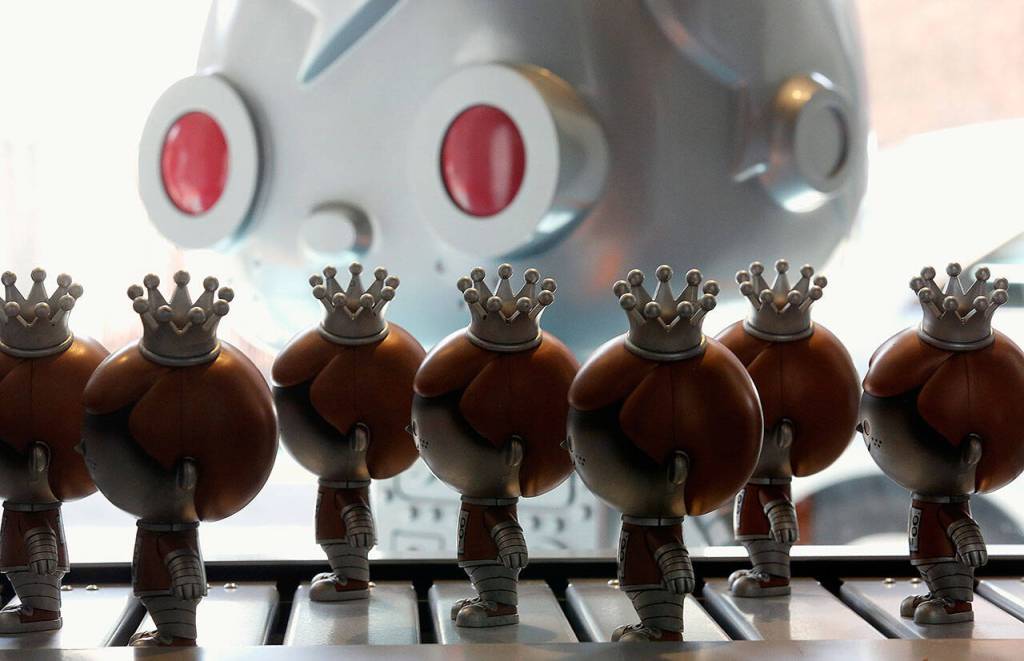
Funko’s main headquarters is located in downtown Everett, as well as a retail store offering vinyl figurines based on characters from movies, television and comic books. Funko also operates a retail store in Los Angeles.
Six months ago, Funko cited economic uncertainty due to rapid changes in the global economy from tariffs as the cause of its problems. The result, the company said, was falling consumer demand for its products, supply chain problems and increased distribution costs. Funko manufactures almost all of its products overseas.
The company reported a $1 million loss in the third quarter of 2025, a decline from the more than $8 million profit it made during the same quarter a year earlier. Sales of Funko’s pop culture figurines totaled $250.9 million, a decline of more than 14% within a year.
Debt continues to be a problem for Funko.
In November, Funko stated that it did not have sufficient cash reserves to fully repay it’s $241 million in loans, which were set to mature in September 2026. In March, Simon said in a press release that the company had reached an agreement with its lender group that extended the maturity to Dec. 31, 2027.
As of March 31, Funko’s debt totaled $215.9 million, a slight decrease from the $225.3 million it owed at the end of December, according to an earnings statement.
Representatives from Funko did not respond to requests for comment.
Alongside the November financial filings, Simon, who had just completed his first two months as the company’s top executive, outlined a turnaround plan in an earnings statement, stressing that the company’s new emphasis on quick product introductions will generate sales. This included Pop! vinyl figures based on characters from KPop Demon Hunters, a popular 2025 animated film about a South Korean girl group that secretly fights demons with their music.
Simon’s plan proved fruitful, with KPop Demon Hunters alone providing 7% of net sales, according to the first quarter earnings presentation. 10 properties, including One Piece, Stranger Things and Funko’s Pop! Yourself lines, providing 37% of the first quarter’s net sales.
James Zahn, editor-in-chief of industry trade publication “The Toy Book,” said Funko’s vinyl figures aren’t as complex to produce as other action figures, so the company can get them on the shelves faster.
“KPop Demon Hunters was a very unique IP in the fact that all of the toy makers passed on it when it was first offered,” he said. “Now everybody is making KPop Demon Hunters products, but the bulk of them still aren’t even in stores yet.”
Meanwhile, Funko’s vinyl figures were available to pre-order in August, as early as two months after the animated film’s release.
Part of Funko’s resurgence is due to the company being more careful about what it puts out, Zahn said.
“There was certainly an overproduction element to all of this, and it became overwhelming, not just for the consumers, but also for the retailers,” he said.
Net sales grew 5%, with the company reporting $200.9 million as of March 31, compared to $190.7 million during the same time last year. However, net sales dropped compared to last quarter’s $273.1 million.
Funko’s Bitty Pop! product line, which offers a miniature version of the iconic vinyl figures, led the sale of core collectables next to the Standard Pop!, the earnings presentation said.
“Because the scale is smaller, now they can do buildings and vehicles and roads,” Zahn said. “Instead of it just being a collectible, as it is for a lot of the adult consumers, for kids, it’s actually something they can play with.”
While the sales of Funko’s core collectables increased by 17%, the company’s apparel division, Loungefly, saw sales decrease by 23% due to a reduction in less-profitable products.
Despite many consumers needing to tighten their belts due to rising costs, people are still willing to treat themselves to items like collectables.
“People want to feel good,” Zahn said. “They want those elements of joy and, for a lot of people, collecting is that joy; they’re bringing the things that are important to them into their lives in some capacity.”
Meanwhile, customers may be less likely to consume the company’s apparel products the way they would the figurines.
“You might want 50 Pop! vinyl figures of your favorite characters,” Zahn said. “But how many purses or backpacks do you need?”
The company also reported an adjusted net loss of $6.3 million, an improvement from the $17.8 million during the same time last year. In the quarter prior, they reported an adjusted net income of $2.5 million.
Jenna Millikan: 425-339-3035; jenna.millikan@heraldnet.com; X: @JennaMillikan