Youth Forum: Just what are those kids thinking
Published 1:30 am Saturday, May 30, 2026

By Jon Bauer
Special to The Daily Herald
The rights enshrined in the First Amendment belong to students, as well as adults; Nevaeh Holm wants you to know that. In part, she says, because of what youths can do with those rights:
“This is important because when students feel like they are heard, they will want to be at school, and they will help make the country a better place,” Holm writes.
For the second year in the row, The Herald has graciously agreed to turn over some space for eighth-graders in John Johanson’s English language arts classes at Lakewood Middle School to share their opinions in the form of persuasive essays. With guidance and instruction from the teacher and some coaching from me, each turned in work that normally wouldn’t be seen by anyone other than Johanson and their parents.
Just as the school day helps develop a range of educational “muscles,” the seemingly singular activity of writing an opinion piece not only reinforces students’ language arts skills, it also offers them the opportunity to think critically, learn more about a topic, refine their thoughts on the subject and gain proficiency in making persuasive arguments, a skill they will need throughout their lives.
What’s clear to me — and perhaps will surprise some readers — is how much these and students and certainly others are paying attention to the world around them and how much concern they have for the condition of a world that in a few years they will be contributing to as employees, business owners, taxpayers and — most importantly — community members. As they are paying attention to what’s happening all around them, we ought to be paying attention to them.
What follows is a sample of the work; a demonstration of abilities under development to research, learn, form opinions and then communicate what they’ve learned.
First Amendment applies to students, too
By Nevaeh Holm
How would you feel if the government had control over what you say?
Throughout the years, First Amendment rights in schools have become decreasingly practiced. This includes freedom of speech and freedom of expression, both of which can impact life at school. First Amendment rights should be less restricted in public school systems.
The First Amendment gives five rights to the people: freedom of speech, freedom of the press, freedom of religion, freedom of assembly, and freedom of petition. An article on the First Amendment said, “The First Amendment grants students many rights within schools.” This shows that students in public schools do have these rights even while they are in schools.
This is important because when students feel like they are heard, they will want to be at school, and they will help make the country a better place. The article also stated that “In 1969, the Supreme Court ruled that students do not lose their Constitutional rights by entering school grounds.” This is important because this means that students do have a voice in schools, and they can use it to change schools for the better.
But let me ask a different question: How would you feel if your freedom of speech was limited so that you could “achieve academic goals?” Some would argue that limiting freedom of speech in schools could help them achieve their academic goals, but that goes against the constitutional rights of the student body.
To start, “Schools can sometimes limit students’ right to free speech and expression when necessary to achieve legitimate educational goals.” This is understandable because if someone is dressing as though they are part of a gang, or if they are advocating for vaping or something else against school policy, then schools should have a right to limit the free speech of that particular student.
In some schools, there are student publications — or a student newspaper. Sometimes in these newspapers, “schools can censor student speech which is likely to disrupt school operations.” This means that schools can censor what is written in the school newspaper if it disrupts the school; this possibly means that someone is advocating for an action against school policy, such as vaping or illegal drug use.
What about freedom of expression at school? Freedom of expression is the right to seek, receive, and give information — whether it is correct or not — with no repercussions. Freedom of expression also allows students to dress how they want — within reason — unless it disrupts the learning environment at school. For instance, let’s say there was currently a war between two countries, and you wanted to be part of the crowd supporting the effort for a truce between the two countries.
Well, “in December of 1969, three students wore black armbands to school in support of a truce during the Vietnam war.” So, these students wore a single piece of cloth in support of a truce during a war between the two countries. Would this severely impact the learning environment? Or would it be a way of students freely expressing their point of view?
But when the principals of the schools became aware of the plan to wear armbands. On December 14, 1965, they met and adopted a policy that any student wearing an armband to school would be asked to remove it, and, if he refused, he would be suspended until he returned without the armband. This shows how the school was willing to adopt a new policy because they didn’t agree with the students’ view of the war.
This goes against a students’ freedom of expression, which is a part of the First Amendment. This is important because how would the school know when the student would arrive without the armband, and how long was the school willing to suspend the students wearing the armbands?
Why would First Amendment rights be important at school in the first place?
First Amendment rights in schools are important because they can help students feel not only welcome on school grounds, but students can learn important communication skills, and they can learn how to speak their opinions freely and respectfully.
First Amendment rights in public school matter because it gives student confidence in who they are, and they can use their freedoms to help make their schools better for future generations.
Free college would benefit economy and students
By Malia McAllister
Making college free would benefit the economy, which benefits you as well.
By making the price of attending college zero dollars would make everyone benefit even if you’re not the one going to college. College is often seen as a way to get higher paying jobs by paying a high price. However, it is not necessary to go into debt that lasts decades just to afford a high paying job. Making college free would benefit the economy and it would also help more people fill jobs that benefit society; young adults would not go into debt before their life even starts and it would reduce crime rates.
To illustrate the point, a Federal Reserve Bank of Philadelphia study found “a significant and economically meaningful negative correlation” between student loan debt and the falling rate of new small businesses. Consequently, the debt that students acquire trying to earn a degree with some wanting to open their own businesses are unable to due to the debt they already have and cannot take out a business loan. Small businesses help circulate currency and are part of the economy.
When student loans are given out, it can take decades to pay back, which does not do any good for our already enormous debt, so making it free would eliminate the growing issue.
Jamie Merisotis, president and CEO of the Lumina Foundation said: “A dramatic increase in the number of Americans with college credentials is absolutely essential for our economic, social and cultural development as a country.”
This would be possible if college were free of charge. Other experts also agree that a drop in price is needed. While people are tempted to ask why they should think about this, there is a satisfactory answer to that. The young people who want to go to college are the future of the world; they will take over the jobs that the previous generation are doing. Now, if the people who are young right now get old, they will need people to take care of them, and the amount of people doing those jobs is decreasing because the cost of education is too high, so the way to ensure continuing societal functionality is to lower or completely remove the cost of higher education.
Making college free would benefit society and reduce crime rates by making higher education more accessible. To provide some evidence of this we can look at studies such as Angrist and Krueger (1991), Meghir and Palme (2005), Oreopoulos (2006) and Aryal, Bhuller and Lange (2019) and there is a very educational article on PubMed Central by Raymond R. Swisher
“Criminological studies have long posited, and largely observed, a negative relationship between various measures of educational success (e.g., high school completion, years of education, postsecondary education, test scores) and delinquency, crime, and incarceration.”
College is important in society as it can benefit many people. Many young people get into crime because they do not do good in school, and from their point of view “why should they?”
College is expensive. Many high schoolers don’t plan to go to college because it is too expensive and they don’t think it’s worth it, so they go straight into the work force. While it is possible to get a good paying job without going to college, it would be incredibly difficult. Many end up in laborious jobs that put a strain on their bodies and years later they have several issues. So, making college free would most likely help prevent some of these kinds of kids from resorting to that or giving up on school.
While we were rapidly advancing, we are headed towards a flat area. We are in a world where people struggle to succeed because of the cost of living. Making college free would provide access to higher education for people in the lower class or minorities. When more people have access to resources, there are also more people to help solve problems that previously had no solutions. Making college free would make society more equal and diverse and open people up to more things and hopefully lead to more acceptance of certain communities when more people are educated.
While there are some cons to free college, overall, it is worth it. While a tax increase to pay for free college puts some strain on people, after the next generation of college students and the people currently in college finish their education, the economy will be boosted by the money being circulated and fewer people owing debt.
The future of the human race will soon be getting ready to go to college, so why not help them continue societal functionality by giving them the necessary education to continue the jobs that help daily life be easier.
Think about how your life is going and how if you need to get a checkup, there are doctors who can help you, because they have an education.
Making college free is the next step in society and for future generations to make sure we continue to have a functioning way of life with people doing the jobs that help the world keep spinning.
Laws affect kids, so 16-year-olds should have vote
By Maddox Mashita
When you were a kid did you ever look at something and say “l want to change that.”
Today’s youth would. They would have the chance to do that at 16 years old if we could get enough people to pass this act. Wouldn’t we want the next generation of 16-year-olds to demonstrate and speak their opinions in the outside world by voting? Allowing the right of voting at 16 would be greatly beneficial to the United States.
One thing to think about is your 16-year-old is being affected by drugs, alcohol and more every day, and if that’s true don’t you think they should be able to vote for their country to give them a chance to change that? On Britannica ProCon, Sofie Whitney, a survivor of the school shooting in Parkland, Florida, says, “If 16-year-old students are old enough to be affected by the laws, and realize that there is a problem, then they should have the power to help change it.”
Ttake into consideration that 17 deaths occurred at that same shooting. Shouldn’t that prove that teens should at least try to help their situation out by voting.
Now, let’s talk about the fact that the United States has one of the lowest voter turnout rates among developed countries, but a person who votes in one election has a 13 percent greater probability of voting in a future election. That being the case, if you vote one year then it can trigger something in your brain to want to vote again at the next election which will increase the vote turnout one year, it is way more likely to have a major increase overall.
Youths, 16 and older, are mentally ready to vote and could be even more ready than some adults. For example, a study in the Annals of the American Academy of Political and Social Science in 2011 found “on measures of civic knowledge, political skills, political efficacy, and tolerance, 16-year-olds, on average, are obtaining scores similar to those of adults.”
Not all teenagers are the same, so shouldn’t we have a little sympathy for the teens who are. Consider a fundamental principle of our democracy: The right to vote in the United Kingdom is not connected to intellectual ability. As soon as we embark on such thinking, we quickly get into dangerous territory. If we say that one group cannot vote because they’re not intellectually capable, we introduce the idea that only clever people deserve the right to vote.If we take into perspective that 16-year-old cannot vote because they are not mentally ready or just aren’t smart enough. That would mean you have to be above average or flat-out better to vote, but that isn’t the case. Being able to vote does not mean that you must be smart or above average to vote because you see homeless people and high school dropouts every day on the street. So, if you’re talking about knowledge, what gives them the right to vote?
The age of 16 is when people’s relationship with the law changes as they often start driving, working, and paying taxes. Some people could argue that teens just aren’t old enough so they haven’t earned their privilege to vote yet but frankly some teens can do the same things you can, and if they can’t even drink then would that make them more responsible and alert at all times.
Involving young people in voting can also have a “trickle up” effect that mobilizes their parents and other adults in their households to vote, increasing the overall voter turnout rate. Turnout among 16- and 17-year-olds in Takoma Park, Maryland, the first U.S. municipality to lower the voting age for local elections, was double that of eligible voters 18 and older. Once a kid gets involved with the voting process, it can increase the chances of them voting again in four years, which can eventually lead to the voting rate going up.
Teens really should be allowed to vote not just because they are ready but because they could improve the United States.
Just one more thing: Kids every day have new opinions that could honestly change the world.
The existential threat of artificial intelligence
By True Salvador
“I’ve said it before, this will be the demise of the human race,” stated Geoffrey Hinton, widely considered the Godfather of AI; urging the idea to eliminate Artificial Intelligence before it’s too late.
Researchers estimate that over 1.7 trillion gallons of water will be consumed annually by 2027. The dreadful amount of water used to cool AI’s data centers endangers many life species. The heat of gas emissions raises nearby ground temperatures by an average of 3.6°F. This subtle and seemingly unnoticeable change in temperature to the world is detrimental to the environment over time. Additionally, AI affects everyday life in the sense of unemployment; AI is adaptive and will soon take over many technical work fields. Furthermore, AI allows the potential exploitation of your facial data to criminals that may use AI tools to carry out sophisticated fraud schemes. Given these concerns, the existential threat of AI is apparent and must be limited and controlled to prevent further dangers.
At the outset, artificial intelligence is pernicious to the environment. AI is a big contributor to carbon emissions. Researchers at MIT state, “The computational power required to train generative AI models that often have billions of parameters, such as OpenAI’s GPT-4, can demand a staggering amount of electricity, which leads to increased carbon dioxide emissions and pressures on the electric grid.” Businesses may lose money to the loss of power from AI’s high electrical demands.
MIT further states, “Beyond electricity demands, a great deal of water is needed to cool the hardware used for training, deploying, and fine-tuning generative AI models, which can strain municipal water supplies and disrupt local ecosystems.” Essentially, the straining of water supplies caused by the AI’s demands could prove detrimental to the distribution to those who need it. Ultimately, AI challenges many operations that place pressure on the environment.
Furthermore, AI threatens the ability to take over many work fields, leading to mass unemployment. American journalist Farhad Manjoo demonstrates, “food service, janitorial work, gardening, home health, childcare, and security — are generally physical jobs, and require face-to-face interaction. At some point, robots will be able to fulfill these roles” This suggests immense job displacement of physical occupations. Consequently, this will lead to mass unemployment within face-to-face work fields.
Calum McClelland, the Head of Operations at Internet of Things points out, “Blue-collar and white-collar jobs will be eliminated—basically, anything that requires middle skills (meaning that it requires some training, but not much).” This highlights the idea that AI is eliminating jobs that don’t require lots of expertise. Such as blue-collar and white-collar jobs being abolished by the persisting growth of AI adaptations. For example, programming roles, transportation, and customer service are subject to being taken over. Thus, we can conclude that AI is a threatening competitor to many occupations
Lastly, AI can be used to endanger individuals with malicious intent. The National Academy of Professional Studies asserts, “While some uses of deep-fakes are done for innocent fun, others can amount to spreading false information in the middle of a tight political race.” This displays the idea that deepfakes tend to be malicious or spread propaganda about individuals. Usually in the form of political usage or to gain attention.
An additional quote from National Academy of Professional Studies notes, “Criminals are taking advantage of the technology to conduct misinformation campaigns, commit fraud, obstruct justice, sow dissent and division, and even bring down an organisation or even a government.” Specifically, criminals will use AI to commit insidious crimes that damage someone’s reputation. Primarily to defraud the victim into giving up their assets and money to save their facial data and visual likeness. In summary, AI can be used to maliciously commit crimes with the intent to ruin someone’s reputation, and in severe cases their life.
Some might argue that AI is beneficial to identify and accomplish problems and assist in helping the user’s needs. This is true, but the over-usage of AI may lead to the user becoming dependent on the AI, reducing the potential of their cognitive function to evaluate and effectively solve problems, lowering the user’s critical thinking skills. According to cognitive psychologists E.F. Risko, S.J. Gilber, “Scholars have cautioned that excessive AI use may promote cognitive offloading, reduce critical evaluation, and diminish independent thinking over time.”
In essence, if left unregulated, AI could create environmental strain, economic disruption, and new forms of large-scale harm. Whether it’s damaging the environment, eliminating the employment of millions of workers, to the malicious use it holds. The rapid expansion of AI presents risks that society is not fully prepared to manage, threatening the very life that birthed it.
What steps will you take to protect yourself from the risks posed by AI?
By Jessilyn Raygoza-Suarez
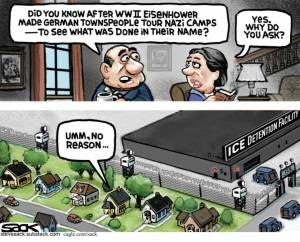
Immigration and Customs Enforcement is pushing people’s limits to the max
It’s a hot summer day and you are out with your family getting ice cream and suddenly a huge SUV with dark tinted windows pulls up and unknown people with weapons jump out and drag your innocent parents into the car along with you.
You arrive at some sort of prison, wondering when you will be released and why you are here. Why should any child or a hard worker have to experience this, especially when the real danger is not being solved?
Many immigrants who are undocumented are experiencing the fear of being taken away from their homes. As a result, there has been a decline in their mental and physical health. People who are documented have even feared going out because of their skin color or race which includes large Hispanic communities.
Immigration and Customs Enforcement should be restricted in their power because of all of the harmful impacts they are leaving on immigrants as well as other communities.
Many people come to the United States seeking better opportunities and spend much time working hard for their family and the country. Since the United States attracts far more immigrants compared to any other country, this makes it the top destination in the world. The U.S. is a haven for immigrants since many choose this country for a better life because of the options there are for them to pick from such as jobs, homes, education, and even the people.
In addition, the U.S. reached a number of 46.1 million immigrants which accounted for 13.8% of the population in 2022. The number of immigrants living in the U.S. is a low number compared to the rest of the population even though it is in the millions. Attempting to remove them is a waste of time. Trying to remove all immigrants or even half wouldn’t be necessary since they come to the U.S. in search of better life instead of committing crimes.
Since ICE (Immigration and Customs Enforcement) has been targeting many groups of people which is mostly undocumented immigrants, many of those aren’t getting the proper care they need. Because of this, the number of immigrant adults who have skipped healthcare from 2023-2025 has increased from 22% to 29%. Many immigrants who need certain treatments opt out of it because of the risk of them being detained and put into ICE detention centers.
In addition, 1 out every 5 immigrant parents have stated that their children’s health has also been impacted due to immigration worries since 2025. Children have been affected because of this. Since immigration has been out in public more and in many areas that have been seen with more people, many immigrants have been anxious to get what they need done.
Many people believe that immigrants who come to the U.S. only come here to commit crimes and nothing more. However, that is not the case since about 77% of immigrants who entered deportation proceedings have not been convicted of a criminal charge. The belief of many people that most or all immigrants are criminals is incorrect since they are not the “worst of the worst.” As a result, many immigrants have explained that they no longer feel confident or safe to do simple things such as go to work, traveling, or going to the store because of the fear of being taken away.
Immigrants should not feel any sort of fear by just simply going out because they came from a different country yet again, they feel very targeted and unwelcomed. Therefore, a lot of immigrants feel looked down upon because of all the stereotypes and beliefs of people assuming they are lethal criminals and this belief system impacts their mental health along with their physical health.
Immigrants face many challenges in just living a normal life and it has been getting progressively worse since they are being impacted mentally and physically. Many saying that immigrants are all criminals is just incorrect because this has been proven to be wrong and is just another made-up statement that has no further research because the percent of immigrants being criminals is only about 23%. Why should an innocent family be constantly targeted because of where they came from?
Gun control won’t improve safety of public
By Julius Smith
Gun control has infected this country, and someone needs to administer the Antibacterial.
Our constitutional right to bear arms is being violated by politicians who don’t understand or acknowledge firearm culture and use. They refuse to listen and choose instead to take away the protection that many families rely on, the tool that hunters all over the United States use multiple times a week, and one of the major parts of the identity of the United States.
Gun control laws don’t even meaningfully reduce gun violence. So, logically, there should be less gun control laws in the United States. Even if half of the population thinks otherwise.
Increased gun control would make it more difficult for citizens to defend themselves. Firearms are used across America as a self-defense weapon against trespassers with harmful intentions, or thieves intruding inside your home, and gun control laws make it more difficult to obtain firearms. As Nelson Lund, professor at George Mason University School of Law states, “many [gun control laws] interfere with the ability of law-abiding citizens to defend themselves against violent criminals.”
Clearly, the people advocating for increased gun control have refused to consider the fact that firearms are also used to keep citizens safe in their homes and in public. They also seem to ignore the statistics provided by Pew Research, which states that 61% of men and 56% of women said that gun control would “make it more difficult for people to protect their homes and families.”
Interestingly, the political group voting for gun control also has a much lower rate of gun ownership. Gun control advocates want to eliminate mass shootings, of which they cannot predict, so they advocate a law that makes it very difficult for any person to obtain firearms. This will supposedly prevent criminals from finding a weapon. This will also remove the most reliable method of self-defense for civilians.
The idea only works if we expect a criminal to follow the law while planning on breaking more. While it will prevent mass shootings, it will just make murders of any other form of weapon easy to get by with because the criminal has no opposition from their target. And the criminals can still illegally obtain firearms, so the law won’t truly prevent gun violence. It may appear counterintuitive but banning firearms will only make these events worse and harm our nation’s integrity.
Gun control doesn’t prevent criminals or people with intentions for gun violence from obtaining firearms. Shown by a Lancet study from 2016, “most state-level gun control laws do not reduce firearm death rates, and, of 25 state laws, nine were associated with higher gun death rates.”
This is a clear sign that these laws seem to be implemented with a lack of understanding of how a firearm functions, or how a firearm would be obtained or used in a combat situation. Why do these people get to restrict something that they don’t have any experience with?
Another misconception that they have made is that banning “assault” weapons is logical, like they are somehow any more lethal than any other firearm out there. Anyone with a decent knowledge of firearms knows that practically all cartridges can be lethal. Additionally, a gun that fires faster or more efficiently does not change the fact that it could take only one bullet, which any firearm should be able to achieve considering that all cartridges can be lethal. Which means that there is no true reason why assault weapons would be any more lethal than your dad’s rusty 9mm.
Gun control goes against the Second Amendment and infringes on the rights of civilized law-abiding citizens. Dan Newhouse, a congressman and gun rights supporter speaks on this, saying that “Whether for home protection, livestock defense, or simply feeling safer when walking the streets, the right to own a firearm is deeply rooted in the foundation of our great nation. Any opposition to that right undermines our individual freedoms and sets a dangerous precedent. If any Constitutional amendment can be overturned or legislated away, none can be considered absolute, leaving everything open to interpretation.”
If denying a constitutional right is something that the government is now capable of, it raises the question as to whether any of our constitutional rights are safe.
The right to bear arms is not an unnecessary amendment; it is the first line of defense against criminal activity, and violence against innocents.
There are glaring issues with the concept of gun control. As long as politicians ignore the issues of restricted self-defense, inefficiency, right infringement, and confiscation of a useful tool for many people, these illogical and frustratingly supported laws will degrade our society and take away from the rights that make the United States of America a free nation.
We need a maximum age limit for president, Congress
By Payton Kautzman
Should there be a maximum age requirement to be able to run for president?
What do you think about elderly people driving? “Get them off the road, they aren’t able to drive right.” Is that what you thought? How come? Is it because of their decline when it comes to basic cognitive thinking and health?
Recently, the age of U.S. Presidents of the United States of America have been increasing. The average age of a U.S. president is 55 when taking office, according to Katherine Schaeffer of Pew Research Center.
Since American presidents are now gradually increasing in age and regressing in health, a common question has been stirring up. Should there be a maximum age for people to be allowed to take office? Studies show that elderly people have less ability in common tasks like basic intelligence and the ability to work at their fullest. Since the elderly decrease in intellect, there should be a maximum of how old someone should be when taking office, and we need to break this cycle of re-election due to popularity and experience.
We need to refresh the politics and bring younger and passionate people into the office as well as more experienced people. This government is turning into a gerontocracy, which has failed in other countries. Give us the melting pot filled with experienced and young but passionate people alike.
What is gerontocracy? It is a government run by old people. Gerontocracies were very popular in ancient times due to elders being seen as wise and smart but in recent times studies have shown that councils like those were destined to fail by the ability of older people to be regressed. Gerontocracies are now deemed unpopular due to multiple instances of it causing more problems than positives. According to Emily Rotondi of the Boston Political Review, there have been times where older people have not been able to do their job in office. Mitch McConnell, the Senate minority leader, had trouble with public speaking following a concussion. He froze in the middle of sentences, making him seem intelligible to people. This is why people were going to try to force him into resignation even after he served America for 4 decades.
There are just certain requirements that should be added to make it so that there is a maximum, while there is a minimum. There is a minimum of how old you must be for certain things like drinking and running for office, and there should be a maximum for certain things like driving and working in certain jobs. It is common sense.
Old people are wise and experienced and have certain things that they are more knowledgeable about but is that enough to override the fact that their health is gradually declining? Why aren’t people that are younger getting voted into office as much anymore? Name recognition and an advantage of being known more by people. Dianne Feinstein had to miss 91 votes due to her public health declining, and that was before she passed away in office.
Since Feinstein and the majority of those who hold public office have been showing declines in their ages and cognitive ability, including those at the presidential level such as Joseph Biden and Donald Trump, who have been pushing 80 now when they have entered office, it is easy to see that that doesn’t affect just the constituents of a county or state anymore. It affects whether or not we are actually able to run this country in the way that the founding fathers wanted us to.
Since the health of elderly people declines in office as much as we see when elderly people drive or do activities that are strenuous, it is hard to think that the leaders running our country can barely speak in public or even vote. We need present people and workers to run our country to its fullest.
Why shouldn’t we have an age gap as a requirement in office? The most popular opinion is that some people are perfectly stable at 80 and beyond, but that isn’t the majority. Some people say that there are people before 35 who are cognitively developed, if not peaked in cognitive ability before 35, so why don’t we have the same requirements for both minimum and maximum?
It is hypocritical to think that the same people that push for a minimum age requirement also don’t agree with the idea of having a maximum age that you need to be to run for office.
When people cannot do their work because of deteriorating health and can’t even vote when it is their main job, it is time to step down from a federal job, even if you are experienced. Multiple people at state and federal levels could not do their job because of their health, and this has caused bills to not be passed, speeches to not be said, and votes to not come.
If you are not able to actually work, there is no way that you should have that job, regardless of if you are experienced. We need to have a starting point so that we can have a melting pot of people in office, just like America started as.
People have a right to a good death
By Ava-Marie Najera
Medical Aid in Dying (MAID), as of February, 2026, has been legalized in 13 U.S. states, along with several countries around the world, including Austria, Canada, and Finland. Legalizing MAID in the other parts of the U.S. would allow for a rather peaceful and painless option to pass for those who choose to participate, as the people who end up choosing this option are surrounded by family members or friends.
The people who are offered this are terminally ill within the next six months, so they should be able to choose how much suffering they want to go through, and how much they want to try to push through. Medical Aid in dying should become an available healthcare option in the United States.
Medically assisted death should become an available option to the people of America. Since it would allow for a choice for the people who are wanting control on the environment in which they spend their last moments in.
The authors at ProCon stated that, “Moreover, because of the waiting periods enforced by MAID laws, the patients have had time to carefully consider their choices for medical care and their own moral or spiritual obligations. Patients who choose medical aid in dying are typically surrounded by family, friends, and other loved ones when they die in a peaceful and comfortable environment. The patients have had time to say goodbye to other people in their lives.”
Since it would allow the patient to control when they get to leave and let them say their goodbyes. Linda Holmes, who is a senator from Illinois, was speaking to her colleagues ,“You think the toughest thing you go through is watching somebody die, and you know what? It’s not,” Holmes said. “It’s suffer and there’s nothing you can do to ease that suffering. That is the hardest thing I’ve ever gone through.” This highlights how people other than the patient may feel. Since many other families have gone through something like what Senator Holmes has experienced. Watching a family member that had to suffer day by day until they eventually passed, instead of being able to ease their pain sooner.
Allowing medically assisted death to be legal in the other parts of the United States, and to be a provided option in healthcare would be best, since it would give peace to both the patient and their families.
People having to push through an illness or condition that takes such a huge toll on their body, and their mentality doesn’t seem right. As people, we should have the right to be able to choose how much we want to endure. As Lawyer Lamar W. Hawkins states, “We should also have a right to decide what suffering we are willing to endure and receive medical assistance necessary to avoid the suffering we want to avoid. Our essential right to take our own lives when faced with unwanted suffering is undeniable—no state prohibits it. What we don’t yet have everywhere is the right to receive assistance in doing so, an omission that discriminates against the too feeble, the too ill, and the too disabled, who nevertheless know their own minds and deserve the assistance necessary to exercise that essential right.”
In other words, we should be allowing people to have the option while they are in pain.
Some may argue that the legalization of MAID would not be good for the United States, since it would normalize suicide. Yet, in the places where it is legal, such as New York, have certain conditions to be able to participate in medically assisted death. Including dying within six months, and mental health evaluations.
Having requirements on who can participate in Medically Assisted Death, as it would make it so the people who want to participate, and not just feel like a burden. Requiring these evaluations would provide a way to make sure the person who is trying to participate in medically assisted death is in the right mind before they participate. Even though some believe that MAID would normalize suicide, there are restrictions and differences between the two. The term MAID, or Medically assistance in death is also to make it so that the patients that they are taking part in something that is medically regulated.
Giving the rest of the people of America this healthcare option would give those who are going to die in six months or less another way to spend their last moments. Allowing MAID would allow patients to have a way to die without pain, allowing them to choose how much they want to go through. If we allow this process to be legal, the amount of pain that people go through could be lessened and gives them an option rather than suffering. If you were in their position, would you want to be in pain every day until you die?
Denying abortion access is to deny women’s right to their bodies
By Brooklyn Johnson
Even as worldwide gender equality is becoming heavily normalized among society, women’s rights are still highly controversial. Specifically targeting topics such as medical abortion care, which is vastly debated among two parties—pro-life, and pro-choice. Pro-choice is the belief that women not only have the fundamental rights to terminate their pregnancy on their own accord, but the right to make their own decisions according to their own bodies. While pro-life is an ideology that, in summary, suggests “all lives deserve to be protected.” However, the issue with this pro-life ideology lies in cost and affordability of maternal care, reasons for seeking abortion care, and the outcomes of banned abortion care.
Visualize yourself getting out of the hospital post-pregnancy; tired, weak, and wanting to go home; just to realize you lack the money to pay off your medical bills. This is the case for many mothers, and even most women accessing medical care who live in the United States. In a study done on women of reproductive age from various high-income countries such as Sweden, Norway, and the U.S., the cost of maternal care in the U.S. was substantially higher than any of the other high-income countries. (Munira Z. Gunja, Shanoor Seervai, Laurie C. Zephyrin, Reginald D. Williams II, 2022). Along with this, the U.S. had a significantly higher maternal mortality rate (pregnancy related deaths) from avoidable causes. In turn, many women, specifically mothers, must juggle the burdens of children and the cost of having said children. And as a result, they put off their own health to put their children or loved one’s health first. Consequently, leading to the progression of missed, ignored conditions, or even having their lives be threatened.
The ban on abortion will not only effect women trying to terminate their pregnancy, but those seeking abortion care for other reasons. According to the Cleveland Clinic, ectopic pregnancies occur in every 1 out of 50 (2%) pregnancies. These pregnancies happen when the fertilized egg grows in an area not in the uterus (usually in the fallopian tubes). If the fallopian tubes rupture, infection, and even death may transpire. Treatment for this condition is necessary and includes surgery or medical abortion. Whether the woman receiving treatment wants a child or not, medical abortion is almost necessary for this kind of condition. Leading me to another case in which, the absence of medical abortion, could lead to death. 10-20% of known pregnancies end in a miscarriage. If the fetus remains in the uterus after the miscarriage, infection, bleeding, and other complications may occur. Again, in cases of fetal remains after miscarriage, medical abortion or surgery is almost necessary to prevent unwanted conditions or maternal death. If abortion is banned throughout the U.S., then these women seeking abortion care for other reasons will not get the medical care they need.
Due to abortion care being a highly controversial topic among countries around the world, abortion often ends up being misclassified and unreported. According to the World Health Organization, 8% of maternal deaths are linked to abortion. Along with this, reports from 2012 estimate around 7 million women receiving medical care for unsafe abortions. The reason being, just because abortion is restricted, does not mean abortion rates will go down. If you were desperate to get something you wanted, in fact, you needed. You would find a way to obtain that “thing.” This logic is the same for desperate women and mothers. A study done by the National Library of Medicine in 2010 reported that most women in the U.S. receive abortions due to financial reasons, partner-related reasons, timing, or needing to focus on other children. Most women getting these abortions fall into multiple of those categories. Restricting abortion care would ultimately lead to an increase in death, as desperate times call for desperate measures.
Is abortion murder, or not? This is a common debate among pro-life and pro-choice ideologists. Paul Scherz, an associate professor of moral theology/ethics suggests that a fetus is a human life from its very origins. In fact, a life beginning at conception. Although religion plays a role, from a more scientific standpoint, the belief that life begins at conception all comes down to what you value a human life to be. As documented by United States abortion surveillance in 2021, 80.8% of abortions were performed before/during 9 weeks (about 2 months) and 93.5% were performed before/during 13 weeks (about 3 months). The Eclipse Clinic states that during 26-28 weeks (about 6 and a half months) of fetal development, the hippocampus (a part of the brain in charge with memory, spatial awareness, and processing emotions) experiences rapid growth. During the 13th week of fetal development, fetus’s do experience some degree of expression. Even so, the only difference between other animals and humans is our exceptionally complex emotions and endless pursuit of knowledge, meaning, and purpose (Brooks R., 2023). Meaning that, fetuses are no more complex than the livestock humans mindlessly slaughter.
All in all, the criminalization of abortion is not, and cannot be justified by life beginning at conception. Yet, countless women and mothers still are shunned for accessing this form of medical care. Which leads me to one question—why must we debate on the fundamental rights of women’s bodies, while advocating for life, liberty, and the pursuit of happiness?