Team Northwest totals 94 medals at 2026 Transplant Games of America
Published 9:33 am Tuesday, July 14, 2026
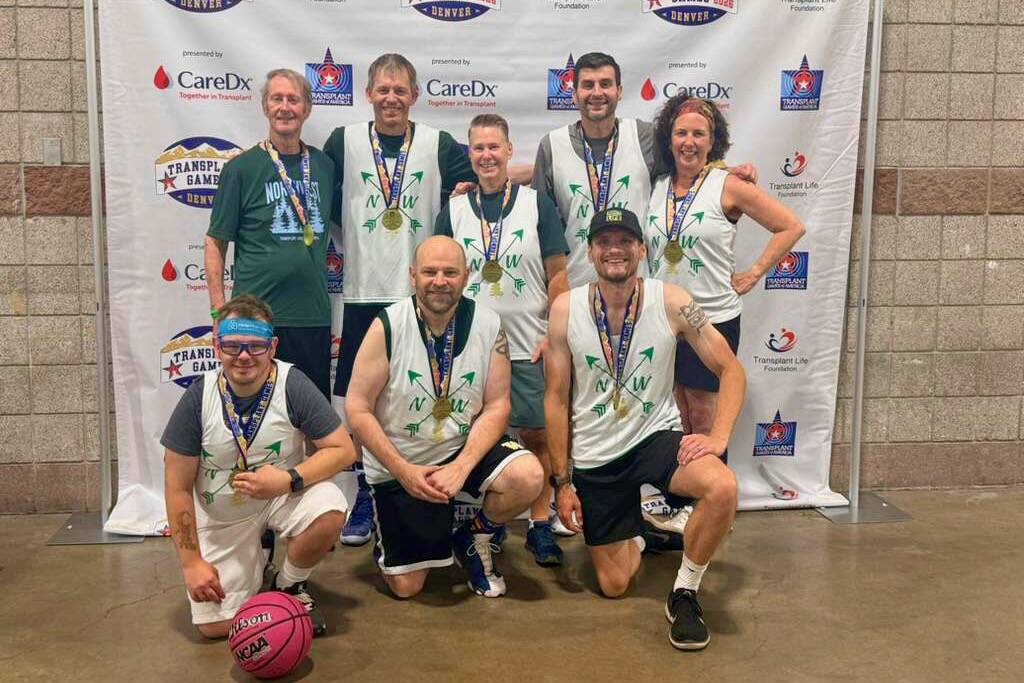
EVERETT — Turner Prewitt is no stranger to winning hardware at the Transplant Games of America.
The 70-year-old Mukilteo resident has competed for Team Northwest at nearly every one of the biennial games since his heart transplant in 2008, particularly in tennis and other racquet sports. Among his top accomplishments was winning a silver medal in the men’s age 30-39 doubles tennis during the 2010 Madison Games — in his early 50s.
Yet at the 2026 Transplant Games in Denver from June 18-23, Prewitt reached a new peak. Roaming the sidelines as the head coach, Prewitt led Team Northwest to its first-ever gold medal in Co-Ed Recreational Basketball.
“That was better than my silver in doubles (tennis),” Prewitt said about seeing the joy it brought to the players and their parents. “… It meant more to me because I love to see other people achieve and have fun. I’ve had my hurrah.”
Comprised of 52 transplant recipients and living donors from Washington, Oregon and Alaska, Team Northwest won 54 gold, 28 silver and 12 bronze medals at the 2026 Games. They also took part in a Guinness World Record for the largest assembly of organ donors and recipients ever recorded, with 966 people gathered in the Colorado Convention Center on June 20.
But at the end of the day, the medals and records are secondary. For the donors and recipients that make the trip every two years, the Transplant Games serve as a valuable opportunity to find and reconnect with the transplant community.
“We compete all day, and then we turn around at night, and sometimes we play til midnight,” said Team Northwest co-captain Nicole Andergard, who donated her kidney to her friend, Anna Lytle, in 2007. “It’s crazy, but it’s fun. And I will say, everyone’s out doing their different competitions during the day, but at night, even people like me who aren’t competing (in later events), we all come to the courts at night. … It’s like a big party.”
The Transplant Games started in 1990 in Indianapolis, originally for kidney transplant recipients as a way to raise awareness and encourage active lifestyles. The Games have since evolved to include recipients and living donors of all kinds in a wide variety of events.
Events are split by gender and age groups as well as by donor/recipient status. Beyond typical athletic events such as basketball, tennis, track and swimming, participants can compete in darts, poker, ballroom dancing and singing. All abilities and experiences are welcome. The youngest competitor in Denver was two years old.
No matter the age, every participant has a story, and Prewitt’s transplant journey began on a tennis court nearly 20 years ago. Competing on the United States Tennis Association (USTA) circuit, Prewitt had qualified for nationals at the age of 50. Just 10 minutes into a practice three weeks after he qualified, Prewitt suddenly could not catch his breath. He lost the sense of where he was and what was going on. Luckily for Prewitt, his teammate was also his primary care doctor.
Prewitt stopped by the doctor’s office the following morning and received X-Rays on his heart, which turned out to be enlarged. An echocardiogram the next day revealed Prewitt’s left ventricle was the twice the size it should have been. He was ultimately diagnosed with cardiac sarcoidosis, a disease where immune cells form inflammatory lumps that interfere with heart activity. In Prewitt’s case, it ultimately led to heart failure.
“My own body thought my heart was infected, so it attacked with T-cells and actually killed part of my heart,” Prewitt said.
Among other measures to monitor his cardiac activity, doctors prescribed Prewitt with Prednisone to suppress his immune system, but the disease progressed to the point where he needed a heart transplant. On Aug. 3, 2008, after waiting over a year, Prewitt received the call from the University of Washington Medical Center at 1:08 a.m. A donor heart was on its way for him.
To this day, Prewitt carries around a few small photos of Joseph Galinet and his family. On Aug. 1, 2008, Galinet was killed in a truck crash in Missoula, Montana. He was 18 years old.
According to Prewitt, an emergency nurse happened to be a few cars behind the crash and called in a medical helicopter. Galinet’s life could not be saved, but his organs were procured for donation. After the heart underwent a series of tests over an estimated 18-24 hour span, the results — and the relative proximity to UW Medical Center — led to Prewitt being the recipient.
Prewitt arrived to UW Medical Center at 2 a.m., and he was prepped for the procedure by 4:30 a.m. Due to HIPAA laws, all Prewitt knew at the time was that the heart came from Missoula. But he would later learn about Galinet’s story and his family, eventually meeting them and scheduling visits every year. The Galinet family even traveled to watch Prewitt compete in 2018, which marked the 10-year anniversary of his transplant. Time is set aside for a donor tribute ceremony at each Games to honor the deceased donors and their families.
“They came and saw me compete, and the coolest thing (is the Transplant Games) love when donor families are there to present medals,” Prewitt said. “Or even if they’re not yours, they still have donor families oftentimes do it.”
When he was first diagnosed with sarcoidosis, Prewitt was annoyed more than anything. He had worked extremely hard to qualify for USTA Nationals, and now he had to give it up out of no where. He doesn’t remember exactly when he first heard of the Transplant Games, but he immediately recognized it as an opportunity to maintain his competitive fire and stay active. Less than two years after his transplant, Prewitt was back on the tennis court winning medals.
Even if he had never won a medal, Prewitt’s transplant is a story of success. It’s also a story of resilience. Even the best transplant matches take a toll on the recipient. Prewitt needs check-ups every six months — although with a 36-year-old heart, it’s still in pretty good shape all things considered. The anti-rejection regiment and immune suppressors have led to complications such as bouts with skin cancer and diabetes, among others. Even prior to the transplant, the now-155-pound Prewitt weighed as much as 232 pounds due to one of the side effects of Prednisone.
Yet even with everything Prewitt has lived through, he walks away from the Games every other year thankful.
“Sometimes, just with good friends or even a team-building (exercise) at work, if you tell other people your problems and put them in the middle of the table, most everyone will take their own problems,” Prewitt said. “Because hearing someone else’s is like, ‘You survived that? You went through that?’ Whereas when it’s your own, I call it ‘survive to thrive.’”
Added Andergard: “It’s a really nice community of people that don’t always get an opportunity to be around other people that are experiencing what they are.”
In Andergard’s case, she was eager to help out her friend, Lytle, who required a kidney transplant due to complications from lupus. After undergoing tests on her antigens, which are genetic markers that help determine matches between donors and recipients, Andergard discovered four of the six matched those of Lytle. It was a stronger match than some siblings or parent-child combinations have.
Andergard’s donation never slowed down. In fact, quite the opposite. She completed all six major marathons in a three-year span, capped by the Tokyo Marathon in March, and she competes in track & field at the Transplant Games. She first participated in 2014 Houston, where she quickly took over as team captain.
“I’m an organizer,” Andergard said. “And the person managing the team that year was not very into it, and I said, ‘Can I relieve you?’ And I’ve been the manager ever since because I’m like, ‘If it’s not done the way you like, then step up and do it.’”
It’s a tall task. With events running from 8 a.m. to midnight nearly every day, Andergard starts at 6 a.m. to organize and manage the team. Even weeks after the Games ended, she’s working to make sure every teammate who earned a medal will receive it. Andergard served as the sole manager until the team added a co-captain this year. It’s a lot of hours and responsibility, but it’s rewarding.
As for Prewitt, he started volunteering at the UW Medical Center prior to his transplant, and he continues to work there today. He helped form the ICU Advisory Board in 2008, where he helped institute changes such as quiet hours and limited overhead page announcements to improve the patient experience. He also works in patient family support, and acts as an advocate for those who cannot speak for themselves, such as when they’re intubated, for example.
Prewitt marvels at the medical advancement he’s witnessed over the years. Back in 2008, the UW Medical Center completed 31 heart transplants. Today, it’s up to 75 in a year. Prewitt has seen patients wait as little as 12 hours to receive a new heart, and often the longest waits are only a few days. Doctors have also learned how to find sarcoidosis in patients earlier with a PET scan. Prewitt said his pastor was diagnosed five years ago, but given the early treatment, he won’t need a transplant.
“He’s basically very healthy,” Prewitt said. “That’s 20 years of advancement, research, development and knowledge. … To me, that’s absolutely phenomenal.”
While continuing to advocate for patients and continued medical advancement remain the priority, both Prewitt and Andergard would also like to another development in the near future: Bringing the Transplant Games to the Pacific Northwest. Both believe that Seattle would be an ideal host city due to its proximity to research hubs and abundance of athletic facilities, but financial obstacles stand in the way.
“The biggest need to get it to come to the West Coast is the financial support of the transplant centers and the pharmaceutical companies,” Andergard said. “Because it just takes a lot of money to put these Games on, so you have to have local financial partners.”
Added Prewitt: “We’ve got everything that you need, other than UWMC is a public hospital. Always money is a huge issue.”
Until then, Prewitt, Andergard and the rest of Team Northwest will set their sights on the 2028 Transplant Games in Saint Paul, Minnesota.