Friendly orca killed by propeller
Published 9:00 pm Friday, March 10, 2006
SEATTLE – Luna, the juvenile killer whale from Washington state waters who got lost in Canada’s Nootka Sound five years ago, apparently died Friday when he was accidentally struck by a tugboat propeller, Canadian authorities said.
Luna, known to scientists as L-98 and a member of one of Washington’s three resident orca pods, or family groups, wandered into Nootka Sound on the west side of Vancouver Island in 2001 and stayed, worrying activists and annoying boaters and seaplane pilots with his friendly curiosity.
“We don’t know 100 percent, but we do believe it’s Luna,” said spokeswoman Lara Sloan with Canada’s Department of Fisheries and Oceans.
Transient killer whales, which range along the coast preying on seals and other marine mammals, occasionally come through the long, twisty sound, but they tend to avoid human traffic.
The dangerously friendly Luna was part of the region’s “resident population,” which spends much of the year in U.S. and Canadian inland waters. They live and hunt in family groups and mostly eat fish, especially salmon.
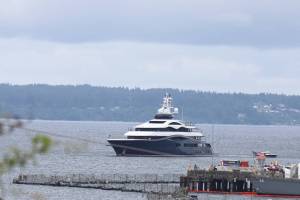
The 1,700-horsepower seagoing tug had pulled into sheltered waters near Conception Point to escape rough weather in the Pacific. Luna, known to enjoy playing in boat wakes, “was swimming under the vessel and was hit by a propeller,” Sloan said.
“It was a really big tugboat – 104 feet,” she said.
The vessel was idling when Luna approached.
“Luna came over as he does and was interacting – disappearing under the hull and so on. … He must have gotten drawn into the propeller,” said government research scientist and orca expert John Ford in Victoria, at the south end of Vancouver Island.
The tug’s big propeller, contained in a cylinder, “generates a lot of current. … It would have been a sudden death,” Ford said.
“The impact was felt by people on the tug,” Ford told Canadian Press. “There were blood and remains in the wake of the tug.”
A spokesman for the tugboat company, Great Northern Marine Towing Ltd. of New Westminster, B.C., said the captain and crew of the General Jackson were heartbroken about the accident.
“We’re all very sad about it,” Barry Connerty told CP. “We did everything we could to avoid that outcome.”
At fisheries offices in Vancouver, B.C., a lot of people are “pretty shocked and saddened,” Sloan said.
“It was one of our fears about what might happen to Luna,” Ford said. “Of course he’s been engaging in these risky interactions with boats for several years now.”
Luna likely was not familiar with the size and power of the vessel. While the carcass was not immediately recovered, “it seems almost certain to me that this is indeed Luna,” Ford said. “And it’s almost certain it was fatal.”
Ford last saw Luna in January, when he visited the sound in a 200-foot research boat. “He came over. He was always curious,” Ford said.
“It’s a very tragic ending,” he said.
Luna was about 6 years old. Orca life stages roughly parallel those of humans, so he was the killer-whale equivalent of a young child.
“The whale has always flirted with this kind of danger,” said Fred Felleman of Ocean Advocates in Seattle, who had pressed for more efforts to reunite Luna with his family. “It was like that old children’s cartoon, ‘Are you my mother?’ Orcas are very social animals, and this was the only way to get his social needs met.”
Lonely and apparently seeking contact, the whale damaged and disabled several boats over the years. Lately, he had been gathering scars from increasingly frequent close calls with propellers, but he apparently suffered no serious injuries.
Canada tried in 2004 to reunite him with his pod in the Strait of Juan de Fuca, which separates Washington state from Vancouver Island.
That effort was scrapped when local Indians lured Luna away from the net pen intended to snare him. The Mowachaht/Muchalaht First Nation believed the orca embodied the spirit of their dead chief, Ambrose Maquinna, and did not want him forcibly removed.