Editorial: Ranchers’ clemency threat to justice, public lands
Published 1:30 am Friday, July 13, 2018


By The Herald Editorial Board
President Trump’s practice thus far in issuing pardons and commutations of prison sentences has raised concerns and eyebrows for skipping the traditional path for a necessary and often just presidential power.
And it is — to be clear — a presidential power, granted by the Constitution. But the pardons and commutations Trump has issued thus far have bypassed the process traditionally used by presidents, which includes a review by the Department of Justice. Currently there’s a backlog of some 10,000 applications for pardons and clemency.
Ignoring that process leaves Trump and the beneficiaries of his forgiveness open to charges of political favoritism, such as those for former Arizona Sheriff Joe Arpaio for contempt of court and conservative author Dinesh D’Souza for violation of campaign finance laws.
The pardons this week of Oregon ranchers, Dwight Hammond, 76, and his son, Steven Hammond, 49, on federal arson charges seem simiarly motivated by political considerations. And they are dangerous, and not only for their threat to conventions that protect public respect for the president’s power to issue pardons.
The commutation of the Hammonds’ sentences demonstrates disregard for public land, one that won’t be ignored in the West, especially at the start of wildfire season.
The Hammonds were convicted in 2012 of arson, intentionally setting fires on public lands in Oregon, which carried a mandatory minimum sentence of five years. Following conviction, however, both were sentenced to far shorter terms and had been released. They were ordered to return to prison in 2015 after a federal appeals court ruled they had been improperly sentenced.
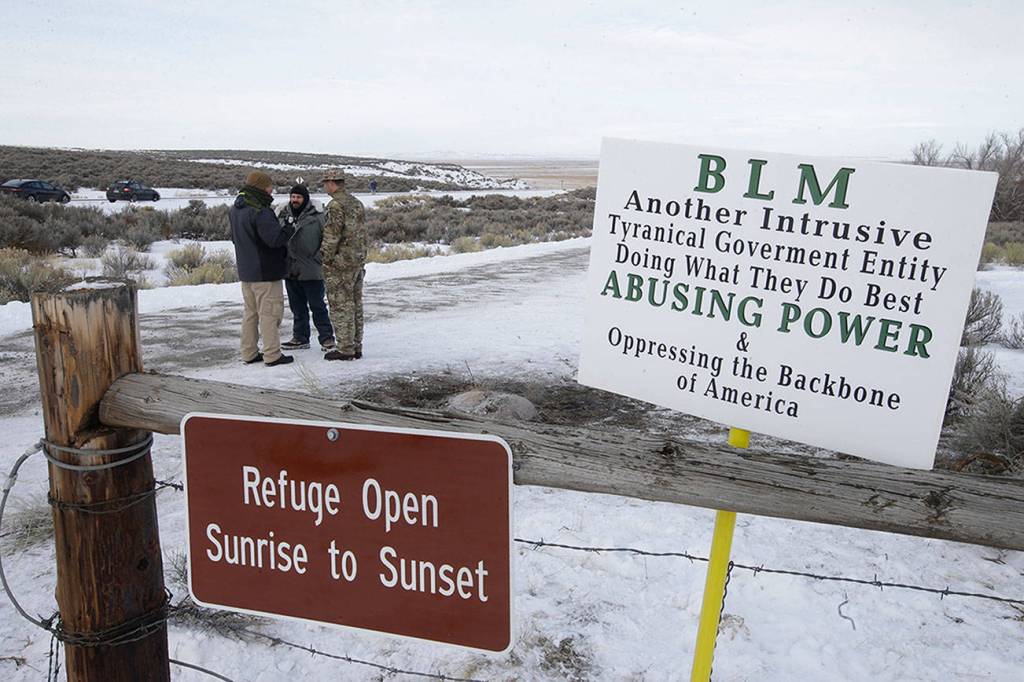
Their imprisonment led to protests — particularly among those opposed to federal management of public land in the West — including the 2016 armed occupation of Oregon’s Malheur National Wildlife Refuge, led by Ammon Bundy, son of Nevada rancher Cliven Bundy.
In explaining the Hammonds’ clemency, White House Press Secretary Sarah Huckabee Sanders called evidence at their trial “conflicting” and that the fires set on their own land had “leaked onto a small portion of neighboring public grazing land.”
The “conflict” was between the Hammonds’ claims that they had set the fires to eradicate invasive species and provide a firebreak and the testimony of witnesses that Steven Hammond had ordered the fires set to hide evidence of an illegal deer hunt, according to a report Tuesday by Wildfire Today.
Among those testifying was Dusty Hammond, grandson and nephew to the Hammonds, who was 13 at the time of the 2001 fire. Dusty Hammond, 21 at the time of the trial, told the jury that the Hammonds and friends, while hunting, had fired into a herd of deer on Bureau of Land Management land, crippling four bucks but not tracking nor collecting the deer.
To hide evidence of the illegal kills, Dusty Hammond said, Steven Hammond handed out boxes of matches and told members of the hunting party to “light up the whole country on fire.” The resulting fires burned 139 acres of federal land.
When the hunting party returned home, Wildfire Today reports, Dwight Hammond told his grandson “to keep my mouth shut, that nobody needed to know about the fire.”
The clemency was requested by the executive director for an Oregon cattlemen’s association and passed along to the president by Secretary of Interior Ryan Zinke. An Oregon congressman had also lobbied for their release.
A more through review by the Justice Department might have at least given greater consideration to the work of a jury of the Hammonds’ peers who had weighed the “conflicting” evidence in the court case and returned a verdict of guilty, rather than dismiss it capriciously at the request of an industry executive.
The message in Trump’s clemency for the Hammonds won’t be lost among those who illegally occupied Malheur.
“Whatever prompted President Trump to pardon them, we hope that it is not seen as an encouragement to those who might use violence to seize federal property and threaten federal employees in the West,” Jamie Rappaport Clark, president of the environmental group Defenders of Wildlife, told the Associated Press.
Such encouragement would be like handing a box of matches to the foes of public lands.