‘Doing this for others’: SnoCo student journalists learn important skills
Published 1:30 am Sunday, April 5, 2026


EVERETT — It was a long shot.
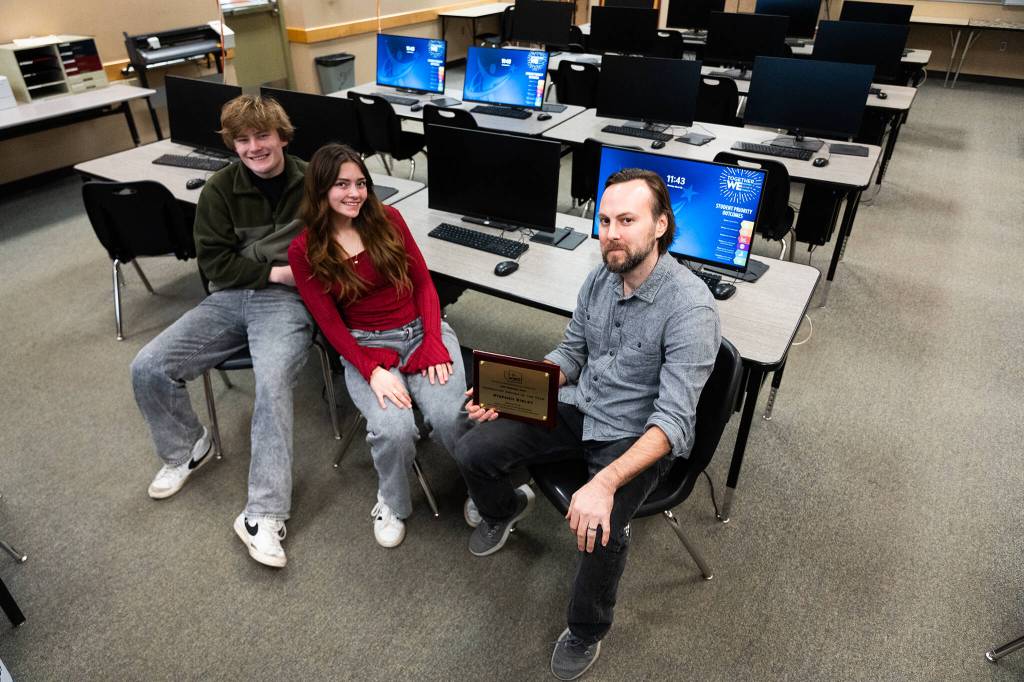
That was what Shundiin Nielsen and Logan Kremian, two students in Cascade High School’s yearbook class, thought when they decided to nominate their teacher, Stephen Sibley, for the Washington Journalism Adviser of the Year.
They said they procrastinated writing the nomination letter to the Washington Journalism Education Association, the state nonprofit that administers the award. Then they turned it in a day late after fine-tuning it to make it as convincing as possible.
Their efforts worked, however. Sibley, as the students call him, received the award at a state conference on March 7.
“I just remember seeing his face,” Nielsen, the editor-in-chief of the Cascade yearbook, said. “Seeing his watery eyes, it was so worth it after seeing him happy.”
Sibley, the yearbook teacher at Cascade High School for over a decade, is one of many journalism educators across Snohomish County teaching journalistic skills to local kids and teens. Students in those middle school, high school or college journalism and yearbook programs learn important, transferable skills of interviewing, writing and working with a team of peers at a young age. The classes and clubs are often jumping-off points for talented reporters. In certain parts of the country, a student publication is the only daily newspaper in the area.
But the students are also doing so at a time when pursuing journalism as a career is a difficult prospect. Newsrooms across the country are shrinking or closing altogether. Jobs are paying less and public trust in news organizations has decreased in recent years.
That means for many students, the goal of realistically becoming a journalist has become less and less common. But when students join these classes, they learn about more than just reporting, educators and students interviewed by The Daily Herald said.
“The majority of my students don’t go into journalism or photography or even design. That’s totally fine,” Sibley said. “The bigger skill that is taught in my class is communication and community, being a part of something bigger, and working within a team for a larger goal … We’re doing this for others.”
‘The quote, unquote ‘real world’’
In 2005, about 75,000 journalists were employed in newspapers across the United States, according the Local News Initiative, a project created by Northwestern University. By 2024, that number had dropped to just above 30,000.
In that same time frame, about 3,400 newspapers have shuttered nationwide. Some research has linked the closure of local newspapers with decreased voting participation and increased political polarization.
Choosing to enter the field right now — considering the state of the news industry, particularly with the rise of artificial intelligence — can be nerve-wracking and intimidating, said Arlo Popa, a former writer at the Everett Community College Clipper who is now studying journalism at Washington State University.
“But I’m really excited to be able to do the one thing that AI can’t replace,” said Popa, who eventually hopes to work in broadcast journalism. “It’s going out and actually doing reporting, actually being in the community.”
Many students who join introductory journalism classes at Everett Community College are not exposed to local news, said Vanessa McVay, the advisor for The Clipper and a professor at the college. As local newsrooms close and staff sizes shrink, many have no experience talking to a reporter or spotting one at sporting events, she said. For a lot of students, they get most of their news from social media.
“They have no experience. Their parents don’t have a physical paper delivered to them every day, so it’s not on their kitchen table waiting for them to slowly ease into the idea of news,” McVay said. “So that is the biggest challenge and disappointment and fear, is that they are not exposed to credible, accurate news.”
A lot of student journalists don’t plan to enter the industry. Many want to teach. Kremian said he hopes to go into graphic design. But he said the skills he’s learned in his yearbook class will translate into any future career, whatever that may be.
“I think this class is a really good way to prepare students for the quote, unquote ‘real world,’” Kremian said. “I think it simulates a workplace much more than any other class I’ve been in or heard of before.”
Over the years, journalism education has changed along with the times, said Anne Hayman, the journalism advisor for the Arlington High School Eagle since 1999. The Eagle, the school’s student publication, no longer puts out a print paper but maintains a news website. It has become very focused on video, she said.
“I try to focus on, in terms of my students, what skills they are using in journalism and how you can apply those later in life,” Hayman said. “The project management, for example, but also being able to talk to people.”
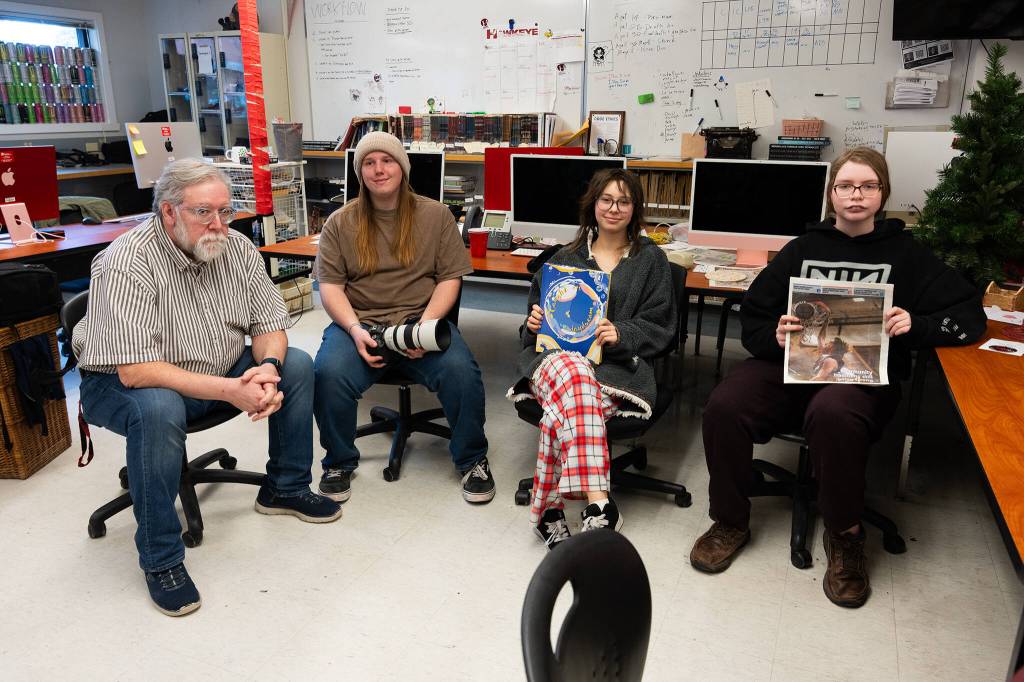
In the newsroom of the Mountlake Terrace Hawkeye, the Mountlake Terrace High School’s student newspaper, teens spend hours hunched over desks in a quasi-newsroom located in a classroom. Staff members get their own workspaces, covered in their personal decorations.
“I’m definitely here more than my own house,” said Sabin Metallo, the co-editor-in-chief of the Mountlake Terrace High School yearbook. “And it really shows. I kind of view my desk as my little space, like a second bedroom.”
Students at The Hawkeye, one of the most celebrated high school newspapers in the region, feel a sense of responsibility and accountability — partly because of the paper’s reputation and partly because their peers are depending upon them to complete their numerous tasks. Much of what the students learn, they learn from each other.
“I think the reason there’s such a legacy is because the students here are always putting in immense amounts of work,” said David Cardwell, a photojournalist at the Hawkeye.
Cardwell hopes to become a professional photojournalist someday. But he’s nervous about potentially going into the field because of its unpredictability.
It may not be as easy to get a job in journalism nowadays, McVay said, but journalism — even if students are just learning about the process — remains more important than ever.
“Even if they’re never going to be a reporter, maybe they’re not going to be a communications person, but they’re going to understand how journalism works and how it’s supposed to work and how important it is,” McVay said. “I think that’s a big, big deal nowadays.”
‘A very unique perspective of student life’
Washington is one of 18 states with a so-called “new voices” law, which protects student journalists from censorship by teachers or school officials.
It means that the Mountlake Terrace Hawkeye can report on student walkouts against Immigration and Customs Enforcement, known as ICE, and include uncensored profanity in quotations. (An editor’s note in the article said removing the profanity would diminish the emotion and weight of the protesters’ language). It means that Popa, a student journalist at the Everett Community College Clipper, can write a story critical of the college’s decision to close its Early Learning Center.
“There is that freedom of expression that protects our student journalists,” Hayman said. “We are not the ones who make the decision about what gets published. Our student editors are the ones who make the decision about that.”
Popa started working at The Clipper while she was a Running Start student, using a program that allows 11th and 12th grade students to take community college classes tuition-free. She loved Everett Community College but felt that the story was important to share the voices of people she said weren’t feeling heard.
“When I wrote that piece, my goal was not just to inform the community, but it was also to tell other students that this is a big issue,” Popa said. “I think it’s so important that the school newspaper stays independent.”
Other than a few conversations with advisers, “everything comes from us,” said Metallo. “We have a very unique perspective of student life and so many valuable voices that are really so passionate about journalism in general.”
The yearbook and the Mountlake Terrace Hawkeye are overseen by Vincent DeMiero, who has held the role for 38 years. In 2023, he received the Dorothy McPhillips Award from the Washington Journalism Education Association — a rare and prestigious award from the organization that recognizes educators for improving scholastic journalism in the state.
He feels that letting students learn as much as they can on their own, with him available to give advice, helps students become experts on different skills.
“Student-centeredness is just so critical to what I believe is pedagogically sound,” DeMiero said. “They are working journalists. Yes, they happen to be high school students, but that’s a decision that they made. Do you want to be a good high school paper, or do you want to be a really good paper that happens to be made by high school students? And I think there’s a difference.”
For 12 years straight, The Hawkeye received the First Amendment Press Freedom Award, MyEdmondsNews previously reported. A wall in DeMiero’s classroom is covered with plaques and awards received by students over the years.
That work has earned respect from the district and its school board. When the Edmonds School District was drafting changes to the district’s publication policy two years ago, DeMiero said, the assistant superintendent came to the staff of the Hawkeye to listen to suggestions rather than implementing something without their input.
“Especially nowadays, it’s so important to have a voice, and have your own voice, and for students to have a little power, because sometimes it feels powerless,” Popa said. “… The least we can do is speak out about the things that we find important and that students find important.”
In the Cascade High School yearbook class, Sibley teaches his students to tell stories that go beyond the surface level. Students have written about peers who had challenges immigrating from other countries, he said, or others who are facing possible deportation if their claims of asylum are denied. He tells his students to build rapport with others, to get them to open up and share the real stories that are impacting their day-to-day lives.
That approach has garnered the yearbook a lot of recognition. Cascade High School’s yearbook has won a number of awards during Sibley’s tenure, repeatedly being selected for a national gallery of yearbooks, an award given to the top 3% of high school yearbooks across the country.
Sibley never expected to be teaching a yearbook class. He started his career in graphic design while teaching high school basketball. Eventually, he made the switch to education, working as a student teacher at Cascade when the former yearbook teacher retired. He ended up taking her place.
Over the years, Sibley’s learned a lot, just as the students in his class have. He hopes to grow the yearbook program and eventually bring another teacher into the class, which currently teaches nearly 60 kids.
He appreciated receiving the state award last month, he said. But his favorite part about it was the fact his students thought he was worth it in the first place.
“When I think back on my career, definitely what will matter more to me is feeling that appreciation, that they thought I was worthy of doing that,” Sibley said. “The title’s cool, but them wanting to do that means a lot more to me.”
Will Geschke: 425-339-3443; william.geschke@heraldnet.com; X: @willgeschke.