DACA recipients now eligible to be cops in Washington
Published 11:00 am Thursday, September 5, 2024


By Mary Murphy / CascadePBS.org
This year, Washington joined four other states in opening police jobs to DACA recipients, in a new program aimed at addressing law enforcement shortages while intending to make officer ranks better reflect their communities.
Washington offers some unique opportunities for Dreamers, as those in the Deferred Action for Childhood Arrivals are commonly called, including access to college financial aid and professional licenses in fields like teaching and nursing. But until this July, becoming a police officer was excluded from that list.
Introduced by former President Barack Obama in 2012, the DACA program protects immigrants who came to the United States as children from deportation.
California, Colorado, Illinois and New Jersey also allow DACA recipients to apply to be police officers, said Sen. John Lovick, D-Mill Creek, a retired trooper of 30 years who sponsored the bill in the Legislature to start a similar program here.
Lovick said this new program offers multiple benefits for Washington law enforcement agencies.
“And I’m not just talking about diversity, I also want to talk about culture,” he said. “We believe that our DACA recipients will change the culture of policing in our state.”
The new program comes at a time when Washington ranks among the lowest in officers per capita in the nation, according to data from the Washington Association of Police Chiefs and Sheriffs.
Steve Strachan, executive director of the association, said many reasons explain why police departments are struggling to keep up with attrition, from the perceived lack of support from communities after the protests of 2020 to the high number of officers reaching retirement age.
Washington has over 16,000 DACA recipients, and law enforcement agencies say they have a significant need for more officers. Seattle police staffing, for example, is at a 30-year low, with 913 active officers but a need for 375 more. Lovick and Strachan say some departments are actively recruiting DACA recipients, either reaching out directly or attending community events.
“I do know that the new acting Seattle police chief, Sue Rahr, is promoting this every week,” Lovick said recently. “I know they’re promoting it in the Tri-Cities (and) there was interest in other agencies, but it’s just a matter of people seeing that now they have the opportunity to do this.”
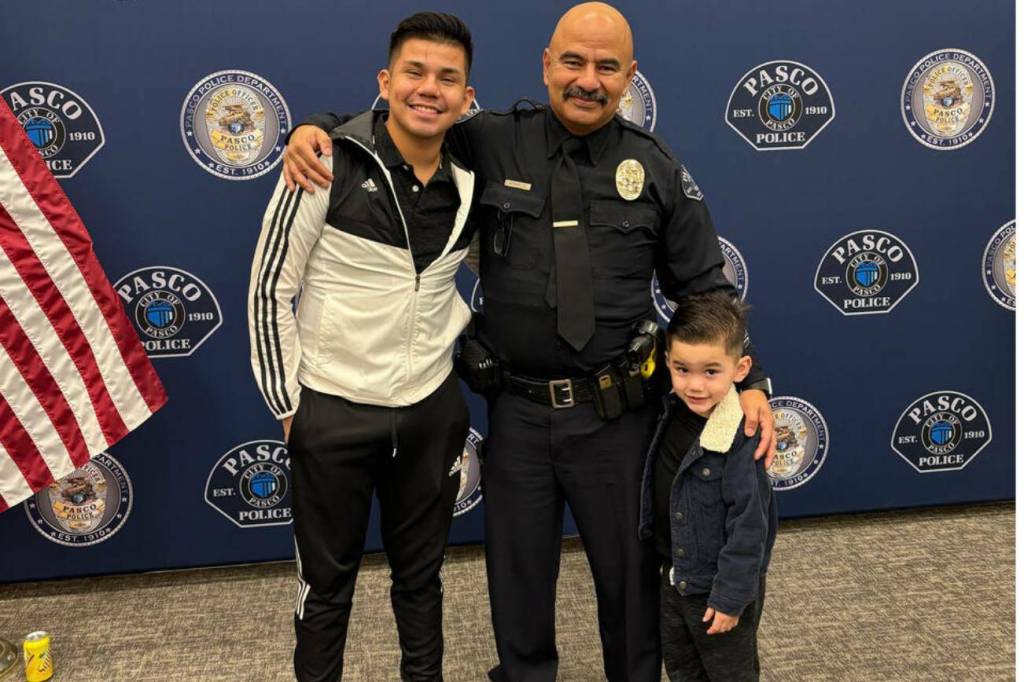
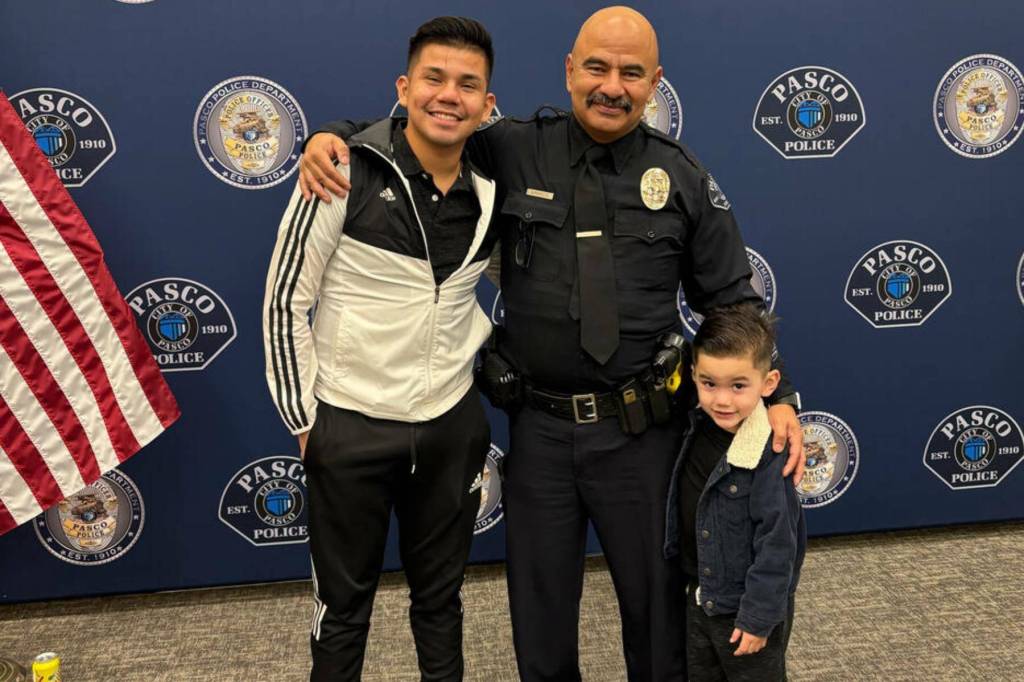
Victor Manuel Arzate, from Mexico, is one Dreamer who didn’t know he had this opportunity.
Arzate grew up being mentored by Pasco police. He says officers were a huge part of his life, always keeping him out of trouble — “the healthy kind of trouble,” he clarifies.
He knew he wanted to be an officer, and remembers how he felt when he learned he wasn’t eligible to enter the force.
“I felt like I lived in a country where I’m able to work but still not considered a normal person; I was still considered, as they call us, ‘aliens,’” Arzate said.
Before he retired, an officer who’d mentored Arzate growing up, called him and said ‘Look, I know you can’t become an officer, but I still want you to experience it.’ So Arzate was invited on some ride-alongs, was voluntarily tasered and did some of the training and tests. But since he still wasn’t allowed to enter the force, he decided to focus on his music career.
But then in July, City Council member and former Pasco Mayor Blanche Barajas called him.
Barajas knew Arzate had been involved in the community, was close to officers and was interested in policing. She wanted to make sure he knew the door was now open.
“I was like, ‘Oh, wow,’ it caught me a little bit off-guard because my interest ended up, you know, switching a little bit, but then I had been thinking over and over about it. And I’m like, wow, I mean, things happen for a reason,” Arzate said.
Arzate came to Washington from Mexico when he was just 2. He doesn’t remember much of his early childhood, but Pasco has always been home.
“I grew up here, and I grew up in this culture that I also love, so of course I would like to protect (it) and stay involved,” Arzate said.
Barajas has worked behind the scenes on this program since 2019. Her passion stems from her own roots in a migrant family, and how while growing up she observed the dynamic between police and immigrants.
“Growing up with kids that either hide, don’t answer the door or don’t report crimes because they’re afraid of being deported,” Barajas said. “There’s always that threat.”
Arzate says that is one of the reasons he wants to enter the force. “I would really (be) honored to be there for for those Hispanics who might feel scared to get closer to law enforcement due to the fact that they feel that they’re going to be treated badly or they’re gonna be ignored, or, worst-case scenario, they might feel like they’re gonna be deported,” Arzate said. “We don’t have to live in that fear.”
Arzate says growing up close to Spanish-speaking officers was a big part of what made him comfortable around police.
Lovick says stories like Arzate’s are why he pursued this idea in the Legislature.
“Having these peace officers, having been raised in those communities, now they want to go back and serve those communities, they speak the language of those communities — how does it get any better than that?” Lovick said.
The new program hasn’t been without hiccups. Former Pasco officer Joshua Glass, part of the genesis of this initiative, explains the context of one of his current worries.
Glass was in recovery from knee surgery in 2019 when he met a young man. “He was helping me as a physical therapist’s assistant, and I had a feeling about this kid, he was kind, athletic,” Glass said. “In Pasco we’re always recruiting, and we’ve always said, ‘It’s not about filling a position, it’s about hiring the right person,’ so I asked him if he’d ever thought about becoming an officer.”
He had thought about it, but knew he wasn’t eligible because of his status as a DACA recipient.
Glass had time on his hands since he was in recovery, so he looked into the issue and brought it to Barajas. While Glass successfully inspired the bill, and eventually the new initiative, the physical-therapy assistant met a roadblock.
Glass informed the young man he might soon be able to enter the force, so he applied, taking physical, oral and written exams.
“He was the best applicant, No. 1 on the list,” Glass said, but he was disqualified because his mother had him work under a false Social Security number as a minor. Glass and Barajas predict this could be a common issue for DACA recipients, and Glass would like to see the law amended to allow some exceptions for law-breaking as minors.
Monica Alexander, executive director of the Washington State Criminal Justice Training Commission, said she always makes a note to ask her students “what their ‘why’ is.”
“We talk a lot about wanting the police force to represent the communities they serve,” Alexander said. “Our last class in Pasco, I was so excited about a lot of bilingual students; we had a lot of students who say they’re first-generation here, or they have no other family members that are in law enforcement, and were so eager to serve their community, and they were so eager to be a part of something good and bigger than themselves.”
As Arzate looks forward, he hopes to replicate what officers did for him when he was a kid.
“I just really want to help teenagers and kids follow their dreams and to make the good kind of trouble,” Arzate said, “not the bad kind of trouble.”
Visit crosscut.com/donate to support nonprofit, freely distributed, local journalism.