Snohomish County bomb cyclone victims can access federal disaster loans
Published 7:30 am Tuesday, January 14, 2025
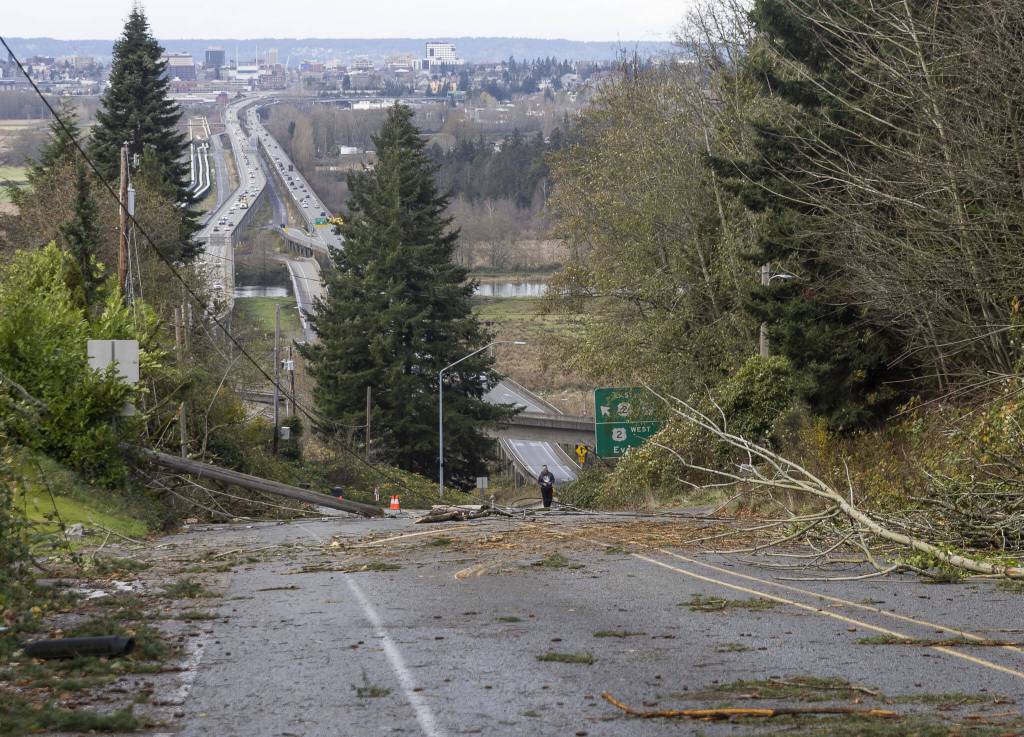
MONROE — Low-interest loans for those with damage from November’s bomb cyclone will soon be available, Snohomish County announced on Monday.
The loans, which are through the U.S. Small Business Administration Office of Disaster Recovery and Resilience, are directed toward people who had damage not covered by their insurance. Residents, businesses and private nonprofits can apply at SBA.gov/disaster.
The loan service is using the VIP Cabin at the Evergreen State Fairgrounds for a Disaster Loan Outreach Center at 14405 179th Ave., SE, Monroe. The loan service will be open from 9 a.m. to 6 p.m. Monday, Tuesday and Thursday and from 10 a.m. to 7 p.m. Wednesday and Friday.
Walk-ins are accepted, but appointments can be made at appointment.sba.gov.
“When disasters strike, our Disaster Loan Outreach Centers are key to helping business owners and residents get back on their feet,” said Francisco Sánchez Jr., associate administrator for the Office of Disaster Recovery and Resilience at the SBA, in a release on Sunday. “At these centers, people can connect directly with our specialists to apply for disaster loans and learn about the full range of programs available to rebuild and move forward in their recovery journey.”
The office will be open for loan applications through Jan. 31. Snohomish County’s Director of Emergency Management, Lucia Schmit, recommends going earlier, if possible, to account for any follow-up appointments that may be needed.
The windstorm caused over $18 million in damage to public property on Nov. 19-20, most of it coming from downed power lines and other Snohomish County Public Utility District infrastructure. The Snohomish County Department of Emergency Management said surveys from 225 residents and businesses reported about $5.5 million in damage to private property.
The state did not meet the threshold for individual assistance through the Federal Emergency Management Agency, which requires a disaster to majorly damage or destroy 300 uninsured homes. November’s storm did not meet that criteria.
Schmit said that due to “widely acknowledged” flaws in federal disaster individual assistance programs, many states, including Washington, have created their own. However, the state has yet to fully fund this office, and it’s still relatively new, she added.
It has been used, though, and in this instance, the governor’s office went to the Department of Commerce and got a one-time allocation of $1 million to use as state individual assistance for damage caused by the windstorm. There are extensive stipulations on who can access it.
The state’s Individual Assistance program also does not cover private property that is not a home. Schmit said surveys showed the damage from the windstorm was mostly to private property like cars and damage to homes that was significant, but not enough to destroy a residence. Damage was also sustained by things like fences and garages, which are both ineligible for federal money.
Most Snohomish County residents are not eligible for the state’s Individual Assistance program, which essentially pays out money to private property owners to fix damages. To be eligible, a person must have a household income at or below 80% of the area’s median income and must prove their home was destroyed or suffered damage that otherwise wouldn’t be covered by insurance.
The federal disaster loans for damage to real estate can range as high as $500,000. Homeowners and renters are also eligible for an additional loan increase of up to 20% to protect their structures against future disasters, Schmit said.
“There is interest in the community in making homes more resilient to disasters,” Schmit said. “And so this might be a good opportunity, say, if your roof got damaged by the storm, instead of just repairing the damage, it might be a time to look at incorporating fire-resilient building materials as you do the do the repairs.”
Additionally, there is also up to $100,000 available in loans for personal property, including vehicles.
Businesses, meanwhile, are eligible for up to $2 million for both physical and economic losses due to storm damage. Seven businesses filled out county surveys, county officials reported.
Interest rates are “as low” as 4% for small businesses, 3.625% for nonprofits and 2.563% for homeowners and renters, a Small Business Administration press release stated. The deadline to return applications for physical property damage is Feb. 21, 2025, while economic loss loan applications are due Sept. 23, 2025.
The county’s hope is that the loans will be able to help more people who suffered storm damage. The federal loan help also hinged on storm reports by county staff and members of the public returning surveys of their damage.
“We certainly used it as an opportunity to get as many of our staff out to participate in those site visits with FEMA, to go to those community gathering spots where we could talk to the community members, all so that we have that breadth of knowledge,” said Schmit, who looked at the entire process as training, too. “More people are familiar with the process, more people are familiar with FEMA-specific criteria for determining whether damages are minor or major … so that we are better positioned for the next one.”
Jordan Hansen: 425-339-3046; jordan.hansen@heraldnet.com; X: @jordyhansen.