Editorial: Lawmakers shouldn’t futz with partisan redistricting
Published 1:30 am Thursday, January 8, 2026


By The Herald Editorial Board
With only a short 60-day session to work with, here’s how state lawmakers can save themselves some time and effort this session, especially as they confront a $2.3 billion budget gap in a supplemental budget year: Don’t waste time with congressional redistricting and gerrymandering, as two state House Democrats have proposed.
Even late into last year it looked as if Washington state would count itself among the saner states of the union who were skipping the temptation indulged in by several states — including Texas (red) and California (blue) — to break with the traditional practice of congressional redistricting only after every 10-year census, instead futzing around with borders mid-decade to give one party or the other a potential advantage in electing members of the U.S. House in upcoming elections in 2026, 2028 and 2030.
Already, five states have adopted new “gerrymandered” maps for partisan benefit, including Texas, Missouri, North Carolina and Ohio for the assumed goal — in the case of two of the nation’s most-populous states — of sending as many of five more Republicans to the House for Texas and five more Democrats for California’s state delegation. Utah redistricted as well, but under court order, and Virginia, Florida and Maryland are undertaking steps to redraw districts to benefit the legislative majority party in their state.
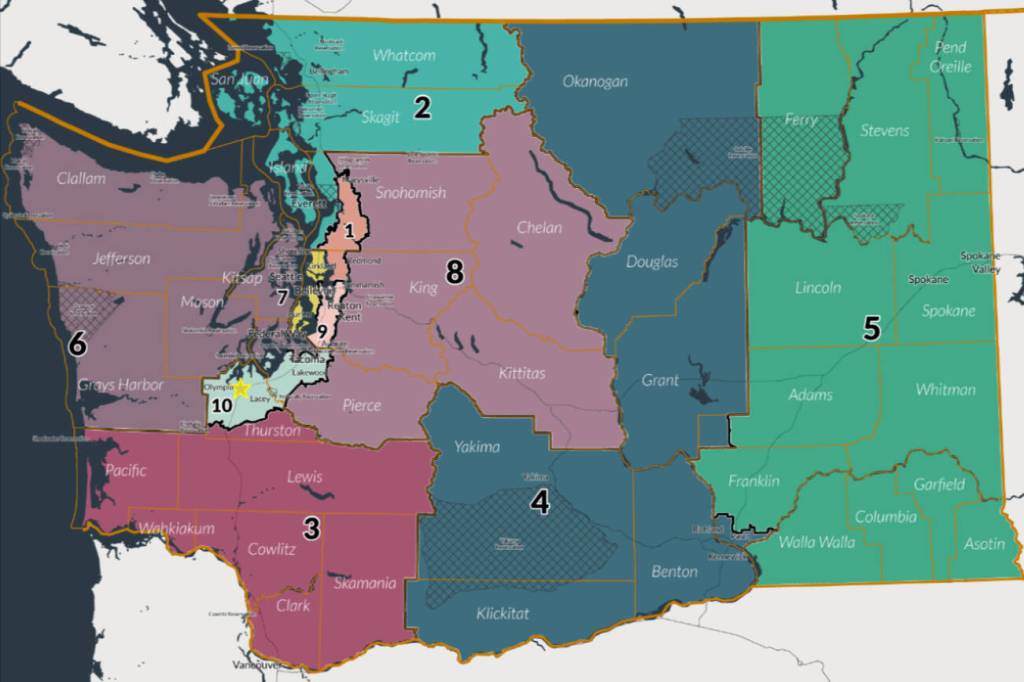
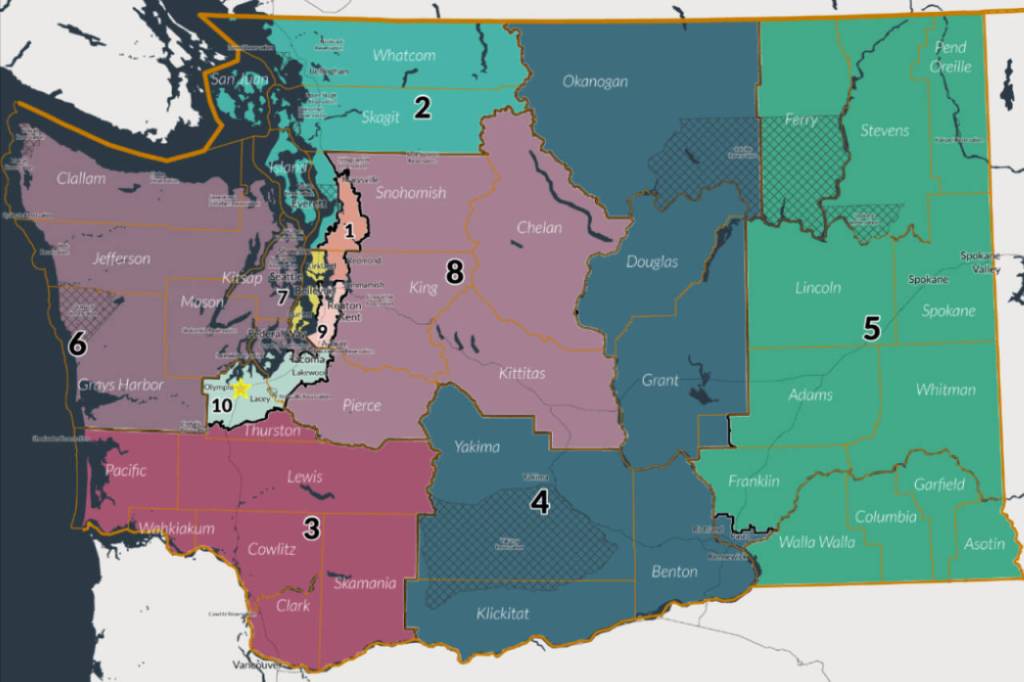
Democrats in Washington state currently hold eight of the 10 congressional districts, and have done so fairly, relying on a universally praised process that has over the decades limited partisan influence in how congressional and legislative districts are drawn. Democratic state lawmakers seemed to agree last year that it would take substantial effort and a convolution of current districts to muscle even one more Democrat onto its delegation. And GOP legislators were correct it would mean less fair representation for the state’s Republican voters.
“There’s literally no way to get the results they are talking about before the 2026 election,” state Senate Majority Leader Jamie Pedersen, D-Seattle, said in July. “We have already done our share to get Democrats in the House. There’s no juice to squeeze in the lemon here.”
Yet, at least two Democrats in the state House now want to try. House Majority Leader Joe Fitzgibbon, D-West Seattle and state Rep. Sharlett Mena, D-Tacoma, have pre-filed House Joint Resolution 4209, which calls for a constitutional amendment that would allow for mid-decade redistricting, redrawing congressional districts with majority votes in each chamber, on condition that another state engages in mid-decade redistricting for reasons other than a court order.
The mid-decade redistricting would shelve the state’s current practice for redistricting, responsible for a substantial measure of trust among the state’s voters that such work is less driven by partisan politics than in other states.
A long history of legislation and lawsuits led to the creation in 1983 of the current process: a bipartisan commission that meets after every national census. Drawing those boundaries are five commission members: two selected by Republican lawmakers, two by Democrats and a non-voting chairperson, who is selected by the other four members. Three of the four voting members must agree on the final boundaries for districts, with the Legislature able only to make minor adjustments to the maps.
Washington is among four other states with similar commissions. Four others have independent commissions. Most of the rest are controlled by the party in control of the state legislature.
For this rush to redraw maps with red and blue crayons, you can thank — with sufficient sarcasm — the current 6-3 conservative majority of the U.S. Supreme Court for determining in 2024 that there was nothing wrong with partisan gerrymandering, redrawing a district — even to the point of a salamander-shaped map — that used a neighborhood’s party preference to determine who was in and who was out of a particular district, with the intent of favoring one party over the other.
That unleashed the recent flood of redistricting efforts, which now threatens to allow — rather than voters choosing their representatives — allow politicians to choose their voters.
That the resolution first seeks a constitutional amendment and would only be triggered if another state jumped off the Elbridge Gerry Memorial Bridge doesn’t make the proposal any more palatable to notions of representational democracy. (Today’s U.S. Semiquincentennial Moment: Gerymandering is named for Elbridge Gerry, the Massachusetts governor who in 1812 signed a state law creating bizarrely shaped partisan voting districts.)
To be certain, there is need for the Legislature, perhaps starting in its 2027 session, to make some changes to the existing redistricting process prior to the 2030 census and the start of the next legitimate redistricting effort in 2031.
The process in 2021 was marred by some last-minute actions — done out of the view of the public — by commission members that violated the state’s Open Public Meetings Act and possibly led to some horse-trading to allow sitting state lawmakers to keep seats in their districts.
The Legislature following that year’s process did consider legislation that would have added additional layers of judicial review and public comment before final approval of maps. That legislation should again come before lawmakers.
And if lawmakers are intent on a constitutional amendment, that effort should be devoted to reforming the current makeup of the redistricting commission, replacing the partisan members with nonpartisan citizen appointees to further assure fairness.
The boundaries of congressional and legislative districts in the state shifted considerably after the 2021 redistricting. Wrestling those boundaries around as often as every two years and doing so with partisan interference from a majority party will only discourage voter participation.