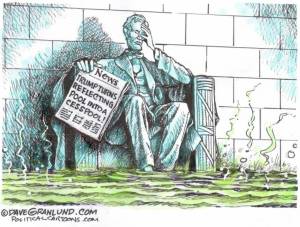
Milbank: What passes for concern in a Dickensian America
Published 1:30 am Friday, June 15, 2018
By Dana Milbank
Donald Trump’s America has taken on a Dickensian pall.
The Trump administration floats a plan for tent cities — modern-day Hoovervilles to shelter the growing number of migrant children it is detaining.
A Honduran man fleeing violence kills himself in a Texas jail after U.S. authorities take his child from him — part of a Trump policy of separating illegal immigrants at the border from their children.
Immigration authorities force a high school senior in Iowa to return to Mexico — the country he left when he was 3 — where he is soon killed, his throat slit.
And in Congress, House Republican leaders fend off a “discharge petition” by Democrats and the meager group of GOP moderates attempting to force a vote on the Dream Act protecting children like the murdered teen.
Whatever the motives behind such policies, they have the appearance of abject cruelty — not a good look for Republicans as they go into midterm elections.
Cue the compassion!
Thirteen House Republicans, party leaders and a few backbenchers in competitive races ambled before the cameras Wednesday morning after their weekly caucus, but instead of taking the usual partisan shots and performing the usual genuflections to the president, they spoke of their tender concern for the addicted.
Most held 8-by-10 photos of constituents recovering from or killed by opioid abuse, and they touted some 57 bills designed to ease the epidemic. The over-the-top, 20-minute show of heart resembled a telethon.
“It’s for the people in these photos that we rallied around bipartisan legislation,” announced Rep. Greg Walden, R-Oregon, holding a photo of “Amanda.”
“We are united in doing everything that we can to help these families,” contributed Rep. Cathy McMorris Rodgers, R-Washington, holding a photo of “Kristin.”
“Through our actions and bipartisan work, we will pass solutions that will help many families,” inveighed Rep. Erik Paulsen, R-Minnesota, holding a photo of “Keegan.”
The likely next speaker of the House, Kevin McCarthy, R-California, who invariably comes up with the wrong word, did not disappoint, promising to “deal with every ability of this addiction.”
Outgoing speaker Paul D. Ryan, R-Wisconsin, with exaggerated emotion, spoke of “America at its strongest, people coming together to help each other through these difficult times.”
Puh-leeze.
There’s nothing wrong with their proposals, per se. Most have broad bipartisan support and will do some good. But they are scattershot and incremental — more campaign material than substance.
Public-health experts have pushed for a comprehensive approach to the crisis modeled after the Ryan White HIV/AIDS program. Sen. Elizabeth Warren, D-Massachusetts, and Rep. Elijah E. Cummings, D-Maryland, have introduced such a plan, which would cost $100 billion over a decade. House Democrats are pushing for a $5-billion-a-year opioid response fund. But Republicans aren’t about to let those become law.
And though Congress has approved $6 billion over two years in new opioid-addiction funding, this comes as President Trump has tried to scale back the two major programs that provide much of America’s addiction treatment, Obamacare and Medicaid. (Trump’s nearly $1.5 trillion proposed cut is, by coincidence, the same as the cost of his tax cut.) The latest assault on Obamacare — the Justice Department’s refusal to defend current law against lawsuits from GOP-led states — could leave many more without insurance and addiction treatment.
Meanwhile, the news is full of ugly accounts about the consequences of the Trump administration’s immigration crackdown, including reports about the tent cities for unaccompanied minors (McClatchy News), the “Dreamer” killed after his forced return to Mexico (Des Moines Register) and the suicide of the Honduran father (The Washington Post’s Nick Miroff). Vulnerable Republicans, seeking shelter from the gruesome consequences of the administration’s actions, tried to force a vote on the Dream Act — but conservatives prevailed. The House will instead take up alternatives next week that are unlikely to pass.
Ryan explained to reporters Wednesday why the Dream Act, which would prevail if given a vote, isn’t going to get one: “Last thing I want to do is bring a bill out of here that I know the president won’t support.”
This is why the show of compassion rings hollow: Republican lawmakers aren’t willing to stand up to the source of their Dickensian dilemma. Rep. Mark Sanford, R-South Carolina, spoke out against Trump —and lost his primary Tuesday. Rep. Martha Roby, R-Alabama, once expressed concern about Trump — and was forced into a runoff. Sen. Bob Corker, R-Tennessee, who is retiring, complains his GOP colleagues won’t defend their own trade principles because they don’t want to “poke the bear.”
Republicans may be afraid voters will see them as heartless — but they are more afraid of crossing Trump.
Follow Dana Milbank on Twitter @Milbank.