Stealing fire from the gods
Published 2:54 pm Thursday, February 4, 2010
WASHINGTON — A friend of mine once had a Toyota that wouldn’t die. The odometer had only a dim recollection of passing 100,000 miles, the body was dinged and the paint was faded and the interior was worn, but the thing just kept running. He finally parked it at the airport, removed the plates and walked away.
But that was more than 20 years ago, long before Toyota became the world’s biggest car manufacturer. Now the gas pedal doesn’t work right on some of the company’s models and the brakes don’t work right on others. A brand name that once meant “indestructible” has become a punch line for late-night jokes.
The company’s stock has lost 20 percent of its value over the last few weeks, helped along Wednesday by Transportation Secretary Ray LaHood’s warning that the U.S. owners of nearly 6 million Toyota and Lexus models with the accelerator problem shouldn’t even try to drive the cars. LaHood quickly withdrew his doomsday alert, explaining that all he meant to say was that people shouldn’t delay getting them fixed. Not what I’d call a message of reassurance.
The obvious lesson for Toyota: Be careful what you wish for. Toyota set out to conquer the world. In succeeding, the company grew so fast that its vaunted mastery of quality control — the craftsmanship and care that made people want to buy a Toyota in the first place — couldn’t keep up.
For years, Toyota dominated the rankings for both initial quality and reliability. But the company’s models had begun to slip well before the current public relations disaster.
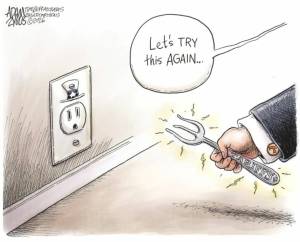
I think this is more than a retelling of the story of Icarus, who flew too close to the sun. It also may be a Promethean tale of punishment for having stolen fire from the gods.
Toyota is not the only thief. Last week, I dropped by the annual Washington Auto Show, which is much like the extravaganza in Detroit, only smaller. I wanted to get a sense of whether the rumors of a U.S. automaking renaissance might be true — and indeed, both Ford and General Motors put on impressive displays.
There was lots of excitement about the not-quite-here-yet Chevy Volt, a plug-in hybrid that will run almost exclusively on electricity — but there was also a buzz about the Nissan Leaf, an all-electric hatchback that will make it to the showrooms first. Ford’s array of state-of-the-art automotive engineering was impressive — the Fusion, the Escape — but there were bigger crowds checking out the wares of the South Korean manufacturers, especially Hyundai. The Koreans are doing what the Japanese once did — offering more features for less money — and they seem to have solved the quality-control problems that once plagued both Hyundai and Kia. For the next decade, they are my candidate to eat everybody else’s lunch.
But back to Prometheus: No matter what company from what country, when you looked under the hood you didn’t see a carburetor. Nor did you see an air cleaner, a distributor or any of the other parts that backyard mechanics of a certain age will fondly remember.
Automobiles used to be mechanical devices. Now they are collections of mechanical parts that are told what to do by computers. In most cars, the gearshift, pedals and steering wheel are nothing more than proxies for electronic controls. When something goes wrong with a car, you don’t start by opening the hood and unbolting pieces from the engine one at a time, the way we used to. You plug in a reader device and ask the vehicle what its problem is.
Technology has made automobiles much safer, more efficient and less damaging to the environment. But a computer is only as good as its software. Some experts believe that Toyota’s acceleration problems may actually be caused by faulty programming, not a faulty pedal. And the brakes on the Prius, which are used not just to stop the car but also to recharge the hybrid’s battery, have already undergone one software rewrite, according to The Wall Street Journal.
Toyota’s competitors should go easy on the gloating. Their cars are fly-by-wire, too, and thus equally at the mercy of information-age technology — the fire we purloined from Olympus. Raise your hand if you think it’s a great idea to make our cars precisely as dependable and problem free as, gulp, our personal computers.
Eugene Robinson is a Washington Post columnist. His e-mail address is eugenerobinson@washpost.com.