Bothell man breaks 40-year-old record for biggest largemouth bass
Published 8:05 pm Wednesday, August 17, 2016


A top executive with the Bass Anglers Sportsmen’s Society visited Washington a number of years ago, promoting the big, national, organization and bass fishing in general. Fully aware, of course, that a majority of our sport fishermen/women much preferred chasing salmon, steelhead and trout over that funny green fish so beloved by anglers in most of our other states, she hung the title “a bass-ackward part of the country” on the Pacific Northwest while speaking in the Seattle area.
She was semi-serious.
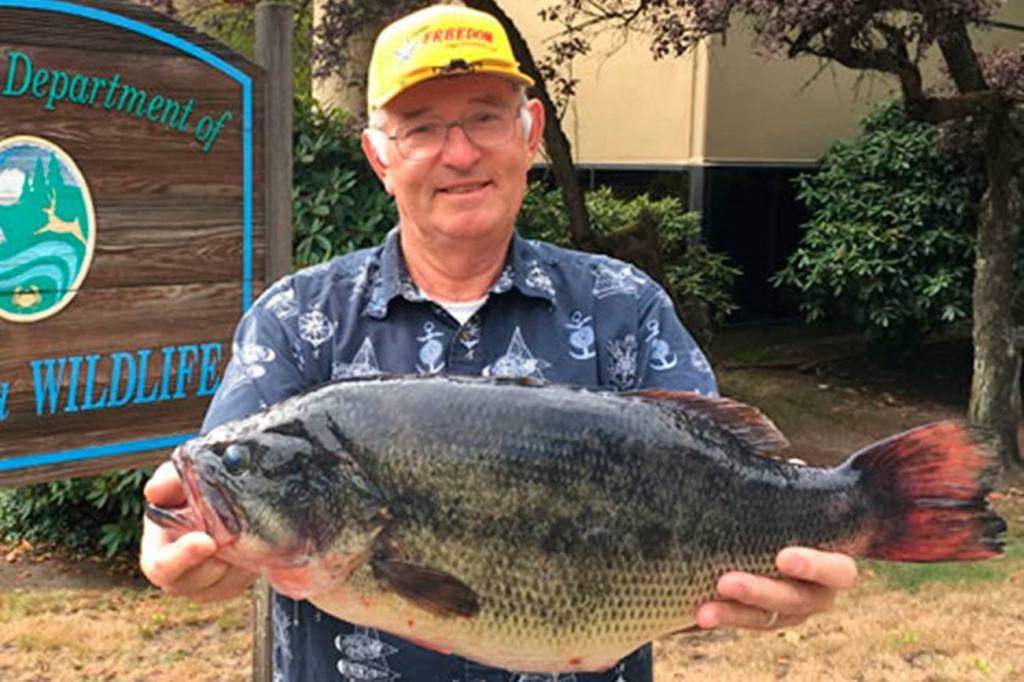
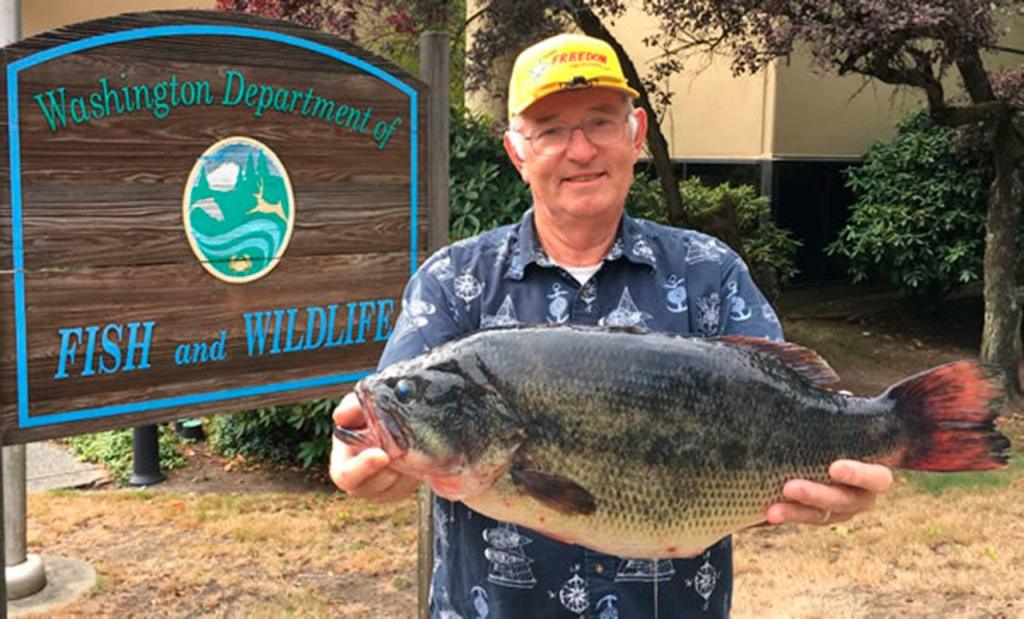
But even as steeped in the salmonid mystique as we are, we can still fully appreciate the breaking of a state bass record set way back in 1977, because it would have to be a huge fish to accomplish what some good bass fishermen thought might never happen. And it was, indeed, an awesome largemouth caught early last week — 12.53 pounds, 20 inches in length and with a girth of 22.5 inches. It destroyed the previous record of 11.57 pounds, caught nearly 40 years ago in Banks Lake.
Bill Evans of Bothell caught the monster bass Aug. 8 in Lake Bosworth, a small lake about two miles south of Granite Falls and a popular opening-day trout water. Evans is a veteran of four decades of bass fishing but moved here a few years back and only broke out his tackle this summer. He fished several lakes in the area; last week being his first trip to Bosworth.
The lucky lure was a 5-inch Strike King Shim-E-stick, wacky-rigged on a 1/0 hook. The Strike King folks tout the plastic worm as a good alternate to sinking stick bait-type lures, and Curt Kraemer of Marysville says “wacky-rigged” means simply hooked part way down the worm to give it more of an off-center, erratic movement.
Kraemer is a retired state Fish and Wildlife Department biologist and an expert fisherman. He says he was a little surprised that the record-breaker came out of Bosworth, but not that it was a Bosworth-type lake.
“There are a number of lakes of that nature, usually small, in our area which could hold a bass that was probably 12 or 14 years old,” Kraemer says. “They have a lot of structure and aren’t fished as heavily as, say, Banks Lake or Potholes Reservoir. A lot of them have motor restrictions which also tends to cut down the fishing pressure, allowing a largemouth to grow to that size without being caught.”
He says a few lakes in this area which would fit the Bosworth model might include any of the seven-lakes group northwest of Marysville, especially Lake Ki; Lake Armstrong, north of Arlington; Lake McMurray, on Highway 9 between Arlington and Mount Vernon, and others.
A release from the WDFW says Evans found Lake Bosworth on the agency’s Fish Washington feature available on the department’s website. The map-based webpage provides access to fishing advice and videos, as well as information by county and fish species for lowland lakes, high lakes and marine areas.
Lakes to reopen; think perch
Lake Washington and Lake Sammamish will reopen to fishing for trout and other game fish on Sept. 1 after having been closed to protect depressed coho salmon runs. Managers have decided the fisheries will not impact coho.
Lake Washington opens just in time for the very popular late summer/early fall yellow perch fishery, colloquially called the “perch pull.” There are no limits on perch, so autumn offers the opportunity to put a nice package of fillets in the freezer, of what is deemed one of the best freshwater table fish in the state.
State biologist Danny Garrett is a warmwater-species specialist with WDFW and he hosts a good video produced by the agency on yellow perch fishing. Go to the WDFW web site and scroll down to the Fish Washington logo, click to see how-to fishing videos, click, then click on “other” and scroll down to yellow perch.
Garrett uses Lake Washington near the I-90 bridge as his demo fishery, but perch are available around most of the lake’s shoreline, most often at the edge of weed growth which offers escape from predators. The weed line is crucial. A good sounder is a big help, but the lake is clear enough to be allow you to find weeds visually and follow them out to where they disappear into deeper water. Garrett says the fishery is fun and available to those with only small boats or inflatables because you can usually find decent perch populations not far from launch sites.
Use a light spinning rod and reel with 4- to 6-pound test line. If you’re familiar with a bass fisherman’s “drop shot” rig, that works great with a small plastic ‘crawler at the hook, in white, brown or green. Or tie a quarter-ounce weight to the end of your line and, using three-way swivels, put two 6-inch droppers at 1-foot intervals above the weight, armed with a #6 bait hook and a piece of worm. A small crappie jig tipped with a piece of worm will also work , and some perch fishermen swear by a triangular piece of skin/flesh cut from the first perch taken. Cast to the weed line, keep it close to bottom, and bring it back slowly, ready for the light tap that signals a take.
The right depth varies, depending on water temperatures, but a good average depth would be 15 to 20 feet or so. These are school fish, so keep moving until you find a bunch, then anchor and work ‘em over. Perch are lousy swimmers and won’t move far to a bait, so keep it slow and on bottom.
There are launch ramps at a number of places around the lake. Garrett used the Newport Marina as his base for the video, but there are ramps at Magnuson Park (Sandpoint), the bottom end of the Sammamish River just before it enters the lake, Kirkland, and others.
Garrett says yellow perch in most of our lakes tend to over-populate and are an underutilized resource, so take as many as you want to fillet, with a clear conscience.
And speaking of filleting your catch, the video does a particularly good job showing how to accomplish the chore. Be sure to notice the value of a very, very sharp fillet knife to the process.