Top planner has the inauguration all mapped out
Published 2:30 am Thursday, January 19, 2017
By Michael E. Ruane
The Washington Post
WASHINGTON — The big man in the dark suit and the size 13 cowboy boots stands behind the lectern that serves as a desk and checks his laptop.
He has briefed his chief veterinarian and is preparing to go meet a local bank official. En route, he will get the lowdown on tents, trailers, “chemical latrines” and the blue dots being painted along the parade route.
He is courtly, 6-foot-3 and a former professional tuba player. A protocol “geek,” he admires Shakespeare and cherishes the role of ceremony in civic affairs.
On a whiteboard in his office, he has written: “20 Jan … Sunrise 0723 Sunset 1716 …”
Finishing at his desk, he asks, “Are we ready to go?”
On Friday, Michael Wagner, 58, will participate in his 11th presidential inauguration. His first was as a high school musician at Richard M. Nixon’s raucous second in 1973.
This time, he is the chief planner for the Defense Department and the main coordinator with the inauguration committees of Congress and President-elect Donald Trump.
Although many are new to their inaugural tasks, Wagner is not. He’s “the old guy who doesn’t get reassigned every two to three years,” he said.
He remembers when the inauguration was on the east side of the Capitol, rather than the west side, as it is now. He recalls when security was casual and Washington seemed a more innocent and provincial town.
He has seen what works and what doesn’t, and he calls himself “the elephant that never forgets.”
The inauguration involves thousands of people, marching bands, horses, bomb-sniffing dogs and a Conestoga wagon, among other things.
There are medical tents, and warming tents, as well as a 1,523-person honor cordon of military personnel lining the Pennsylvania Avenue parade route. (The blue dots on the street show the service members where to stand.)
There are VIPs and escorts and drivers and a deep-voiced U.S. Navy announcer for the swearing-in. There are bleachers and bathrooms and the parade.
And there will be pomp and solemnity.
Wagner, based in an office building in Southwest Washington, doesn’t have to make all this happen. But he is key to putting it together and bent on ensuring that it comes off well.
“What ceremonies and protocol do is they give you a language,” he said in an interview this month. “They give us, as a people, a language in which to talk about [and] accomplish … transition.”
Be it a military change of command, a funeral or an inauguration.
“Having that language and understanding how to go about that process of transition, whatever that transition might be, not just inauguration, to me, that’s fascinating,” he said.
•
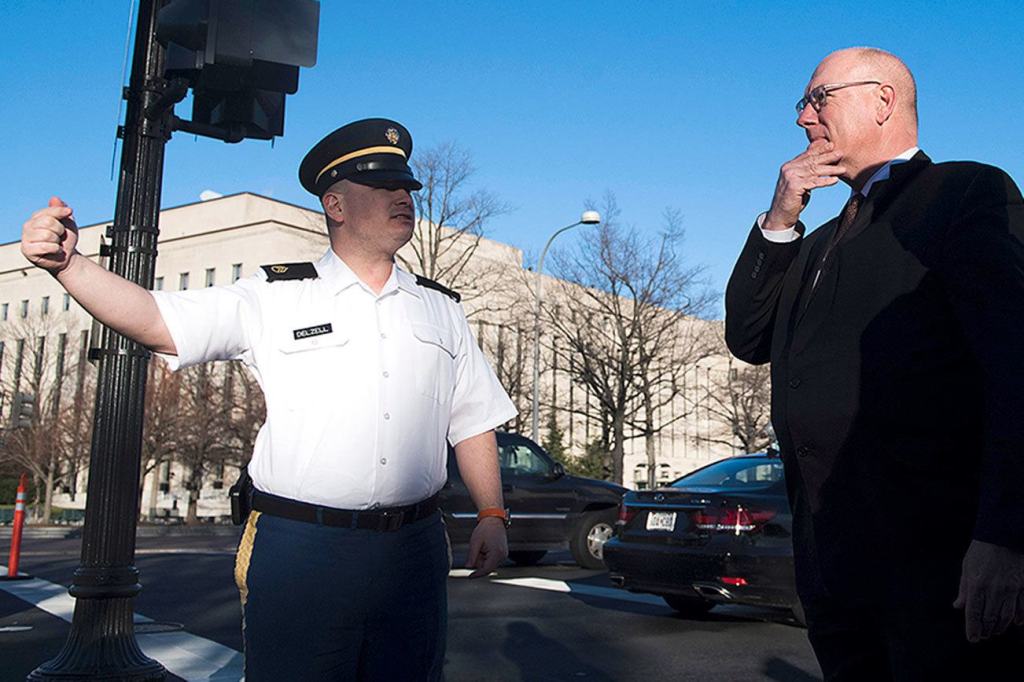
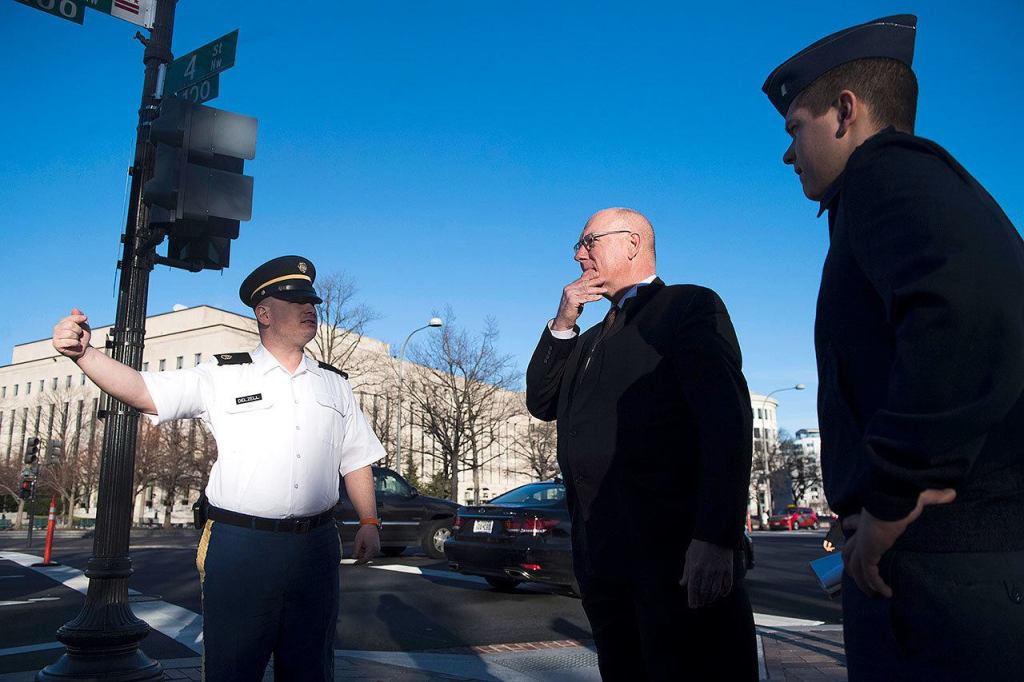
The big military van pulled over at L’Enfant Promenade, and Army Staff Sgt. Christopher Delzell gestured toward the green fire hydrant across the street.
Delzell is Wagner’s permits guy, the person in charge of securing permission from various agencies for things like tents and trailers.
“Talk us through,” Wagner said as he sat inside the van with five other staffers.
Delzell explained that this is the area where parade horses will be assembled. “We’re good to go on all our permits here,” he said.
Except, possibly, for water.
If local water is going to be used for the horses, “that’s going to be a different permit,” he said. “We need to determine where the source of the water is… . Are we going to be tapping into the water hydrants?”
Wagner said the question should be answered by the president-elect’s inaugural committee, which promised logistical support for the horses.
The van moved on, making stops around the Mall and the parade route, as Wagner was briefed on what was being placed where — from generators to bleachers to a scissors lift.
One of the last stops was at the Bank of America office at 15th Street and Pennsylvania Avenue, a block from the White House on the parade route.
Wagner wanted to put an 8-by-20-foot trailer right outside and wanted to make sure the bank was okay with it. He spoke with bank official John Collingwood and inaugural consultant Frederick Ahearn on the sidewalk. “We wanted [to extend] the courtesy of making sure we talked to you,” Wagner said.
“Our ask is really to … tuck it in this space … as close to the building as is reasonable.”
Collingwood replied: “Whatever works for you guys.”
The group exchanged pleasantries, and Wagner and his staff returned to the van.
It was important to be good neighbors, he said. “We’re going to be back in four years.”
•
Jan. 20, 1973, was a cold, gray Saturday in Washington.
At the Capitol, Nixon was being inaugurated for his second term as president. At the Washington Monument, tens of thousands of protesters gathered to denounce him and the ongoing war in Vietnam.
And in a rear rank of a huge Fairfax County marching band, teenage tuba player Michael Wagner strode down Pennsylvania Avenue in the green and gold uniform of Fort Hunt High School. He remembers the rotten weather and the enormous size of the band — 1,976 high school students, in honor of the coming 1976 Bicentennial.
That was his first inauguration. He would have roles in 10 more.
He was away at Michigan State, majoring in music, when President Jimmy Carter was inaugurated in 1977 but was involved in every one after that, he said.
An accomplished musician, Wagner landed a job with the elite U.S. Army Band, “Pershing’s Own.” He took part in Ronald Reagan’s first inauguration in 1981.
He remembers meeting Reagan that year at an evening ceremony at the Lincoln Memorial.
Reagan walked among the band members, shaking hands, including Wagner’s. “I was a brand-new guy in the band,” he said. “I had been in the band eight months… . It was one of those, ‘Hey, this is real.’ “
In 1985, he prepared with the band for Reagan’s second inauguration, but the parade was canceled because of frigid weather. He marched in the parades of 1989 and 1993. In 1997, he was picked to join the Armed Forces Inaugural Committee that helped plan that inauguration.
In 2001, then-retired from the Army, he helped organize the opening inaugural ceremony for George W. Bush at the Lincoln Memorial. In 2005 and 2009, he helped with inaugural security. In 2013, he got his current job.
The biggest change in those four decades came with the 9/11 terrorist attacks. Since then, “the emphasis on security … has profoundly changed the way we do events like an inauguration,” he said.
“What in 1973, or 1985, or ‘97 would have been an inconceivable level of security precaution is now something that as a society we take for granted,” he said.
On Friday, Wagner will spend much of his time in a conference room at the Capitol, not far from the swearing-in ceremony overlooking the Mall. “I’ll have a radio and an earpiece in each ear,” he said. “And occasionally pick up the cellphone.”
“Things rarely go seriously wrong,” he said. “They’re well rehearsed. They’re well planned. Most of what I’m doing is listening, making sure that things are happening on the timeline.”
He can nudge things along, if necessary, but he won’t be following a script. “I know the plan,” he said.