Everett Transit, Community Transit will again consider merger
Published 6:17 pm Wednesday, April 22, 2026
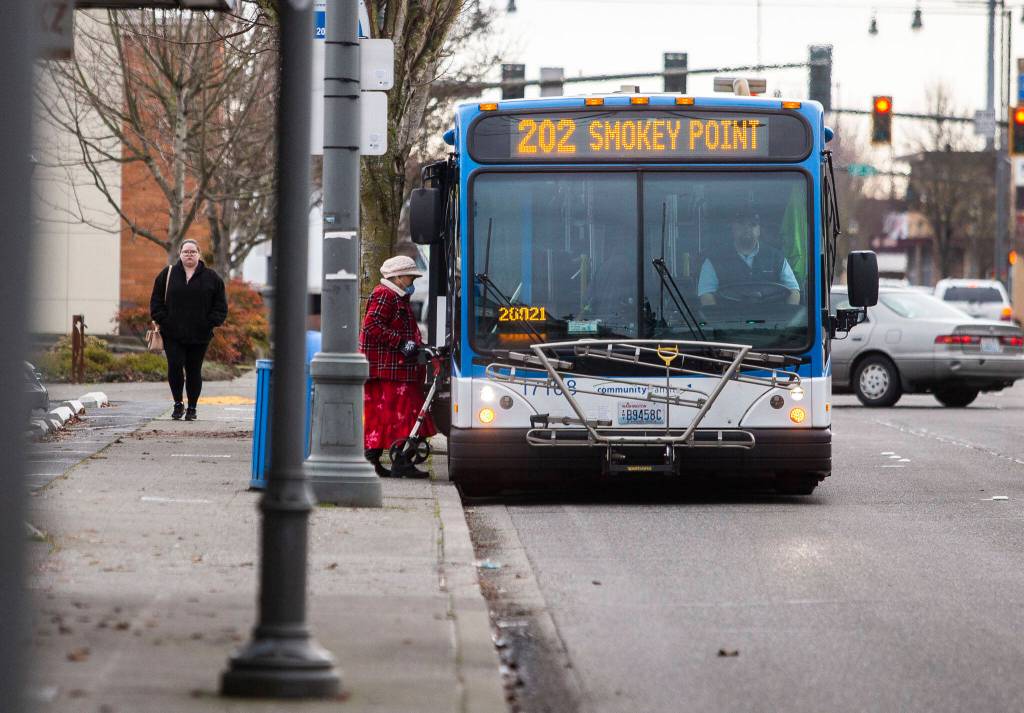
EVERETT — The city of Everett is once again looking into a possible merger of Everett Transit and Community Transit, Mayor Cassie Franklin told the city council on Wednesday.
If approved, it would mean Everett Transit would cease to operate; its services replaced by Community Transit with expanded borders and more revenue, thanks to that agency’s higher sales tax rate.
The consolidation of the two agencies could lead to more efficient and more frequent bus service within the city of Everett while increasing connections to other parts of Snohomish County, officials say. Detractors of the plan say the city would lose its relatively unique local control of its public transportation network.
Everett has studied the possible merger before multiple times, though it paused in recent years because other short-term projects were more pressing at both transit agencies, a 2024 document by Community Transit, Everett Transit and the city of Everett reads. Now that planning has resumed, Franklin said in an interview Wednesday.
The final decision will be up to the Everett City Council and Community Transit’s board of directors, a decision they are expected to make months from now after the two agencies work out more details of the potential merger.
The consolidation of the two agencies, an idea that has been floated by both city officials and Community Transit staff for years, no longer requires a public vote to approve it. That’s thanks to a 2025 state law, amended in 2026, that allows public transportation benefit areas like Community Transit to annex municipal transit agencies via an interlocal agreement approved by the boards of both governing bodies.
In May 2025, Franklin said during a council meeting that the city had not asked or advocated for the state legislation allowing for transit mergers without a public vote. But now that the tool is in place, she plans to use it and recommend that the city council vote on the issue, Franklin said Wednesday, not the public.
“That’s what elected representative government is about. We were elected to office to make these decisions,” she said. “So I will be working to put together a package that I can recommend to the council and that I hope the council ultimately approves.”
The merger could mean a significant sales tax increase for Everett residents. Everett Transit collects a 0.6% sales tax to fund its operations; Community Transit collects 1.2%. If it goes forward, it would bring the sales tax rate in Everett up from 9.9% to 10.5%.
That increase in funding, however, could pay for an increase in transit service. In 2021, Everett and Community Transit agreed to form a committee to study the effects of consolidating the two transit agencies. They worked together between 2022 and 2023 to come up with a plan that called for a significant increase in bus service, including five new bus routes in the city as well as higher frequency and more nighttime buses.
That plan will need updating and revision over the coming months, Franklin and Community Transit CEO Ric Ilgenfritz said, as years have passed since it was created and Community Transit has learned lessons about how best to connect to light rail, thanks to the opening of the Lynnwood Link extension in 2024. But the broad goal of consolidation would be to increase service within the city of Everett while also improving connections to and from nearby cities, Ilgenfritz said.
“This is literally a perfect example of how we can join forces and perform more strongly together on behalf of the people of the county,” he said Wednesday.
Franklin said Wednesday that she is in support of the merger.
“Regional transportation connectivity is a necessity in today’s world,” she said. “Residents in Everett want to get to places in and outside of Everett. They don’t want to just stay in the boundaries of the city, they go all over the place and beyond it. And we need to support them in doing that.”
The coming arrival of Sound Transit’s Link light rail was also a major consideration, Franklin said. Everett Transit can only grow so much. It is limited to collecting a maximum of 0.9% in sales tax per state law; Community Transit can bring in a maximum of 1.2.% in sales tax. (Everett Transit, in its recently-approved long range plan, said it hoped to go to the voters for a 0.3% sales tax increase in 2030 via a ballot measure to fund the expansion of its services over the next 20 years).
Steve Oss, the president of Amalgamated Transit Union 883 for over two decades — the union that represents Everett Transit’s drivers, inspectors and maintenance workers — opposes consolidating the two agencies.
In an interview Wednesday, he said the benefits of keeping the local transit agency include the flexibility to provide specialized shuttle services, temporarily remove fares and send buses to support other operations. Everett Transit often provides shuttles to local events like Sorticulture. Just last year, the mayor made Route 12 free for six months in response to the closure of Fred Meyer along Casino Road to help residents reach other grocery options.
“When we have our own transit agency, it only takes a call from the mayor to say ‘Let’s get a bus to go do this or that,’” Oss said.
He opposed the fact the citizens wouldn’t have a direct say in the matter.
“If the citizens want to vote and say ‘We would rather have a merger and have our sales tax go up,’ I’m all for that. By golly, let’s have a vote and let’s do it that way,” Oss said. “But to do it the way it’s being done, that’s not right.”
Oss was also concerned about a potential loss of transit service in Everett due to the merger. He said that Community Transit’s service focuses too much on connections between cities, rather than transit service within cities.
But any consolidation plan would call for an increase in bus service within the city of Everett, Ilgenfritz said, not a decrease.
“There is no scenario here where service in Everett decreases or gets worse,” Ilgenfritz said. “It only gets better.”
Everett’s paratransit service is also a matter of consideration in the plan. Federal law requires transit agencies to provide paratransit services to individuals with disabilities who can’t navigate traditional fixed-route bus systems on their own.
Everett Transit provides the door-to-door, on-call service to more people than it’s required to — the agency serves those with disabilities as well as all residents over the age of 65. Community Transit’s DART paratransit service does not provide services for those over 65 without a disability.
What exactly paratransit services would look like if a merger takes place is still the subject of negotiation, Franklin said.
“I think any time you have a coming together of organizations like this, you have a rich opportunity for learning and leveraging the strongest parts of each organization’s culture,” Ilgenfritz said of Everett Transit’s paratransit service. “That’s something we would want to do in this case.”
A representative from Everett — either a city council member or the city’s mayor, yet to be decided — would gain a seat on the Community Transit board if consolidation is approved.
The financial aspects of the deal, like many of its other details, still have to be worked out. Everett has a number of bus bays, transit centers and other infrastructure Community Transit would likely have to compensate the city for. The city also has about $34 million worth of transit dollars in its fund balance, city budget documents show. Franklin said the money the city receives from the merger could go toward parks, infrastructure or other improvements the city needs.
Ilgenfritz said the transfer of assets between Everett and Community Transit would also be closely watched by state and federal regulators.
“It’s a very audit-rich environment,” he said.
Members of ATU 883 have protections under federal law that assures they will remain employed if the transit agency is annexed, Oss said. But he has concerns about other staff at Everett Transit that are not represented by a union.
Ilgenfritz said he wants as many people as possible from Everett Transit to join Community Transit in the event of a merger, to gain the institutional experience the staff members have while also filling the need for more employees. (The agency would likely need more drivers than Everett Transit currently has because of the plans to increase service).
“That’s my goal here, is to make sure we make that transition as smooth and respectful as possible and open our arms to welcome people into our organization,” Ilgenfritz said.
City-run transit agencies are relatively rare in Washington State. Only six currently exist, according to the Municipal Research and Services Center, a nonprofit that provides information about local governments in the state.
The vast majority of transit agencies in the state operate as public transportation benefit areas, which serve specific areas within counties. Community Transit serves all cities and towns in Snohomish County — except Everett — as well as the Tulalip Reservation and a number of unincorporated areas.
Oss said that Everett Transit is “a real jewel” for the city’s residents and that it allows the city to do things a larger transit agency couldn’t.
“I was born and raised here in Everett. My parents were born and raised here, my grandparents were born and raised here,” Oss said. “I feel some ownership here. We can do better. I don’t want to see it just taken away from us.”
Franklin said that through annexation, Community Transit could provide more service than Everett Transit would be able to on its own.
“Better transit service is necessary,” Franklin said. “And I absolutely believe it’s achievable with consolidation. That’s why we’re exploring it.”
Franklin said Wednesday the two agencies hope to have a final version of an interlocal agreement ready for a vote by the end of the year. Public engagement processes will take place over the coming months, Ilgenfritz said. If the agreement is approved by the city council and the Community Transit board of directors, it would likely take years before it is fully implemented.
Will Geschke: 425-339-3443; william.geschke@heraldnet.com; X: @willgeschke.