Everett council approves utility tax increase
Published 10:30 am Thursday, May 28, 2026
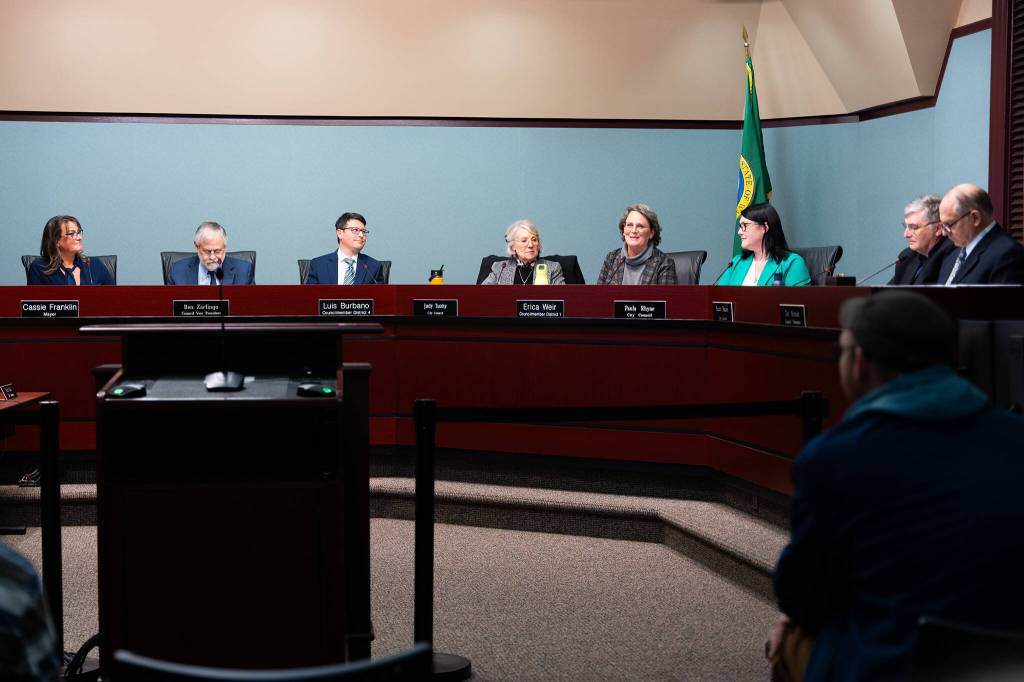
EVERETT — The Everett City Council approved an increased utility tax rate on Wednesday that will bring money into city’s general fund as it faces the need to close a financial gap in the coming year.
The newly approved 12% utility tax will replace an existing 6% “payment in lieu of taxes” fee levied on the city’s water and sewer utility — which operates essentially identically to a tax — that was first implemented in 1983.
An official at a water and wastewater district based in south Snohomish County warned the city council Wednesday that the tax increase could face a legal challenge, though Everett’s attorneys said it had been carefully vetted by lawyers inside and outside the city.
The average ratepayer will pay an extra $12 per month on their utility bills due to the increase, city staff said, and the increase will impact all of the city’s utility customers. Everett supplies water services to about 670,000 people and sewer services to about 180,000 people across Snohomish County.
The tax increase is expected to raise about $7.5 million toward the general fund budget in 2027.
City officials had floated the idea of increasing the city’s utility tax rate as a way to shore up funding and close as much of a looming $15 million deficit in the 2027 budget as possible. The idea was raised at a council retreat in January and staff announced the proposal to increase the tax at a committee meeting in March.
The council voted 6-0 to approve the measure Wednesday afternoon. Council member Ben Zarlingo wasn’t present.
Council members said the measure would reduce the need for yet another year of deep cuts to general government services due to an ongoing structural deficit.
“Nobody wants more taxes, I know that, but also that’s what pays for the services that we all enjoy,” council member Erica Weir said. “It’s a tricky one.”
Council member Judy Tuohy said she struggled with the measure, calling the tax “regressive.” She also said the city should have taken more incremental steps to increase the utility tax over time.
“Yes, we haven’t raised the rate since 1983. I say shame on us for not being businesslike and reasonable,” Tuohy said. “I think we should take slower steps as we go, as inflation takes, but we didn’t.”
Higher water and sewer rates that will pay back the costs of the utility tax go into effect Aug. 1, the ordinance reads.
Joe Bennett, the general counsel for the Alderwood Water and Wastewater District, said at Wednesday’s meeting that the tax is a “pure case of taxation without representation” because it would affect ratepayers in that water district. The Alderwood district purchases wholesale water from Everett and provides service to about 300,000 people in south Snohomish County, outside of the city of Everett’s boundaries.
“If adopted, Alderwood will consider all of its legal remedies to oppose this unlawful tax,” Bennett told the council.
The Washington State Supreme Court has previously upheld the ability of cities to levy taxes on revenues earned by water and sewer utilities from providing services to both resident and nonresident customers. In 1989, utility customers outside of Vancouver, WA sued the city, arguing that its utility tax violated the Constitution and amounted to taxation without representation because they were not able to vote in the city’s municipal elections.
The state Supreme Court disagreed, ruling that nonresidents had proper due process protections via the opportunity to participate in public meetings held by the city council, and that utility customers outside of the city receive “both direct and indirect benefits from the City as a result of the City’s financial resources, its bonding capacity and its willingness to provide utility services to individuals residing outside the city limits,” the court wrote in its decision.
But Bennett argued Wednesday that the state Supreme Court has recognized a distinction between charging wholesale customers outside of city limits instead of individual customers within city limits. A separate 1978 State Supreme court ruling found that the city of Seattle could not pass on a business and occupation tax to water districts outside the city limits by way of water rates, with the court stating that “such taxes must be exacted from the beneficiaries thereof, that is, the citizenry of the City of Seattle.”
“It is not difficult to imagine an experienced plaintiff’s attorney pursuing a class action lawsuit on the behalf of the tens of thousands of ratepayers who would be burdened by this tax,” Bennett told the council at the meeting.
Ramsey Ramerman, Everett’s deputy city attorney, said at Wednesday’s meeting that the city attorney’s office had worked on the ordinance for months and engaged with outside counsel regarding potential legal challenges.
“We’ve taken all that into account in drafting and preparing this,” Ramerman said.
He also said that the Alderwood water district has already been paying Everett’s existing 6% “payment in lieu of tax” fee.
“I think it’s important to note that the utility does not pay property taxes and it is not subject to the typical B&O tax, so the utility tax is meant to account for that, and account that the city subsidizes the utility through its police service and everything else property tax normally pays for,” Ramerman said. “The courts have looked at this issue and recognize that it doesn’t violate the principle of taxation without representation.”
Everett’s structural deficit has plagued its general fund budgets for more than a decade. City staff have cited a 1% cap on annual property tax increases as a primary factor for the continuing need to make budget reductions. Everett went to voters for a property tax levy lid lift in 2024 to shore up funding for city services, but it failed. Thirty-one employees then lost their jobs and library hours were cut to balance the $12.6 million gap in the 2025 budget.
Without finding new revenue to plug the budget gap, city staff argued that Everett would have to cut back further for its services. Exact decisions on what could be cut have not yet been made, but areas that may be affected include permitting, the city’s municipal court and its information technology department, said Jennifer Gregerson, the city’s government affairs director, at a May 20 council meeting. Cuts to those could increase permit timelines, reduce the number of cases being brought to court and open up the city to cyber security risks, she said.
As utility rates increase, city staff said they will take steps to expand rate assistance programs. By September, the city hopes to increase its annual maximum benefits for people enrolled in its low-income bill assistance program from $700 to $875, public works director Ryan Sass said at a May 20 meeting.
Everett is also hoping to meet with a nonprofit to consider expanding the eligibility of the bill assistance program, which is currently limited to individuals who earn less than 200% of the current federal poverty level. (For one person, that’s about $2,660 per month; for a family of four, about $5,500 per month).
By the time the next rate ordinance comes to the city council in 2028, the city will evaluate whether it could implement a “good neighbor” program that allows customers to round up their bills to support households in need and also hopes to develop a new low-income assistance program specifically for renters paying utility bills, Sass said May 20.
Correction: A previous headline of this article incorrectly stated that the city increased the utility tax by 6%. The city increased the utility tax by 6 percentage points, from 6% to 12%.
Will Geschke: 425-339-3443; william.geschke@heraldnet.com; X: @willgeschke.