Patterson: M’s lack of homegrown talent is a big concern
Published 1:30 am Saturday, October 14, 2017


Related: A look at the wins above replacement data for playoff teams from 2012 to 2017
Last week I was listening to the Major League Baseball playoffs on the radio, Game 1 between the Houston Astros and Boston Red Sox in the American League Division Series.
During the pregame the broadcasters were listing the lineup for the Astros, who finished 23 games ahead of the Seattle Mariners in first place in the AL West. Leading off, George Springer in center field. Batting second, Alex Bregman at third base. Batting third, Jose Altuve playing second base. Hitting cleanup, Carlos Correa at shortstop.
As I listened to those star names, the players most responsible for Houston being the highest-scoring team in the majors, being rattled off, a thought flashed across my head:
Weren’t all of those players homegrown?
Indeed, some quick research revealed that all four of those players were either drafted or signed by Houston, and every second of their professional baseball careers have been played for the Astros organization.
That got me to thinking. How much of the core of Houston’s team is made up of homegrown players, players who were developed by and broke through with the Astros?
The answer? Most of it. I headed over to Fangraphs.com and checked out the top 10 Astros in 2017 based on wins above replacement (WAR), a calculation designed to evaluate a player’s total contributions to a team’s success relative to a player who could be acquired for essentially nothing (major-league fringe players). Of those top 10 Houston players, seven spent either all or part of their time in the minors in the Astros system, then made their major-league debuts with Houston.
Between them, those seven players — Altuve, Correa, Springer, Bregman, utilityman Marwin Gonzalez and pitchers Lance McCullers and Dallas Kuechel — accounted for 30.6 wins above replacement. The generally accepted number of games a team made up completely of replacement-level players would win in a 162-game season is 48. So those seven players alone would have gotten the Astros a better record than this year’s 78-84 Mariners.
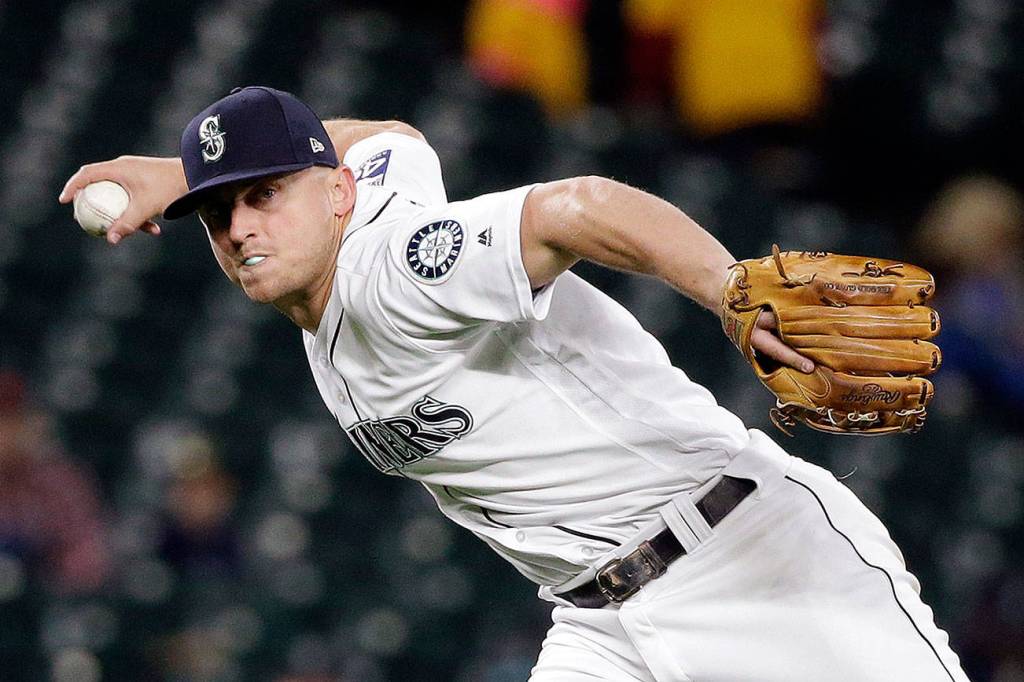
And that’s a considerably different method of roster construction compared to the Mariners, whose biggest-name players (Robinson Cano, Nelson Cruz) were signed as free agents. Looking at Seattle’s top-10 players by WAR, just three came up with the Mariners, those being pitcher James Paxton, catcher Mike Zunino and third baseman Kyle Seager, who between them accounted for 11.7 WAR.
When compared to its best division rival, Seattle’s core homegrown players contributed about a third of what Houston’s core players did. The difference there (18.9) makes up more than 80 percent of the 23-game difference between the teams.
So I got to wondering. How does the Mariners’ core compare to all of this year’s playoff teams? It sure seemed like this year’s playoff teams were rife with All-Star caliber homegrown talent. Dustin Pedroia, Mookie Betts and Xander Bogaerts with Boston. Clayton Kershaw, Corey Seager and Kenley Jansen with the Los Angeles Dodgers. And so forth.
What did I find? Doing the math this year’s 10 postseason participants averaged 6.2 homegrown players and 23.2 WAR among their top 10.
Seattle hasn’t made the playoffs in 16 years, and the team in this year’s playoffs that most resembled the Mariners’ predicament was the Colorado Rockies, who ended a seven-year postseason drought by reaching the wild-card game. How did the Rockies end their stretch of futility? With seven homegrown players accounting for 22.4 WAR.
Based on this measure, the Mariners have a lot of work to do to build a playoff team. To match the average playoff team Seattle would need to come up with three four-win homegrown players, guys who are worthy of All-Star consideration. To match the worst of this year’s playoff teams (the Chicago Cubs and Arizona Diamondbacks, each with five homegrown players for 16.4 WAR among their top 10) the Mariners would still need to produce two two-and-a-half-win homegrown players, or a pair of solid starters.
Unfortunately for Seattle, those type of players don’t appear to be arriving in 2018. The Mariners are thought to be in the bottom third among baseball’s current minor-league systems, and top-rated prospects like Kyle Lewis and Nick Neidert are thought to be at least a year away. Part of this could be addressed by Felix Hernandez returning to form, but whether that ever happens is in considerable doubt.
So does that mean the 2018 Mariners are doomed to another year of missing the playoffs? Not necessarily. I went back and looked at the cores of every playoff team since 2012, when Major League Baseball added a second wild-card team in each league. The six-year average is 5.3 homegrown players and 19.0 WAR among the top 10, so maybe 2017 was just a spike in the data. There are teams that made the playoffs with fewer contributions from homegrown players, as 10 of the 60 playoff qualifiers between 2012 and 2017 received fewer than 11.7 WAR from homegrown players among their top 10, with the 2012 Oakland Athletics bottoming out at just one 1.6-win player. So it can be done.
But it’s also against the odds. General manager Jerry Dipoto and manager Scott Servais arrived prior to the 2016 season preaching the importance of player development — heck, Servais’ background wasn’t in managing, but in player development. If the Mariners want to end their long crawl through the postseason-less desert, the numbers suggest they’re going to need those player-development skills to start paying off.
Follow Nick Patterson on Twitter at @NickHPatterson.