Editorial: State of city address makes case for Everett’s future
Published 1:30 am Saturday, March 23, 2024


By The Herald Editorial Board
“State of” speeches by city mayors and other local government officials are a bit like the family year-end letters sent out to update friends and loved ones on the past year’s accomplishments, milestones and other news, except that rather than Christmas cookies, hors ‘doeuvres are passed out.
And rather than providing an account of the athletic and academic accomplishments of Emma and Ryan, state of the city and budget announcements do serve a purpose in updating the community on what got done, challenges that remain and what to look forward to. Recent examples:
Last September, County Executive Dave Somers outlined a proposed budget that reflected the responsibilities and stewardship to be met in addressing law and justice, roads and transportation and economic projects, including the Sustainable Aviation Fuel research center at Paine Field.
At the start of February, Marysville Mayor Jon Nehring, in his state of the city address, updated the community on the city’s ongoing efforts regarding public safety, business growth and coming developments in transportation and infrastructure.
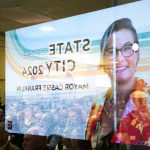
And Everett Mayor Cassie Franklin, in her state of the city speech Thursday afternoon, addressed similar topics, using a wing of the Everett Mall and a few vacant store fronts for sponsor displays. The speech’s new venue allowed Franklin — in a nearly hour-long speech — to highlight development and other plans throughout the city, including the mall itself, which she said plans to announce a new family entertainment tenant soon, among other redevelopment plans at the mall as it marks its 50th year.
Challenges
Upfront about the city’s challenges with crime, addiction and behavioral health, housing supply and homelessness, Franklin outlined some of the responses to those issues.
With a new police chief with 25 years of experience, John DeRousse, Franklin said, is leading a department that has added 18 officers in recent years to a department of more than 220 full-time employees, including a new violent crime unit and continued partnerships with the Snohomish Regional Drug Task Force and the countywide mayors public safety coalition.
Franklin also provided an update on the Mayor’s Drug Crisis Task Force, launched earlier this year, that has assembled community members, business leaders, law enforcement, nonprofit agencies, health care providers and others who are working on a report and recommendations to be released later this year.
Franklin noted the growth in housing availability in the city, including more than 2,400 homes and apartment units built in the last five years, as well as 2,200 more in progress. Even so, nearly half of the city’s residents still must budget more than 30 percent of their income to housing, and for some that monthly payment exceeds 50 percent of income, even as the city faces increased population growth.
Addressing homelessness, Franklin celebrated the work of the community’s numerous faith-based organizations and nonprofits addressing those needs, and the city’s own Pallet Shelter villages near the Everett Gospel Mission and the new Faith Family Village for women and children. Two models of the shelters, built by Everett-based Pallet, were on display at the event.
The city’s Municipal Court is expanding its therapeutic court program and its diversion options, thanks to a $220,000 grant. As well, the city’s success with pairing social workers with police patrols, firefighters and the library, is better connecting individuals and families with options for treatment, shelter, health care and other services. A new program, Franklin said, intends to bring addiction treatment directly to those who need it, as well as counseling and peer support. And a new alternate response program offers a new option for responding to calls involving behavioral health issues, sending trained behavioral health specialists to calls rather than police or EMS responders.
Other highlights
On education, Franklin outlined recent investments by Everett and Mukilteo school districts in pre-K education and special education, a $20 million investment from the county in early childhood education, the city’s own $1 million investment of federal covid relief funds for a Housing Hope child development center, as well as early childhood programs at the Everett Station’s Bezos Academy and at Everett Community College, EvCC’s new resource center and library and WSU-Everett’s new partnership with Amazon to provide employee education programs.
Regarding the city’s arts heritage, this year also marks the 50th anniversary of the city’s 1 percent for the Arts program and its Arts Commission, as well as for the John and Idamae Schack Center, and new public arts commissions, including a new sculpture, “Aumangea” by Stuart Nakamura, and through a National Endowment for the Arts grant the land acknowledgment installation at the city municipal building by Tulalip artist James Madison.
On infrastructure, Franklin recapped improvements to a water system that supplies not only the city, but 75 percent of the county and the Tulalip Tribes, noting recent work, supported by federal grants to move a water line that also allowed restoration of salmon habitat at Chinook Marsh, southeast of Ebey Island; and upcoming work to replace the Edgewater Bridge on West Mukilteo Boulevard and a pedestrian bridge above Broadway to connect the EvCC campus and its new resource center.
On transit, Franklin touted clean-energy advancements in transit, including Everett Transit, which offers 19 electric buses with more on the way, and the connections that Sound Transit’s Link light-rail station in Lynnwood, set to open this fall, will offer throughout the county.
Opportunities
Franklin, noting the city’s milltown and resource-dependent beginnings, boasted of its transformation through aviation and a new focus on clean technology. Franklin mentioned the work of Helion and Zap in fusion power generation; MagniX’s electric engines; Eviation’s electric planes; ZeroAvia and its expected commercial sales of hydrogen-electric engines; TerraPower, working on nuclear energy and medical technology; and the county’s sustainable aviation fuel center.
The city is looking forward to the 2026 FIFA World Cup matches in Seattle, which offers an opportunity for Everett to host a Fan Zone for the World Cup, with public viewing of matches and other events.
And with the baseball season starting in just a few weeks for the Everett AquaSox, Franklin reiterated that she and the city council are committed to keeping the team in Everett by pursuing a new stadium for the High-A minor league team that meets Major League Baseball’s stadium requirements, either building a new stadium at its current location at Memorial Stadium or at a location downtown east of the Angel of the Winds Arena. State funding is secure for a public-private endeavor that will sustain and create new employment and tourism opportunities and ensure the city remains the sports and entertainment center of the county.
“State of the city” addresses are part update, part boosterism and part promise to do more and do better. As such, it’s an opportunity to inform the larger community on the work of local government.
It’s part of what city residents will have available to consider in the next few years as they are asked to approve, as outlined last week, an increase of the city’s property tax rate, likely this fall; and the future of both the city’s library and fire department and whether each will be merged with larger districts in order to tackle the city’s structural deficit.
Everett residents are being asked what they want their city to look like and what its priorities will be. That’s the case Franklin is making.
“These efforts and bold investments have led to so many great new beginnings,” Franklin said at the conclusion of her remarks. “Everett always has and always will be a place for innovation, for making important things, starting businesses as well as families; building homes and creating community.”