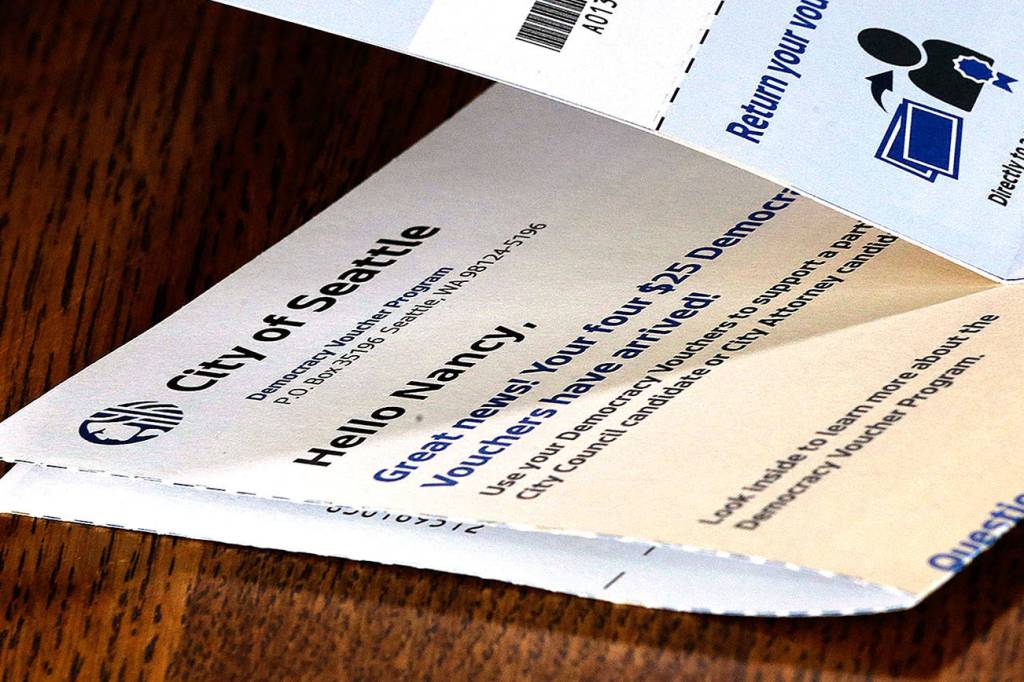
A Seattle Democracy Voucher. A judge has upheld the city’s voucher system as constitutional. (AP Photo/Ted S. Warren, File)

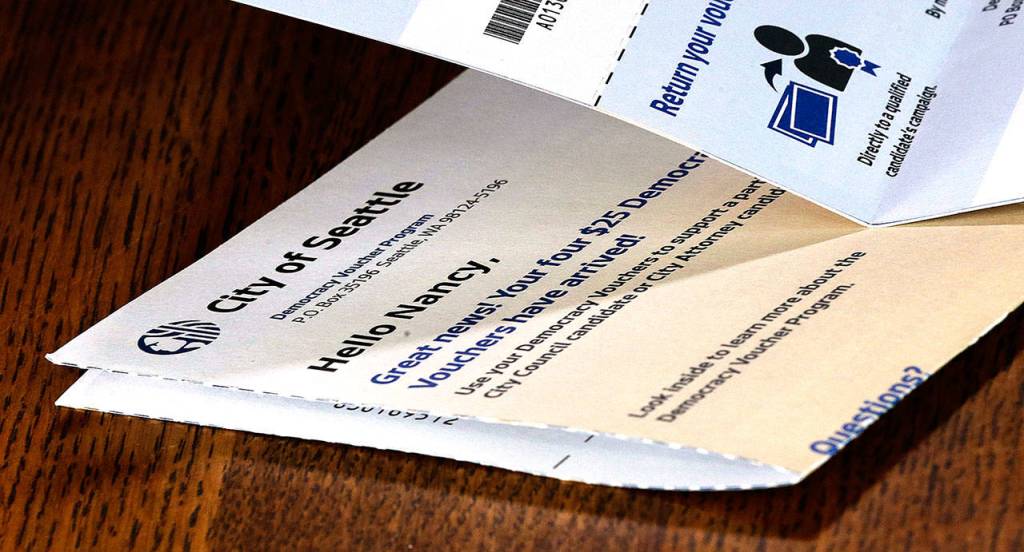
A Seattle Democracy Voucher. A judge has upheld the city’s voucher system as constitutional. (AP Photo/Ted S. Warren, File)

Judge upholds Seattle’s novel campaign finance vouchers

Voters get four $25 vouchers that they can sign over to candidates. It costs taxpayers $3 million.

  • By GENE JOHNSON Associated Press
  • Friday, November 3, 2017 1:03pm
  • Northwest

By Gene Johnson / Associated Press

SEATTLE — A judge has upheld Seattle’s first-in-the-nation voucher system for publicly financing political campaigns as constitutional.

In a decision late Thursday, King County Superior Court Judge Beth Andrus rejected a challenge brought by two local property owners who said the so-called “democracy voucher” program forces them — through their tax dollars — to support candidates they don’t like.

Seattle’s voters approved the program in 2015, and it’s being used for the first time in this year’s City Council and city attorney races. Under it, the voters taxed themselves $3 million a year in exchange for four $25 vouchers that they can sign over to candidates.

The idea is to counter big money in elections, help lesser-known candidates raise money to communicate their views, and to get more voters involved in politics.

The program is legal because the city has a reasonable justification for it, it doesn’t promote any particular viewpoint over any other, and it falls within the scope of public campaign financing allowed by the U.S. Supreme Court, the judge wrote.

“The City has articulated a reasonable justification for the Democracy Voucher Program,” Andrus wrote. “It seeks an increase in voter participation in the electoral process. … The Democracy Voucher Program is a viewpoint neutral method for achieving this goal.”

The Pacific Legal Foundation, the libertarian-leaning law firm which represented local property owners Mark Elster and Sarah Pynchon, will appeal, said attorney Ethan Blevins.

“This disappointing decision runs contrary to a long line of Supreme Court cases stating that the First Amendment allows each of us to decide what to say and what not to say,” Blevins said in a written statement Friday. “The Supreme Court has applied this rule to compelled speech and compelled subsidies of speech, like the tax at issue here. Our clients and Seattle property owners generally should not be forced to sponsor other people’s political views.”

But the U.S. Supreme Court has generally upheld the public financing of campaigns, within the limits of the First Amendment, saying that “public financing as a means of eliminating the improper influence of large private contributions furthers a significant governmental interest” — helping to eliminate corruption.

The ruling was welcomed by the city and by groups pushing to reduce the influence of big money in campaigns.

“This positive decision protects the city of Seattle’s ability to boost citizen engagement in local campaigns,” said Tara Malloy, of the Washington, D.C.-based Campaign Legal Center.

According to the city, the tax that raises money for the program costs the average homeowner $11.50 per year. Only a fraction of the city’s voters have provided vouchers to candidates, so there’s been more than enough money raised by the tax to cover the costs.

Candidates must qualify to receive the vouchers by collecting certain numbers of small-dollar contributions. The latest data from the program, updated Thursday, shows the candidates have redeemed more than 42,000 vouchers valued at more than $1 million.

City Council candidates Teresa Mosqueda and Jon Grant have each received and redeemed the maximum number allowed — 12,000, valued at $300,000.


Talk to us

> Give us your news tips.

> Send us a letter to the editor.

> More Herald contact information.

More in Northwest

The so-called “big, beautiful bill” that congressional Republicans approved in July included a total of $50 billion for the Rural Health Transformation Program. The money is meant to offset some of the expected damage to rural hospitals from the law’s steep cuts to Medicaid. (Olivia Vanni / The Herald)
Washington makes pitch to feds for $1B in rural health funding

The money was included in Republicans’ “big, beautiful bill.” The state’s goals include strengthening the rural health workforce and improving care in tribal communities.

Screenshot from the state Employment Security Department’s website at esd.wa.gov. (File photo)
Expected slide in WA unemployment trust fund balance could trigger new tax

Washington businesses would need to shoulder roughly $700 million in additional taxes… Continue reading

The Washington state Capitol. (Jerry Cornfield/Washington State Standard)
State Democrats mull imposing income tax on higher earners

The idea is brewing ahead of the 2026 legislative session. It would target those making above $1 million. The state is one of nine that does not tax wages.

Washington state Commissioner of Public Lands Dave Upthegrove speaks at a press conference on wildfire issues Monday in Tumwater. (Photo by Bill Lucia/Washington State Standard)
Climate dollars eyed to backfill WA wildfire funding

Washington’s lands commissioner, Dave Upthegrove, is on a mission to secure $60… Continue reading

Washington Gov. Bob Ferguson, left, shakes hands with Cowlitz Indian Tribe Chairman Bill Iyall after signing an executive order to improve the state’s relations with tribal governments on Wednesday. (Photo courtesy of Washington governor’s office)
WA governor moves to improve state consultation with tribes

A new directive expands tribal relations training for state workers among other actions. Tribal leaders voiced support.

New map tracks measles exposures across Washington

Afraid you may have been exposed to measles? Washington’s Department of Health… Continue reading

A combine at work in wheat fields in the Walla Walla region during 2018. (Washington State Department of Agriculture)
State halts rebates to farmers hit with fuel fees under WA climate law

Instead, a new online directory shows retailers who provide the farm fuel exemption by not imposing surcharges.

Washington transportation officials say a lack of funding means dollars intended for preservation and maintenance are the ones diverted to deal with emergency situations. Before (left) and after (right) photos of the mudslide and cleanup on State Route 20 following an Aug. 11 mudslide. (Washington State Department of Transportation)
‘Early stages of critical failure’: Outlook grim for road upkeep

Billions more dollars are needed for preserving highways and bridges, WSDOT says. The agency’s leader didn’t request more maintenance money for 2026.

Washington state Attorney General Nick Brown, seen here during a January interview, is sparring with members of Congress over the state’s immigration policy (Photo by Ryan Berry/Washington state Standard)
Washington AG pushing new law to protect workers from immigration raids

The proposal would require businesses to tell employees if ICE is coming to inspect company records in search of employees who are not legally able to work in the country.

A helicopter conducts bucket drops over the Bear Gulch Fire. (Olympic National Forest)
WA officials take stock as wildfire season winds down

With fall weather dampening wildland fire conditions in Washington, officials are beginning… Continue reading

WA’s food aid program for infants and mothers now funded through October

When the federal shutdown began Oct. 1, officials said money for the benefits could run out in a couple of weeks.

A different utility lines branch off in different directions from a utility pole along Railroad Avenue in 2024 in Skykomish. A bill proposed this year looked to add civil penalties for scrapyards that make deals for stolen copper used in telecommunication cables, but it failed to gain traction in the Legislature despite bipartisan support. (Olivia Vanni / The Herald)
Utilities and telecoms turn to WA lawmakers for help as copper wire theft surges

Legislators are looking at tougher penalties and new requirements for scrapyards.

Support local journalism

If you value local news, make a gift now to support the trusted journalism you get in The Daily Herald. Donations processed in this system are not tax deductible.