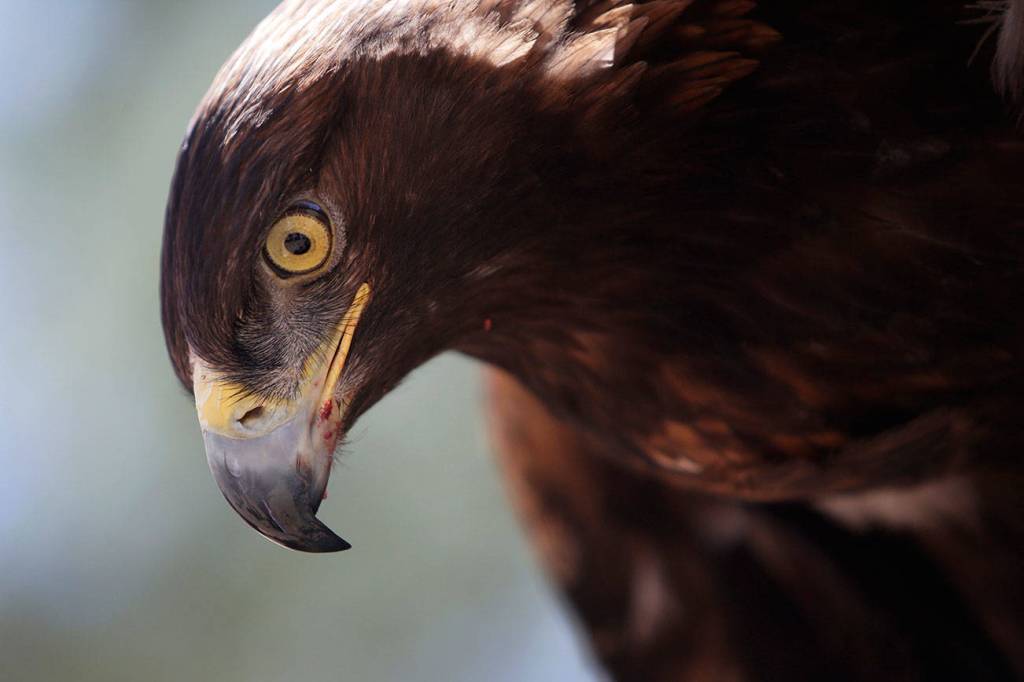
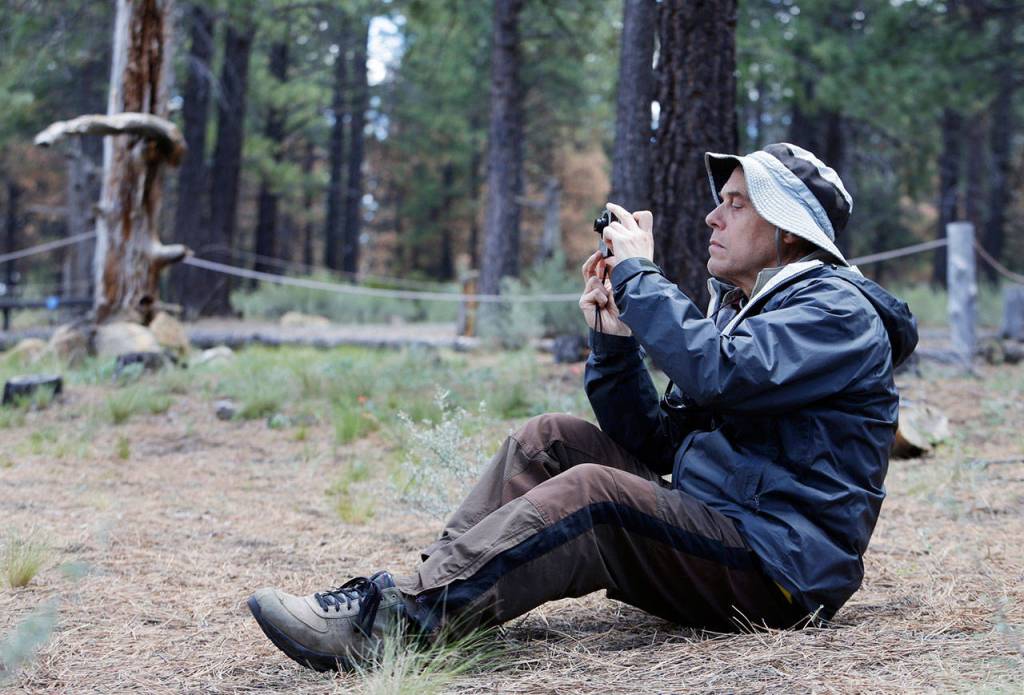
Oregon State University associate professor Roberto Albertani photographs as Walter, a golden eagle, flies to a perch at the High Desert Museum on Monday, June 11, 2018, in Bend. A team of grad students was working with OSU associate professor Roberto Albertani at the High Desert Museum, recording golden eagle flight to develop technology that ultimately reduces the number of golden eagles killed by wind turbines. (Joe Kline /The Bulletin via AP)

Oregon State University associate professor Roberto Albertani photographs as Walter, a golden eagle, flies to a perch at the High Desert Museum on Monday, June 11, 2018, in Bend. A team of grad students was working with OSU associate professor Roberto Albertani at the High Desert Museum, recording golden eagle flight to develop technology that ultimately reduces the number of golden eagles killed by wind turbines. (Joe Kline /The Bulletin via AP)

Researchers hope to reduce eagle deaths caused by turbines

$625,000 grant from the U.S. Department of Energy aims to develop tech for detection and deterrence.

By STEPHEN HAMWAY

The Bulletin

BEND, Ore. — On a Monday afternoon, a captive audience watched a 14-year-old golden eagle named Walter fly from branch to branch outside the High Desert Museum, gobbling up bits of dead quail as he went.

However, the demonstration was not part of the museum’s well-known Raptors of the Desert Sky show. Instead, it was a piece of an ongoing Oregon State University project using the museum’s collection of eagles to help model behavior and flight patterns to develop technology that ultimately reduces the number of golden eagles killed by wind turbines.

“It is critical to help the species survive,” said Roberto Albertani, associate professor of mechanical engineering at OSU’s Corvallis campus.

In May 2017, Albertani and the team at OSU received a 27-month, $625,000 grant from the U.S. Department of Energy Wind Technology Office, aimed at developing a technology for detecting and deterring golden eagles that fly too close to the blades of wind turbines.

Albertani said the project will have three components, which can be used independently and can be added to existing wind turbines.

A sensor that can be mounted on the tower of the turbine can detect a nearby bird and determine if it is an eagle in danger of hitting a blade. If it is, the sensor triggers another component of the project: a deterrence system on the ground, designed to scare the birds away from the turbine. The final portion of the project is a series of blade-mounted sensors designed to confirm that a bird did not collide with them.

To develop the detection portion of the system, Albertani and his team, which includes two other OSU professors and several graduate students, needed data on how golden eagles look, fly and generally behave.

Albertani reached out to the High Desert Museum last year about using its eagles, including Walter, to model behavior. The team set up a 360-degree camera that can track an eagle as it flies, transmitting data to a computer in real time. While the sensor is only capable of detecting eagles, Albertani said, the software can be adjusted to respond to any species of bird.

“The key point is to train the algorithm to automatically detect a certain species,” Albertani said.

If it’s successful, the project will help solve one of wind energy’s ongoing challenges: bird fatalities caused by turbines. A 2013 study notes that at least 140,000 birds are killed by wind turbines every year. While energy-industry groups dispute that total, Albertani noted that the true total has likely increased in the past five years, as the industry has grown.

Jon Nelson, curator of wildlife for the High Desert Museum, said wind turbines are relatively low on the list of human-caused dangers to golden eagles, behind uncovered windows and power lines. But he said the eagles, which tend to prefer open areas like the sagebrush fields east of Bend, often fly near ridges and other areas that receive a lot of wind.

“And those are the exact types of places we like to build wind farms,” Nelson said.

While Albertani has worked with other eagles in other locations, he said working with the High Desert Museum has been a good fit, given the museum’s collection of trained birds of prey and proximity to Corvallis.

“The museum has been absolutely wonderful to support our work,” He said.

Dana Whitelaw, executive director of the museum, said the museum supports a mix of research in Central Oregon, including a carnivore-monitoring project in the Deschutes National Forest, which tracks a variety of mammals, including the rare Sierra Nevada red fox.

Whitelaw said the partnership with Albertani and his team dovetailed perfectly with the museum’s goal to be a place for exploring areas of conflict within Oregon’s High Desert.

“It’s hard to find another example of a project that so closely knits our mission to an area of research,” Whitelaw said.

Albertani said he plans to have a proof of concept for the entire system by next year, which can then be adapted for the commercial market.

“Hopefully there are companies interested in picking up the system,” he said.

As for Walter, who came to the museum about 2½ years ago after being struck by a car and spending time in a Washington animal shelter, Nelson said the recent flight acted as a test run of sorts.

If all goes well, Nelson said he’d be able to perform in Raptors of the Desert Sky before long.

“Hopefully he’ll be flying for the public next week,” Nelson said.
Talk to us

> Give us your news tips.

> Send us a letter to the editor.

> More Herald contact information.

More in Northwest

The U.S. Capitol building in Washington, D.C., on May 7, 2025. (Photo by Jennifer Shutt/States Newsroom)
End of shutdown ignites sparring among congressional lawmakers

Meanwhile, U.S. Rep. Marie Gluesenkamp Perez was among six Democrats who sided with Republicans in voting the legislation out of the House.

Attorney General Nick Brown has proposed new advice for locales on how to interpret state public records law, with a focus on providing records faster. (Stock photo)
Need for speed: Plan to unclog WA public records system gets mixed reviews

Washington’s attorney general is seeking to reduce public record backlogs as concerns… Continue reading

Washington state Commissioner of Public Lands Dave Upthegrove waves to the crowd during inauguration ceremonies at the Washington state Capitol, in Olympia, on Jan. 15, 2025. (Photo by Ryan Berry/Washington State Standard)
Dave Upthegrove on land sales, federal funding cuts and wildfire immigration raids

Washington state’s new public lands commissioner came into office with his own ambitious agenda. It’s playing out against a shifting backdrop in D.C.

The so-called “big, beautiful bill” that congressional Republicans approved in July included a total of $50 billion for the Rural Health Transformation Program. The money is meant to offset some of the expected damage to rural hospitals from the law’s steep cuts to Medicaid. (Olivia Vanni / The Herald)
Washington makes pitch to feds for $1B in rural health funding

The money was included in Republicans’ “big, beautiful bill.” The state’s goals include strengthening the rural health workforce and improving care in tribal communities.

Screenshot from the state Employment Security Department’s website at esd.wa.gov. (File photo)
Expected slide in WA unemployment trust fund balance could trigger new tax

Washington businesses would need to shoulder roughly $700 million in additional taxes… Continue reading

The Washington state Capitol. (Jerry Cornfield/Washington State Standard)
State Democrats mull imposing income tax on higher earners

The idea is brewing ahead of the 2026 legislative session. It would target those making above $1 million. The state is one of nine that does not tax wages.

Washington state Commissioner of Public Lands Dave Upthegrove speaks at a press conference on wildfire issues Monday in Tumwater. (Photo by Bill Lucia/Washington State Standard)
Climate dollars eyed to backfill WA wildfire funding

Washington’s lands commissioner, Dave Upthegrove, is on a mission to secure $60… Continue reading

Washington Gov. Bob Ferguson, left, shakes hands with Cowlitz Indian Tribe Chairman Bill Iyall after signing an executive order to improve the state’s relations with tribal governments on Wednesday. (Photo courtesy of Washington governor’s office)
WA governor moves to improve state consultation with tribes

A new directive expands tribal relations training for state workers among other actions. Tribal leaders voiced support.

New map tracks measles exposures across Washington

Afraid you may have been exposed to measles? Washington’s Department of Health… Continue reading

A combine at work in wheat fields in the Walla Walla region during 2018. (Washington State Department of Agriculture)
State halts rebates to farmers hit with fuel fees under WA climate law

Instead, a new online directory shows retailers who provide the farm fuel exemption by not imposing surcharges.

Washington transportation officials say a lack of funding means dollars intended for preservation and maintenance are the ones diverted to deal with emergency situations. Before (left) and after (right) photos of the mudslide and cleanup on State Route 20 following an Aug. 11 mudslide. (Washington State Department of Transportation)
‘Early stages of critical failure’: Outlook grim for road upkeep

Billions more dollars are needed for preserving highways and bridges, WSDOT says. The agency’s leader didn’t request more maintenance money for 2026.

Washington state Attorney General Nick Brown, seen here during a January interview, is sparring with members of Congress over the state’s immigration policy (Photo by Ryan Berry/Washington state Standard)
Washington AG pushing new law to protect workers from immigration raids

The proposal would require businesses to tell employees if ICE is coming to inspect company records in search of employees who are not legally able to work in the country.

Support local journalism

If you value local news, make a gift now to support the trusted journalism you get in The Daily Herald. Donations processed in this system are not tax deductible.