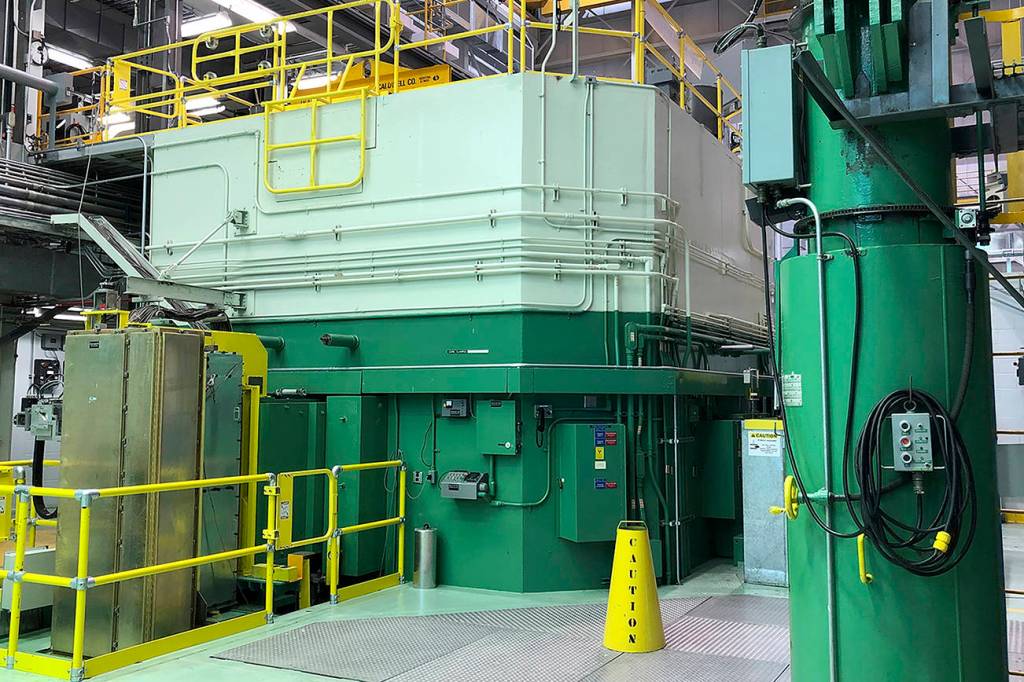
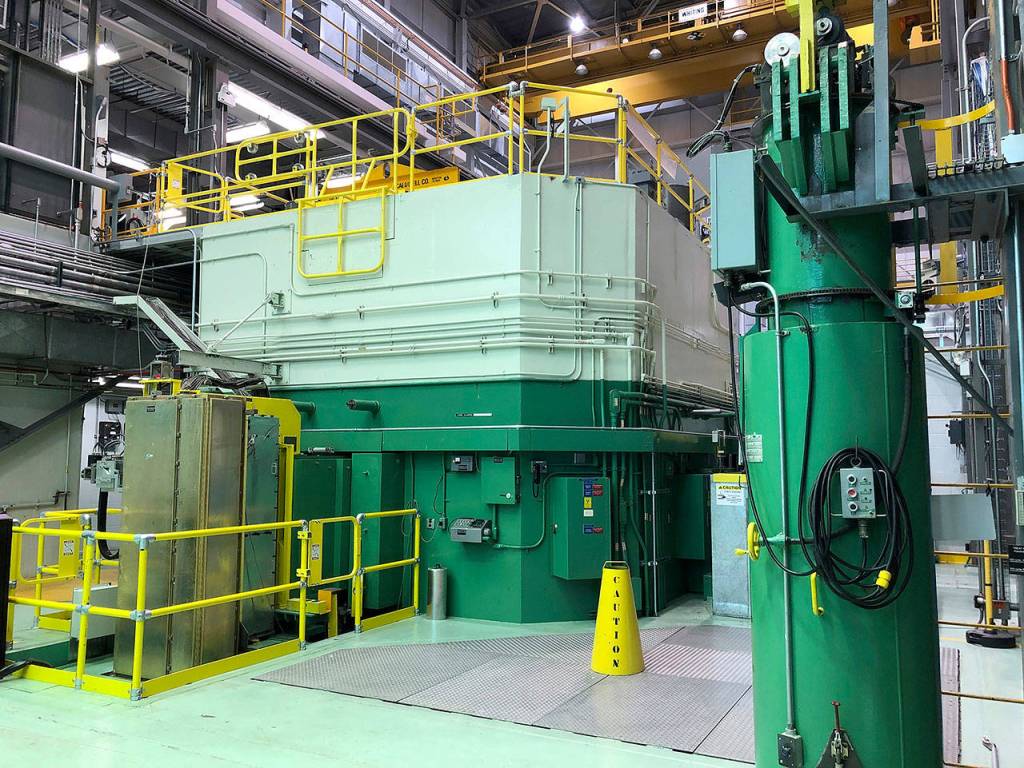
This 2018 photo shows the Transient Test Reactor at the Idaho National Laboratory about 50 miles west of Idaho Falls, in eastern Idaho. The Deseret News reports the Carbon Free Power Project is promoted as the next generation design for nuclear power. (AP Photo/Keith Ridler, File)

This 2018 photo shows the Transient Test Reactor at the Idaho National Laboratory about 50 miles west of Idaho Falls, in eastern Idaho. The Deseret News reports the Carbon Free Power Project is promoted as the next generation design for nuclear power. (AP Photo/Keith Ridler, File)

Utah co-op wants to build 12 small nuclear reactors in Idaho

The small reactors can produce enough megawatts to power more than 50,000 homes.

  • By KEITH RIDLER Associated Press
  • Thursday, September 3, 2020 6:53am
  • Northwest

By Keith Ridler / Associated Press

BOISE, Idaho — U.S. officials have for the first time approved a design for a small commercial nuclear reactor, and a Utah energy cooperative wants to build 12 of them in Idaho.

The U.S. Nuclear Regulatory Commission on Friday approved Portland-based NuScale Power’s application for the small modular reactor that Utah Associated Municipal Power Systems plans to build at a U.S. Department of Energy site in eastern Idaho.

The small reactors can produce about 60 megawatts of energy, or enough to power more than 50,000 homes. The proposed project includes 12 small modular reactors. The first would be built in 2029, with the rest in 2030.

NuScale says the reactors have advanced safety features, including self-cooling and automatic shutdown.

“This is a significant milestone not only for NuScale, but also for the entire U.S. nuclear sector and the other advanced nuclear technologies that will follow,” said NuScale Chairman and Chief Executive Officer John Hopkins in a statement.

Utah Associated Municipal Power Systems already has agreements with the Energy Department to build the reactors at the federal agency’s 890-square-mile site that includes the Idaho National Laboratory, a nuclear research facility that would help with the development of the reactors.

The Department of Energy has spent more than $400 million since 2014 to hasten the development of the small modular reactors, or SMRs.

“DOE is proud to support the licensing and development of NuScale’s Power Module and other SMR technologies that have the potential to bring clean and reliable power to areas never thought possible by nuclear reactors in the U.S., and soon the world,” said Rita Baranwal, assistant secretary for Nuclear Energy.

The energy cooperative has embarked on a plan called the Carbon Free Power Project that aims to supply carbon-free energy to its nearly 50 members, mostly municipalities, in six Western states. The company plans to buy the reactors from NuScale, then assemble them in Idaho. The company is also looking to bring on other utilities that would use the power generated by the reactors.

Cooperative “members themselves would use a portion of the electricity, but other utilities would become involved and purchase power,” said LaVarr Webb, spokesman for the cooperative.

He said not all the power that will be produced from the proposed reactors has been allocated, but he expects more interest with the U.S. approval of NuScale’s design.

He said the next step is for the cooperative to submit a combined construction and operating license application to the Nuclear Regulatory Commission. The process also includes an environmental analysis. Webb said the cooperative will likely have that ready within two years.

The first small modular reactor is scheduled to come online in 2029, with 11 more to follow in 2030.

The modular reactors are light-water reactors, which are the vast majority of reactors now operating. But modular reactors are designed to use less water than traditional reactors and have a passive safety system so they shut down without human action should something go wrong.

The Nuclear Regulatory Commission’s approval of the design means the agency is satisfied such technology will work properly.

The modular reactors are also part of a much larger U.S. plan to replace current reactors, many of them decades old, with more efficient and safer reactors. U.S. officials say nuclear power helps reduce carbon emissions from coal and natural gas, a cause of global warming.

There are currently 95 licensed commercial nuclear reactors operating in the U.S., generating about 20 percent of the nation’s energy, according to the Nuclear Regulatory Commission.

The Utah Taxpayers Association has come out against Utah Associated Municipal Power Systems building the reactors, contending costs will soar as they have with some traditional reactors that are much larger.

But the cooperative says such a comparison is unfair, and akin to comparing a 1960s gas guzzler automobile with a modern electric vehicle.
Talk to us

> Give us your news tips.

> Send us a letter to the editor.

> More Herald contact information.

More in Northwest

Washington state Supreme Court Justice Colleen Melody is sworn in Wednesday, Jan. 21, 2026, in Olympia, Washington. (Photo by Jake Goldstein-Street/Washington State Standard)
Washington’s newest Supreme Court justice is sworn in

Colleen Melody is officially the Washington state Supreme Court’s newest justice. Melody… Continue reading

Washington Gov. Bob Ferguson at his State of the State address on Jan. 13, 2026. Ferguson did not discuss the budget cuts he’s proposing in his speech but they’ve stoked plenty of testimony in the first days of the 2026 legislative session. (Photo by Bill Lucia/Washington State Standard)
An icy reception for Gov. Bob Ferguson’s proposed budget cuts

Advocates for schools, public universities, and climate programs are among those unhappy with the raft of cuts the governor relies on to close a $2.3 billion shortfall.

The log-in page of Instagram’s website. (Photo by Alexander Castro/Rhode Island Current)
Push for youth social media safeguards revived in WA Legislature

A proposal would prohibit addictive feeds and push notifications at certain times for minors. Opponents believe it’s unconstitutional.

State lawmakers are considering bills requiring AI detection tools and disclosures to address deepfakes and to establish new safeguards for children using the technology. (Stock photo)
How Washington state lawmakers want to regulate AI

Reining in chatbots, protecting kids from harmful content, and requiring disclosure of AI-generated material are among the ideas under discussion in Olympia.

House Bill 1608 seeks to build on a 2024 law banning octopus farming in Washington. (File photo)
Washington may ban sales of farmed octopus

Octopus is back on the policy menu for Washington state lawmakers. A… Continue reading

Gov. Bob Ferguson delivers his State of the State address on Tuesday in the House chamber at the Washington state Capitol. (Photo by Bill Lucia/Washington State Standard)
What Gov. Bob Ferguson said in State of the State address

The speech drew a more positive reaction from fellow Democrats than last year’s inaugural address. He touched on flood recovery, taxes and immigration enforcement.

A damaged section of State Route 542 between mileposts 43 and 45 east of Glacier after flooding from an atmospheric river in December 2025. (Photo courtesy of Washington State Department of Transportation)
Road damage from WA flooding to cost at least $40M

Last month’s heavy flooding inflicted at least $40 million to $50 million… Continue reading

The Washington state Capitol in 2025. (Photo by Jacquelyn Jimenez Romero/Washington State Standard)
WA’s 2026 legislative session is getting underway. Will anyone be smiling when it’s over?

Washington state lawmakers begin a 60-day session today, in which a fiscal… Continue reading

Portland police officers stand behind police tape in front of an apartment building in east Portland. (Photo by Alex Baumhardt/Oregon Capital Chronicle)
Federal agents shoot two people in Portland, police say

Federal agents reportedly shot and injured two people near a medical clinic… Continue reading

The entrance to the Washington state governor’s office in Olympia. (Photo by Bill Lucia/Washington State Standard)
Top Ferguson aide who went on hiatus to return in new role

A top adviser to Washington Gov. Bob Ferguson is back at work… Continue reading

Freightliner eCascadia electric trucks used in a Coca-Cola Bottling fleet are pictured in 2023. (Photo courtesy of Daimler Truck AG)
$126M incentive program for zero-emission trucks nears launch in WA

Transportation is the biggest share of emissions in the state. Advocates are frustrated by how long it’s taking for the program to start.

The Beacon Pacific Village housing complex where Washington Gov. Bob Ferguson announced new proposed housing investments on Thursday, Dec. 18, 2025, in Seattle, Washington. (Photo by Jake Goldstein-Street/Washington State Standard)
Ferguson proposes $244M boost for housing programs

Some of the money will be dedicated to flood recovery. The governor is also starting the process to create a state Department of Housing.

Support local journalism

If you value local news, make a gift now to support the trusted journalism you get in The Daily Herald. Donations processed in this system are not tax deductible.