Comment: Arbery’s killers’ trial asks if they acted on racism
Published 1:30 am Sunday, February 20, 2022


By Robin Givhan / The Washington Post
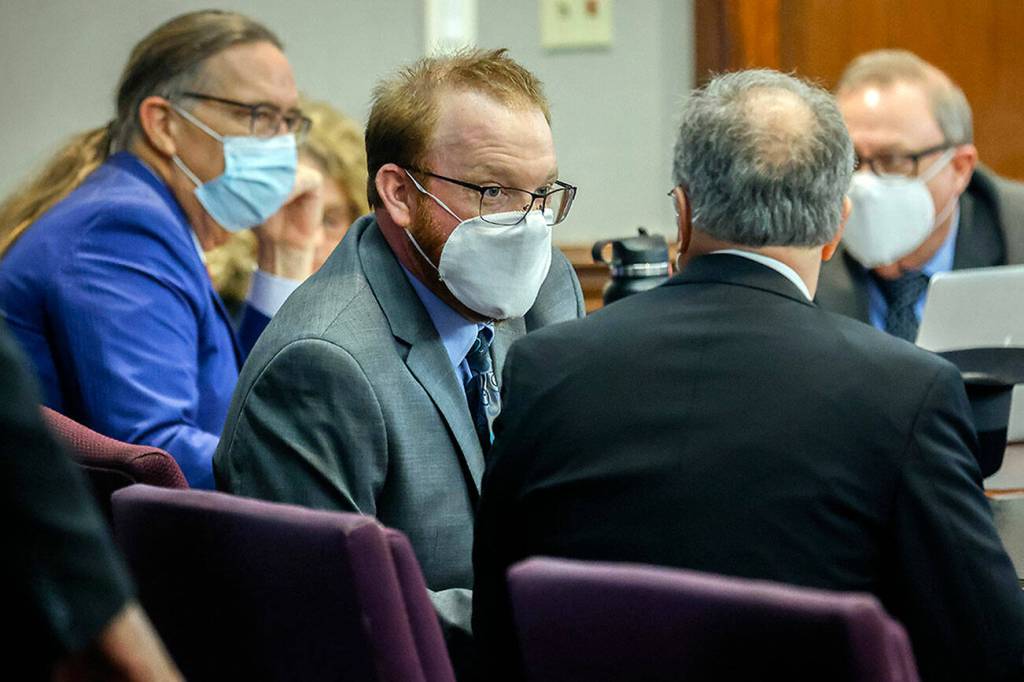
The federal hate crime trial against the three white men who were convicted in Georgia state court last year of killing jogger Ahmaud Arbery began this week with lawyers trying to make sense of racism. Both the prosecution and the defense aimed to find a thread of logic in an inexplicable grotesquerie.
The current trial asks whether Gregory McMichael, Travis McMichael and William “Roddie” Bryan chased, cornered and killed Arbery because he was Black. The question is not whether these men are racists. Their lawyers have essentially stipulated that they are. They have acknowledged their clients’ use of racist tropes, agreed that their past expressions of racial animus are repugnant and have made it plain that their clients’ heinous opinions are most definitely not their own.
“I can’t stand before you today and say that my client never used the n-word,” said Amy Lee Copeland, a lawyer for Travis McMichael. “Yes, you may think these words and these opinions are absolutely wrong. I do.”
The question seems to be whether these men were actively racist. As if racism ever really goes dormant.
As a culture, we want to believe that racism — that assemblage of lies, stereotypes, distrust, disgust and abuse of power — can be held back by a retaining wall of misdirection, euphemisms and references to neighborly concern. We want to believe that a person can feast on poisonous language without having that toxic diet inevitably impair their ability to see clearly. We want to believe racism can be controlled at will.
The trial’s opening statements began Monday with Bobbi Bernstein, a lawyer from the Justice Department’s civil rights division, advising the jury that this federal prosecution does not require proof of hate. Instead, it requires evidence that the defendants acted as they did because of Arbery’s race. This is a legal standard but it is a confounding human one. It’s a challenge to grasp the notion that someone could hunt and kill another human being without some degree of hate churning in their heart.
And as Bernstein went on to list the array of derogatory, dehumanizing names that Travis McMichael used to describe Black people — animals, monkeys, savages and, of course, the n-word, which she uttered in full — it’s hard to fathom that such a litany wouldn’t count as evidence of hate.
The law demands a sterile consideration of the facts but our understanding of race isn’t based on anything as immutable or as clarifying as fact. Instead, racism bubbles up from a cauldron of emotion that periodically boils over depending on the rising level of fear or aggrievement or personal belief in the righteousness of one’s social or economic position. The prosecution is asking the jury to remove hate from its calculation of guilt even though hate lies at the root of this case; what one of the lawyers called “an American tragedy.”
Of all the high-profile cases that sent protesters into the streets these past two years, this is the one in which racism is being considered as central to the events. With the death of Breonna Taylor in Louisville and George Floyd in Minneapolis, investigators and juries had to wrestle with questions about aggressive policing, bad apple cops, mishandled search warrants and the nuances of police training. But this case is distinctive, and the only one the federal government is prosecuting as a hate crime, alleging that the defendants violated Arbery’s civil rights and targeted him because he was Black. It’s one in which jurors are being asked to assess the pure humanity of Bryan and the McMichaels. They’re not weighing whether these men were failed by their superiors or their community. There’s no debate about outside mitigating forces. In the murder of Floyd, the inhumanity of convicted former police officer Derek Chauvin was on full display. But Chauvin’s actions were judged within the framework of policing.
Arbery was simply a Black man killed by white men. And his death forces the perilous question with which society has such a difficult time contending; it’s the one that makes people recoil in indignation at the audacity of the inquiry. Are you a racist?
The verdict in this trial will do little to change the defendants’ circumstances. They have already been given life sentences for murdering Arbery. Murder is what they did; and there are a multitude of ways in which they can rationalize their actions to themselves. A guilty verdict in this hate crime trial would be an indictment of who they are. And there’s no escaping that.
In their opening statements, defense lawyers advised the jury that repugnant commentary isn’t illegal. It’s not a crime to think terrible things about your fellow citizens. But awful opinions can shape the way in which people see the world. They can influence the way in which we regard those we don’t personally know. Bryan’s attorney, J. Pete Theodocion said that his client saw the McMichaels chasing Arbery and assumed that the Black man might have done something wrong and so he hopped in his truck and followed after Arbery, too. “The natural assumption that he made, that anyone would make, was that they had to be chasing him for a reason,” said Theodocion, who in uttering this sentence presumably made a conscious decision to ignore the vast collected works detailing what it means to be a Black or Brown person living in contemporary America.
Theodocion argues that Bryan would have made the same assumption if Arbery had been white or Latino. But would Bryan have made a similar assessment of the situation if the people who had been doing the chasing were Black and the person they were pursuing was white? To whom would Bryan have given his benefit of the doubt then? Would he presume that a white jogger being chased by two Black men in a truck was dangerous or in danger?
Racism doesn’t exist in a vacuum. It’s shaped and fueled by history, context and environment. It’s a poison that runs through the body and impacts every organ. It is, as has been said a multitude of times, systemic. Perhaps it’s possible for someone to degrade and debase the Black populace in general but shower the individual Black people they know with kindness and loyalty. That, after all, is the essence of someone responding to an accusation of racism with the defensive retort: “Some of my best friends are Black …” But racism isn’t so much about individual relationships as it is one’s world view. It’s not a matter of whether you can get along with the lone Black neighbor on the corner but how you respond to the shifting complexion of your entire community.
For the defendants who regularly spewed prejudiced bile and vitriol, the legal question is whether they acted upon their racism in the killing of Ahmaud Arbery. The moral question regarding the pernicious power of their hate has already been answered.
Robin Givhan is senior critic-at-large writing about politics, race and the arts. A 2006 Pulitzer Prize winner for criticism, Givhan has also worked at Newsweek/Daily Beast, Vogue magazine and the Detroit Free Press. Follow her on Twitter @RobinGivhan.