Editorial: DACA’s protections must be made law now
Published 1:30 am Friday, December 1, 2017


By The Herald Editorial Board
We’ve heard repeatedly that Republicans in Congress are keen on demonstrating before the end of the year their ability to lead — working from the distinct advantage of having control of the House, Senate and Oval Office — which explains their rush to push through tax reform legislation that increasing appears to offer few real benefits to many Americans, particularly those making $75,000 a year or less.
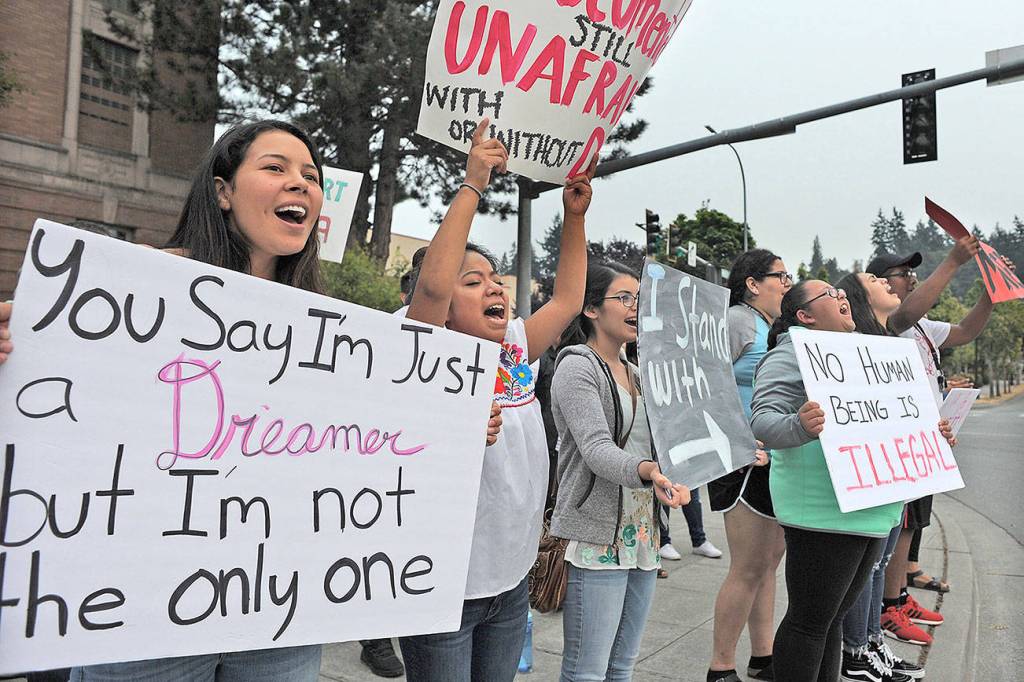
But Republicans have an opportunity not only to demonstrate their leadership but also their ability to work with Democrats by passing legislation that will formalize the protections for the Dreamers, the estimated 800,000 immigrants who were brought to the United States as children and have since built productive lives in their adopted communities.
There’s general agreement that the Dreamers deserve that assurance, and even a path toward citizenship.
A Washington Post-ABC News poll from September found that 86 percent of those polled supported allowing DACA participants to remain in the U.S., compared to 37 percent who supported construction of a border wall. Similarly, a Politico/Morning Call poll, also from September, found that 58 percent of those polled supported citizenship for Dreamers. An additional 18 percent supported legal status to remain but not a path to citizenship.
Since it went into effect five years ago, Deferred Action for Childhood Arrivals has afforded 800,000 young immigrants — those who came here as children under the age of 16 with their undocumented parents — temporary relief from deportation and the ability to work legally. To be eligible, enrollees had to be in high school or have a diploma or be a veteran who has served honorably and not have been convicted of a felony or significant misdemeanor.
This allowed those who have lived nearly all of their lives in the United States to go to college, earn degrees, get driver’s licenses and find good-paying jobs that support their families and add to the strength of the nation’s economy.
But facing lawsuits from a handful of state attorneys general, President Trump in September rescinded DACA and gave Congress until March to pass legislation that would put its protections into law.
Three months in to that six-month timeline, there has been little movement by the Republican-controlled Congress, even though legislation, specifically the 2017 Dream Act, has been introduced in House and Senate, each with bipartisan sponsorship, although its support among Democrats is strongest. The Dream Act would grant those eligible permanent residency and a path to citizenship through achievement of higher education employment or military service.
Failure to extend those protections will mean that by March, the 800,000 — most who have known no other home than the U.S. — will be subject to deportation and whose authorization to work will begin to expire. Between March and November of next year, work permits for nearly 300,000 of the Dreamers will have expired, ending their ability to hold jobs that allow them to support their families and contribute to local economies and as local, state and federal taxpayers.
In Washington state, there are an estimated 18,000 to 19,000 DACA recipients, about 15,000 of whom are currently employed. An August study by the Center for American Progress, published in a CNBC report, estimates that Washington state stands to lose $1.06 billion each year in GDP with the end of DACA, the eighth-largest loss among the 50 states. The center’s survey estimates that the nation as a whole will lose $433 billion over the next 10 years.
The lack of movement on the Dream Act appears less a matter of basic support than of the leverage-seeking that Congress is prone too, specifically Republicans seeking to use the Dream Act to win acquiescence on other issues.
President Trump showed his hand in that regard when, prior to a planned meeting between Republican and Democratic congressional leaders on budget issues, he tweeted that House Minority Leader Nancy Pelosi and Senate Minority Leader Chuck Schumer “want illegal immigrants flooding into our Country unchecked, are weak on Crime and want to substantially RAISE Taxes,” adding, “I don’t see a deal!”
Pelosi and Schumer, not surprisingly, skipped the meeting.
The 800,000 Dreamers — and an estimated 1 million more who would be eligible for similar protections but had not applied before Trump rescinded DACA — should not be used as a bargaining chip.
Passing these protections as a piece of larger immigration reform ordinarily would make sense, but adopting such far-reaching legislation before March would be an impossible task for the current Congress.
The Dream Act, on its own, is within the ability of Congress to adopt and the president to sign, even in view of his lukewarm support for Dreamers. And it should be done before the end of the year.
More on DACA: “Viewpoints: Why Congress should keep DACA dream alive“