Homecoming for a Husky
Published 9:00 pm Monday, October 23, 2006
In recent years, Jim Lambright has faced other challenges and crises, some far more serious than losing his job as head football coach at the University of Washington. A few were literally matters of life and death.
Yet through it all – the faith-testing trials along with moments of great blessing – he always had a longing to come back. Maybe more importantly, he wanted to be wanted back.
That’s how it is when you devote over half your life and more than a third of a century to one school, one team. Football was never just a game to Lambright. Coaching at Washington was never just a job.
It was a life. His life.
And so he waited and wondered.
Nearly eight years have passed since the day Lambright was abruptly fired, and now, finally, he’s being welcomed back. After eight years of coaching changes, administrative changes and philosophical changes, someone at the Montlake campus decided Lambright belongs in the university’s Husky Hall of Fame.
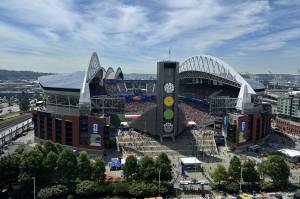
It will happen this weekend, beginning with a Friday night banquet and formal induction ceremony at a downtown Seattle hotel. On Saturday there will be recognition at halftime of the Washington-Arizona State football game at Husky Stadium.
It promises to be a weekend full of tributes and well-wishes, and there is a good chance that Lambright, who was a tough-as-nails player and an equally tough-as-nails coach, will end up a weepy mess.
“It’s hard for me to explain what this (honor) means without tearing up,” Lambright said. “I immediately get very emotional because it is that important to me.
“I played there for five years and I coached there for 30 years, and it was a highlight of my life. It’s unbelievable to me how much I appreciate it and how significant a role the University of Washington played in my life for so many years.”
It ended on Dec., 30, 1998, the day Lambright – having just finished his sixth season as head coach – was dismissed by then-UW athletic director Barbara Hedges. Yes, the program had slipped from the heyday years of coach Don James, who resigned when the Pacific-10 Conference slapped sanctions on his program back in the summer of 1993. Lambright inherited that team and those sanctions, and still went on to guide the Huskies to a six-year mark of 44-25-1, including a bowl appearance each year Washington was eligible.
In the end, though, there were no Rose Bowls, only one bowl victory, and discontent among some of the school’s deep-pocket boosters.
“I’m sure there were alums who had a hand in (getting Lambright fired),” James said. “When people donate big dollars, they get some votes on things.”
To this day, Lambright said, people tell him they wish he was still the head coach, largely because of “what’s happened to the program after (Hedges) made that decision. … I take pride in the fact that we were doing things right and holding the program as stable as you could during some really hard times. We were finally coming out the other side, and I just wish I’d had the opportunity to finish the job.”
Hedges resigned in January of 2004, and Lambright said there is no coincidence to the timing of his Hall of Fame induction.
“This honor wouldn’t have come to me with Barbara Hedges still there,” he said. “So, yeah, this definitely washes away part of that hurt.”
Everett boy makes good
The Lambright story begins in a residential neighborhood of south Everett in the late 1950s. Had he been born a few years later, he would have gone to Cascade High School, but there was no Cascade back then. He ended up at Everett, which billed itself as “The School of Champions” because of its proud athletic traditions.
Lambright enjoyed that nickname because he liked being linked with excellence. Never the biggest, the fastest or the strongest, he made himself one of the best by working harder and being mentally tougher than anyone else.
It was more of the same at Washington, which was coming off one Rose Bowl victory and was soon to get another when Lambright arrived in the fall of 1960. Because there were no scholarship limits in those days, he began as one of 110 freshmen on the team. Many were so-called blue-chip prospects, but not Lambright, who was maybe 5 feet 10 inches and 170 pounds.
“I was a recruiting mistake,” he said with a laugh.
He was also a survivor. Jim Owens, the UW coach back then, had a program designed to run off the weak of body, weak of mind. Evidently it worked. By the time Lambright graduated five years later, he was one of just 12 players left from his freshman class.
Not only did he last, but against all odds – most notably his size – he became a standout player. He won two varsity letters, and as a senior was a first-team all-conference pick at defensive end.
By this time Lambright knew he wanted to coach, which he did after graduation for a few years at Fife High School and Shoreline Community College. Then, in a defining moment for him, he was invited by Owens to become an assistant coach at Washington in the spring of 1969.
When Owens resigned six years later and was replaced by James, Lambright was one of three assistants asked to join the incoming staff.
James and Lambright would enjoy a long and prosperous professional relationship. They coached together for 18 years and in that span the Huskies won six conference championships, four of six Rose Bowls, one Orange Bowl, five of seven other bowls, and the 1991 national championship.
For many of those years Lambright was the defensive coordinator and had what James called the UW’s “most critical recruiting area,” which was essentially the Seattle area north to Canada. Players from Snohomish County like Everett’s Chris Chandler, Ron Gipson and Chuck Nelson, Snohomish’s Curt Marsh, Jerry McLain and Rick Fenney, and Marysville-Pilchuck’s Jeff and Shane Pahukoa – all part of some of Washington’s best years of football – committed to the Huskies because Lambright sold them on the program.
“He did a very good job. In recruiting, he got just about all of the local kids, and that’s what got us started,” James said. “And he had integrity. I never had to worry about him going out and cheating. His way was to recruit by the rules.”
On the field, Lambright “was tough on the kids, but I think they respected him. He was tough, but he was fair.”
When the sanctions came in the summer of 1993, James submitted his resignation. He recommended Lambright as his successor.
The new top Dawg
Lambright, who is 64, had other coaching offers after leaving Washington, but turned them down because they would have required moving from the Puget Sound area.
He instead worked for a time with Lou Tice at the Pacific Institute, helping to teach businesses to succeed by using the same principals that went into a winning football program. In time, though, personal and family matters, many of them medical, became overriding issues in his life.
In May of 2004, Lambright was diagnosed with an aggressive form of bladder cancer, resulting in an eight-hour operation to remove his bladder and prostate gland. The surgery was successful, and regular checkups since have revealed no return of the cancer.
He barely had time to relish his recovery when his wife, Lynne, was also diagnosed with bladder cancer. Her surgery was in August and to date “she’s doing great,” Lambright said.
Cancer, though a frightening disease, often can be overcome. Not so for Niemann-Pick Disease, a condition in which the body fails to metabolize cholesterol properly, allowing it to accumulate in certain organs, including the brain. It is progressive, inevitably fatal and with no known cure, and it afflicts two of Lynne Lambright’s sons from a previous marriage, Brad and Bart Mackie (a third son, Brent Mackie, died years ago from a heart attack).
It is hard to imagine one family living with so much stress and grief, but the Lambrights do because to do otherwise is to quit.
“In life, there are always going to be blocks put in your way,” Lambright said, “and you’re going to be judged on how you get through them.” It helps, he added, “to have a wife who’s a wonderful, care-giving type of a person. She’s been just a tremendous source of strength, and you make it because the two of you are strong together.”
When Lambright coached at Washington, the team often went to Children’s Hospital in Seattle to visit sick youngsters. Even now, he said, “the day I start thinking that I’ve got it bad is the day I go back to Children’s or some other hospital. … It reminds you that you don’t have it that bad and that you’ll be OK.”
And, he was quick to point out, his life includes many joys. Among the greatest is his family, which also includes son Eric (an ex-Husky player), daughter Kris, their spouses, and nine delightful grandchildren.
“I am,” Lambright said, “very blessed. Blessed and challenged at the same time.”
New challenges
When he coached, Lambright never thought much about not coaching. He loved his work and found it hard to imagine doing anything else.
“Joe Paterno,” said Lambright of the legendary Penn State coach, who turns 80 in December, “is a great example.”
Coaching involves “a whole lot of work, a whole lot of problems and a whole lot of overcoming along the way,” he went on. “You know you’re going to have problems, little glitches here and there, but the highlights are great. I thrived on it. It was such a wonderful culmination of everything I wanted to do in teaching. I got so much pleasure from bringing in young players, and then having something to do with giving them a direction and a better life.”
As he looks to the future, Lambright knows he can expect other challenges. Yet he still holds to the same mindset for success he first learned in Everett as a young athlete, and which has served him well all these years.
“Regardless of my age, I have two choices,” he said. “I can go out and be as good as I can be, or I can die. And I’m not preparing myself to die. So I’m going to squeeze everything I can possibly get out of today because today is the most important day of my life.”
With his own consulting firm and occasional speaking engagements, “it’s different than what I was doing when I was coaching,” he said. “But it still has all the pleasure and energy. It still fills my cup, and that’s the most important thing.”