Legislation would close school for disabled
Published 7:58 am Monday, February 25, 2008
A bill that would close Fircrest School, a state institution located in Shoreline that houses developmentally disabled citizens, has passed the state Senate and is now headed to the House of Representatives.
On March 13 the state Senate voted 37 to 12 in favor of the bill that would close the institution and move its 260 residents to other locations. Some could move to one of the other five developmentally disabled institutions in the state, others would move to nursing homes or into community living situations. The bill requires that revenue made from the sale or lease of the property, which is estimated to be worth over $30 million as it’s currently zoned, would go into a trust that could only be spent on providing services to the state’s developmentally disabled. The bill now goes to the House of Representatives.
The House Children and Family Services, Health Care and Capital Budget committees held a joint committee work session and public hearing on the bill March 24.
Over the past 30 years populations at the state’s Residential Habilitation Centers (RHCs) have declined 75 percent from over 4,000 to just over 1,000 today. The decline is being attributed to a change in social attitudes and acceptance of the disabled in schools and the community, so that more families are choosing to have their disabled family member live at home or in community home situations rather than in state institutions.
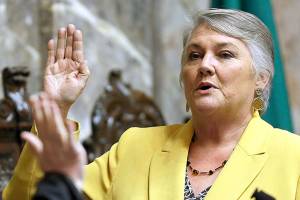
State Sen. Darlene Fairley, D-Lake Forest Park, who sponsored the bill, said it is the right time to consolidate.
“There will always be a place for institutions because there will always be people who feel their child can be addressed best there, but we need to consolidate because the populations have gone down,” Fairley said.
The bill is supported by developmentally disabled community services advocates like Arc and the Parents Coalition. The bill is opposed by parents and guardians of people living at Fircrest and the state unions.
Rep. Ruth Kagi, D-Lake Forest Park, chairs the House Children and Family Services Committee. That committee held a work session on the bill on March 12. She said because the bill affects the budget, there is no timeline. It could be worked on until the end of the session, but she expects it to be a priority.
“We must look at consolidating facilities. We are facing a tremendous budget challenge and it’s incumbent on us to deliver services more efficiently where we can,” Kagi said.
“What we in the House want to do is look at the pros and the cons of closing various facilities, not just Fircrest, but Rainier and the Frances Hadden Morgan center as well to see which makes the most sense financially, in terms of the residents and the ability for them to be absorbed into other facilities,” she added. “These are fragile vulnerable residents, so a lot of planning needs to go into where they can go, and we must work with their families.
“There are a lot of numbers being thrown around about the cost of closing Fircrest, and the cost of expanding Rainier, and so we need good data on the real projected costs,” Kagi said. “I don’t feel as though I’ve looked at the issue in enough depth yet to say which is the best alternative.”
Rep. Maralyn Chase, D-Edmonds, who serves on the Capital Budget committee, has come out strongly against the bill, and in support of keeping Fircrest open, speaking at several rallies on the Fircrest campus recently, organized by the state unions and Friends of Fircrest.
“What we have here is a real estate study, and I’m terribly concerned,” Chase said. “There’s asbestos all over that property, and they omit talking about that, which might become a liability for the state in terms of a resale.
“I am also very concerned for the residents. One performance audit of Developmental Disabled Division states that 81 percent of the cost of community placements are not calculated into the Developmentally Disabled budget. And I’ve also asked for morbidity rates in states where institutions have closed,” she said.
“Also there is the looming question of declining numbers — parents, guardians and doctors have told me that the declining numbers at RHCs was by design and a political decision through a policy called ‘Admittance Diversion’ in which patients that want to get placed into the RHCs can’t get in, and are put out in the community, so it’s not been a voluntary decline. DSHS just got a negative assessment from the feds for denying admission to RHCs and the Department of Justice is in the process of investigating a number of RHCs,” she said.
“If we are going to make a serious change in public policy, I want to have all the facts on the table first, and I don’t think the Senate had all the facts,” she said.