Sounder service on track for this year but price tag jumps
Published 6:16 am Tuesday, February 26, 2008
SEATTLE – A promise that the first commuter train will roll into Everett station by the end of the year – only 19 days away – is likely to be kept.
But a report released Dec. 3 shows that the bill for delivering the service has shot up substantially – by about $200 million.
That means taxpayers will shell out about $377 million to get the trains rolling between Everett and Seattle.
Paperwork has been flying back and forth between Sound Transit and Burlington Northern Santa Fe Railway in recent weeks, the apparent closing stages of negotiations that were to culminate on Dec. 11, after deadline for this edition of The Enterprise.
If all goes well, Sound Transit directors then will approve 10 separate agreements with the railroad.
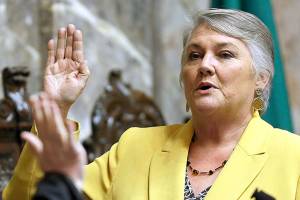
“If we get the contracts signed on the 11th, then there will be a train by the end of the year – absolutely,” said Joni Earl, Sound Transit CEO. “I’m very optimistic that we’re going to get there.”
Sound Transit board member and Edmonds City Council president Dave Earling said “I feel very confident we’re going to come to agreement” by Dec. 11.
If not, then the only way Sounder service could start by the end of the year is if the board holds an emergency meeting.
Earling’s estimate for the day the trains would begin running is for the Seahawks game Dec. 21, with commuter service to begin Dec. 22. The exact date won’t be known for sure, though, until after the agreement is finalized, said Sound Transit spokesman Lee Somerstein.
Whether it comes now or later, the price tag for the Sounder service is pricier than the $177 million voters were told it would cost when they approved Sound Move in 1996.
A report given to Sound Transit’s finance committee Dec. 3 shows the price for sending Sounder trains chugging up and down Burlington Northern Santa Fe’s tracks from Everett to just south of Tacoma will cost $1.2 billion.
That’s up nearly $500 million from the $746 million package – adjusted for today’s dollars – voters approved in 1996.
Earling said the agency is able to absorb the extra cost for several reasons. Tax revenue has been higher than expected, the agency was able to shift money from other projects and originally budgeted with a $20 million reserve.
“It was very good planning to do that,” Earling said.
Earling said all the money is coming from the Snohomish County subregion, per the original plan that said the money raised in each county would stay in each county.
Taking a lesson from the massive cost overruns the agency identified in its light rail program in 2001, Earl told her staff to give Sounder thorough scrutiny. They spent the past year working on it.
Earl told Sound Transit’s finance committee members that they now have a much more accurate budget worksheet to work from.
The majority of the overruns came from severely underestimating how much it would cost Sound Transit to get access to Burlington Northern Santa Fe’s tracks. Sound Transit estimated it would cost $385 million to get access, but it has ended up costing $820 million, a $435 million underestimate.
The bill for access to the tracks from Seattle to Everett has gone from an estimate of about $115 million to $250 million, the amount Burlington Northern Santa Fe agreed to last spring.
Sound Transit was also supposed to get $136 million from the state Department of Transportation and from Amtrak. That money never arrived.
While finance committee members already knew about the cost overruns, they were not aware until Dec. 3 that the bill for building stations along the Everett-to-Seattle section and the Tacoma-to-Lakewood section had also climbed significantly.
The largest increase is a plan to build a station in Mukilteo, which went from $11.2 million to $18.2 million. Improvements to Everett Station went from $24.7 million to $26.9 million, while the cost to build a station in Edmonds went from $9.6 million to $13.1 million.
Finance committee member Dave Enslow said he was disappointed that the numbers for the stations came in so high. He told Sound Transit staff to try to stick to the original estimates anyway.
“Let’s see if we can’t figure out a way to live within our budget,” he said.
Lukas Velush is a reporter for The Herald in Everett. Edmonds Enterprise editor Bill Sheets contributed to this story.