To Seahawks, a player’s tangibles important but not everything
Published 11:01 pm Saturday, April 19, 2008
Twenty-something years later, John Thompson can’t even remember the numbers. They seem so insignificant now.
A couple of inches here, a tenth of a second there. The numbers, once considered vital, have faded from his memory.
Now, when the Seattle Seahawks’ first general manager watches the NFL draft on television, he’s not nearly as concerned with heights, weights or 40-times. All he knows is that the prospects seem to get better and better every year.
“They keep getting bigger and faster,” Thompson said last week, “and you don’t have to be a rocket scientist to figure that out.”
With the growth of players and available information, the NFL has continued to approach the draft from a numbers standpoint above all else. There are tangibles assigned to nearly every position, giving teams a standard by which to weed out some of the incoming talent.
Led the Southeastern Conference in tackles last year? Unless you’re over six feet tall, nobody cares.
Set an NCAA record for career touchdown passes? Without a big-time arm, you’re headed to the Arena League.
The draft has become a cut-throat business over the past few years, so much so that players like Steve Largent (too slow), Steve August (too small) and Sherman Smith (a running quarterback in college) might not have been selected in the drafts of the 21st Century.
Quarterbacks under 6-foot-2 are rarely considered on Day 1 of the draft. Running backs, receivers and cornerbacks need to run the 40-yard dash in 4.6 seconds of less. And offensive tackles who carry less weight than 300 pounds can either throw down a few more cheeseburgers or find a different profession.
“All the old grading scales were based on those (tangibles) before,” said current Seahawks president Tim Ruskell, who oversees the annual draft. “It was actually in the definition of the (player’s) grade.”
As recently as four years ago, the Seahawks’ draft room had some pretty steadfast rules when it came to the draft. Defensive linemen under 280 pounds were of little use to the team, while the Seahawks also liked their linebackers to be big and fast.
When Ruskell took over in Jan. 2005, some of those restrictions were shattered. That’s how Virginia Tech’s Darryl Tapp, a 252-pound defensive end, wound up in a Seahawk uniform in 2006. It’s also how USC linebacker Lofa Tatupu, barely six feet tall with an underwhelming 40 time of 4.73 seconds, ended up representing the Seahawks at multiple Pro Bowls.
“We definitely go off the film, and we definitely go on what is inside the kid, the makeup of the kid,” Ruskell said. “You won’t find a chart in our room where the linebacker has to be six feet tall.”
But you won’t find a 5-foot-9 quarterback, or a cornerback who runs the 40 in 5.0 seconds, on the Seahawks’ draft charts either. For all the talk about a player’s heart and character, the tangibles are the quickest way to separate the men from the boys.
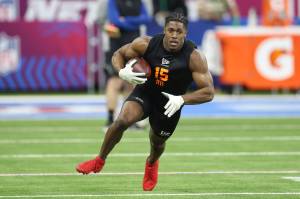
That’s why 235-pound Oregon running back Jonathan Stewart, who runs the 40 in 4.47 seconds, is considered a first-round pick while productive Michigan star Mike Hart, who was timed at 4.76 seconds, might not even be selected on the first day of next weekend’s draft. It also explains why Chadron State’s Danny Woodhead, a 5-foot-9 sparkplug who played against Division II competition, is a late-round pick — at best — despite being the NCAA’s all-time leading rusher.
The so-called tangibles have been around for about as long as the draft. Even when Thompson was running the Seahawks from 1975 to 1982, there was a certain emphasis put on numerical data. But in the past few years, the growth of the league has made some of those tangible numbers nearly impossible to reach.
The offensive tackle position is an obvious case in point. The players have gotten so much bigger and stronger that a 280-pound tackle has a better chance of being a jockey than being a first-round pick. (Consider that people still call New York Jets’ offensive lineman D’Brickashaw Ferguson, at 6-foot-6 and 312 pounds, an “undersized” tackle.)
Some positions go through fluctuating trends every few years. The prototype defensive end used to be Reggie White, until scouts eventually learned that White is the only 300-pounder who can move that quick. When undersized ends like Akron’s Jason Taylor (255 pounds) and Syracuse’s Dwight Freeney (265) came into the league and showed they could use their speed to overcome a lack of size, the standard changed.
Defensive tackles have gotten shorter and more compact over the years, with scouts favoring leverage over mass.
The receiver position has also gone through several changes in philosophy. Speed has always been considered a priority, but Randy Moss came along in 1998 and led the way for a love affair with tall receivers. The recent re-emergence of diminutive wideouts like Carolina’s Steve Smith and Washington’s Santana Moss, along with some recent flameouts like 6-5 USC star Mike Williams, have led many teams to put down the tape measure.
Tatupu also has helped buck a trend at the middle linebacker position. The 6-footer had borderline size and average speed, leading some people to question whether the Seahawks had made a so-called “reach” when selecting Tatupu in the second round of the 2005 NFL draft. Three years and three Pro Bowls later, Tatupu is the new standard for production over potential.
“There was criticism,” Ruskell said, “and everybody said: ‘You can’t take this guy until late because of his size.’ It really was a story about a guy that plays with heart.”
Tatupu also proved that speed isn’t as important for a player who’s always in the right spot. (Case in point: the top two middle linebackers in the 2008 NFL draft, Penn State’s Dan Connor and Oklahoma’s Curtis Lofton, have been timed in the 4.8 range.)
Several other players have overcome a lack of tangibles in recent drafts. Five-foot-9 safety Bob Sanders is the defensive leader of the Indianapolis Colts. Too-thin quarterback Tom Brady of the New England Patriots — Pro Football Weekly’s 2000 Draft Preview referred to him as “frail” — has carved out a nice career. And the Jets’ “undersized” Ferguson is holding his own despite his lack of serious girth.
Maybe one day, enough players will buck the trend to make everyone forget the tangibles.
Until then, don’t expect a 5-foot-8 receiver with 5.2 speed to hear his name called in Round 1.