County’s latest drug-court graduates ready to face world with a new attitude
Published 10:53 pm Tuesday, November 17, 2009
EVERETT — A bleak photo from when Laura Wilson was arrested for drug-related crimes shows the dark circles under her eyes, her expression blank.
The photo next to it shows a glowing young woman with a bright smile.
Wilson, 26, of Everett, got her “before and after” photos as a parting gift at her drug court graduation ceremony on Monday evening.
“It reminded me of what I don’t want to go back to,” she said.
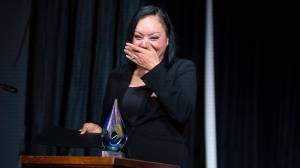
Wilson was one of five graduates who successfully completed Snohomish County’s alternative sentencing program for adults facing nonviolent, drug-related charges. She wore a black dress and had her hair and makeup done for the evening. A judge at the end of the ceremony signed a certificate dismissing her charges.
Federal drug czar and former Seattle Police Chief Gil Kerlikowske was a special guest at the ceremony.
Kerlikowske was selected by President Barack Obama earlier this year to head the Office of National Drug Policy. He is known as a strong supporter of drug courts.
“We look at addiction as a disease. It can be treated; it can be cured, and here are five wonderful examples (of that),” he said.
He congratulated the graduates and praised the county’s drug court team for its efforts.
“Drug courts are the perfect reason for people coming together and working together,” Kerlikowske said.
More than 2,000 drug courts have sprung up in almost every state of the country since the program first started in 1989 in Miami.
Snohomish County has three different programs. Two of them, including one for minors, focus on people facing criminal prosecution. The third, a pilot project started in February 2008, is for parents with drug-abuse problems whose kids were taken from them because of alleged neglect.
Participants agree to get random drug tests, attend frequent meetings and receive treatment. They face jail time if they don’t follow the rules. They also do community service work.
People charged with violent crimes are not eligible for any of the drug courts.
The program has its critics, however. For example, a recent report by the National Association of Criminal Defense Lawyers criticized drug courts for denying entrance to more serious offenders who might benefit from the program and instead focusing on people who can find help themselves or with community support.
For Victor Ross, 47, of Everett, drug court became the tool he needed to put his life back together after 30 years of addictions and eight DUIs.
“This program has helped me have a life,” he said.
When it was Ross’ turn to receive his certificate, one of his six children stood up to hand it to him.
Research shows that drug courts save taxpayer money, said Snohomish County Superior Court Judge David Kurtz, who presides over the program. Less than 7 percent of its graduates commit new crimes, compared to more than half of people who drop out, he said.
The program’s future was made uncertain recently because of deep budget cuts, but a $3 million federal grant in September provided relief.
The money from the U.S. Justice Department will keep the courts afloat for the next two years and even allow for expansion.
Katya Yefimova: 425-339-3452, kyefimova@heraldnet.com.