Citing new data, FAA relents and grounds the Boeing 737 MAX
Published 1:30 am Wednesday, March 13, 2019


News services and Herald staff
WASHINGTON — The U.S. government issued an emergency order Wednesday grounding all Boeing 737 MAX aircraft in the wake of the crash of an Ethiopian Airlines jet that killed 157 people.
Many nations had already barred the newest 737 model from their airspace, but until an announcement by President Donald Trump, the Federal Aviation Administration had said it didn’t have data to show the planes were unsafe. Trump cited “new information” that had come to light in the ongoing investigation.
“All of those planes are grounded, effective immediately,” Trump said during a scheduled briefing on border security.
Trump said the decision to ground the aircraft “didn’t have to be made, but we thought it was the right decision.”
“Boeing is an incredible company,” Trump said. “They are working very, very hard right now and hopefully they’ll quickly come up with an answer.”
The U.S. action came after a growing number of airlines and other countries had already grounded Boeing 737 MAX jets, or banned them from their airspace, following the crash of the Ethiopian Airlines plane on Sunday. Five months ago, an Indonesian Lion Air 737 MAX plunged into the ocean, killing 189, in apparently similar circumstances.
In a statement, Boeing said it “continues to have full confidence in the safety of the 737 MAX.” The company added that it had decided “out of an abundance of caution and in order to reassure the flying public of the aircraft’s safety — to recommend to the FAA the temporary suspension of operations of the entire global fleet of 371 737 MAX aircraft.”
Boeing CEO Dennis Muilenburg said the company was “supporting this proactive step out of an abundance of caution.”
A little later Wednesday, the FAA issued a statement confirming the official order.
“The FAA is ordering the temporary grounding of Boeing 737 MAX aircraft operated by U.S. airlines or in U.S. territory,” the statement said. “The agency made this decision as a result of the data gathering process and new evidence collected at the site and analyzed today. This evidence, together with newly refined satellite data available to FAA this morning, led to this decision.”
The FAA’s emergency order temporarily halted all flights of the Boeing MAX 8 and MAX 9 planes, effective immediately, “to address an emergency related to safety in air commerce,” the order says.
“On March 13, 2019, the investigation of the [Ethiopian Airlines] crash developed new information from the wreckage concerning the aircraft’s configuration just after takeoff that, taken together with newly refined data from satellite-based tracking of the aircraft’s flight path, indicates some similarities” between the Ethiopia and Indonesia crashes, according to the order.
Those similarities “warrant further investigation of the possibility of a shared cause for the two incidents that needs to be better understood and addressed,” according to the order.
Once current U.S. flights landed, they “may not again take off,” according to the order. Special flight permits may be issued, “including to allow non-passenger carrying flights, as needed, for purposes of flight to a base for storage, production flight testing, repairs, alterations, or maintenance,” the FAA said.
The order also says “experimental airworthiness certificates” may be issued “to support certification of design changes.”
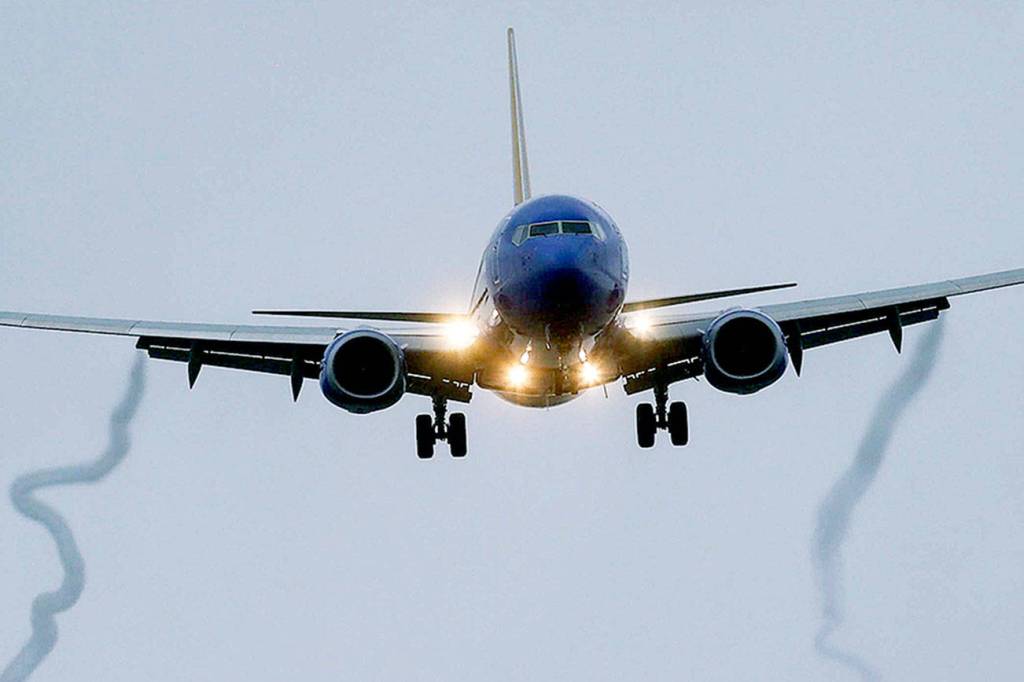
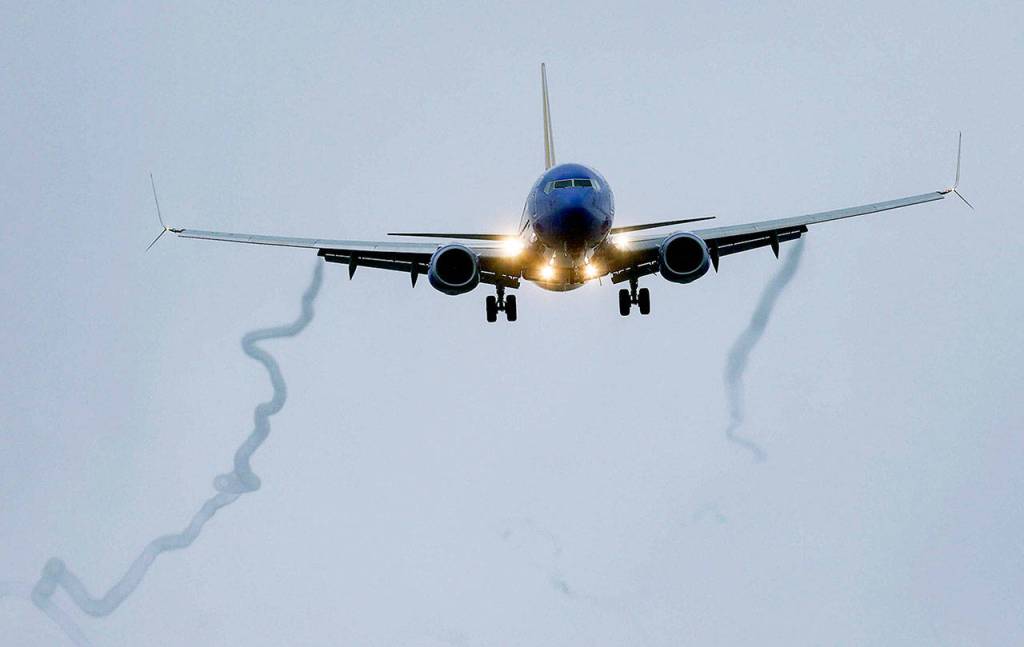
The order grounds more than 70 aircraft in the U.S. and covers both the 737 MAX 8 and MAX 9, the newest versions of Boeing’s venerable jetliner. The Renton-built plane is used by American Airlines, Southwest Airlines and United Airlines. American and Southwest combined have 58 MAX 8s in their fleets, and United has 14 bigger MAX 9 planes.
Earlier Wednesday, Canada joined much of the rest of the world in barring MAX planes from its airspace, citing the satellite tracking data, which suggested similarities between the Ethiopian airliner crash and the previous crash. Air Canada, that country’s leading carrier, flies the MAX.
Canadian Transport Minister Marc Garneau was the first official to publicly reveal the new satellite data, saying that a comparison of vertical fluctuations found a “similar profile” to that of the Lion Air crash that killed 187 people in October.
Garneau said the new information indicated that the Ethiopian jet’s automatic system kicked in to force the nose of the aircraft down after computer software determined it was too high. He said that in the case of a Lion Air crash off Indonesia, the pilot fought against computer software that wanted to drop the nose of the plane.
“So if we look at the profile, there are vertical fluctuations, in the vertical profile of the aircraft and there were similarities in what we saw,” Garneau said. “But I would repeat once again: This is not the proof that is the same root problem. It could be something else.”
Meanwhile, Ethiopian Airlines said Wednesday that flight recorders from the MAX 8 jet, which crashed six minutes after takeoff from Addis Ababa from an altitude of about 8,000 feet, will be sent abroad for analysis. It was unclear where. An airline official said one of the recorders was partially damaged.
Before the grounding, Boeing had said it had no reason to pull the popular aircraft from the skies and it did not intend to issue new recommendations to customers. Boeing CEO Muilenburg on Tuesday spoke with the president and reiterated that the 737 MAX was safe, the company said.
The FAA, too, had backed the jet’s airworthiness. But the list of countries barring Boeing 737 MAX planes continued to grow Wednesday. After Canada’s announcement, the U.S. government changed course.
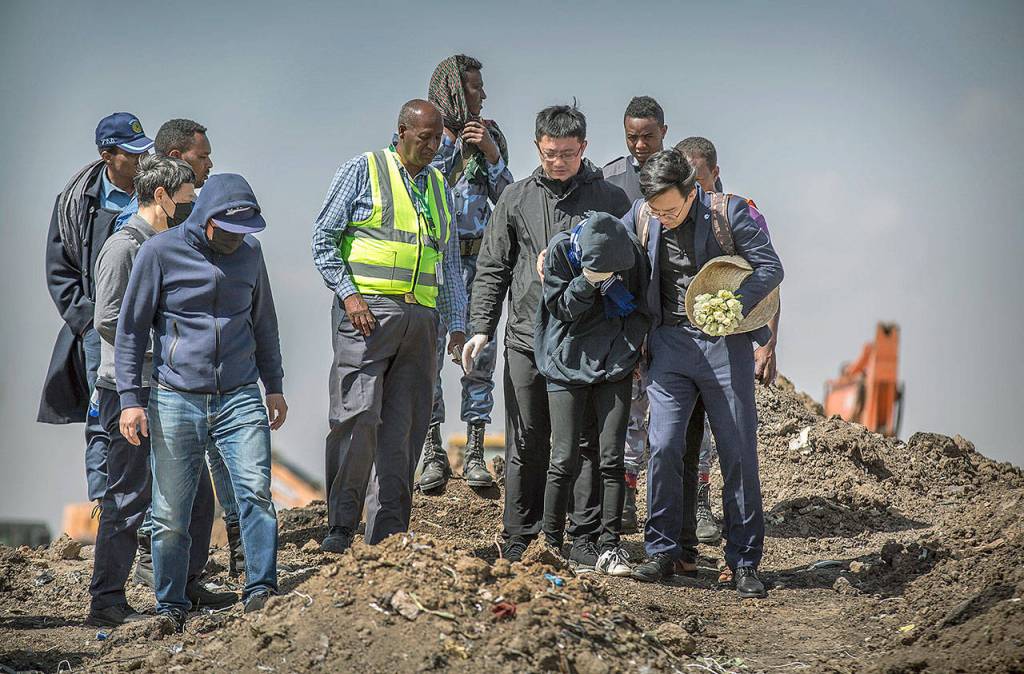
In Ethiopia, a Boeing technical team has joined U.S., Israeli, Kenyan and other aviation experts in the investigation led by Ethiopian authorities as more devastated relatives of victims arrived at the crash site Wednesday, some supported by loved ones and wailing.
Others mourned in private. Dawit Gebremichael sat with a photograph of his only sister, Sara, a flight attendant on the plane. She left three children.
“It is customary for Ethiopians to have a body and a proper burial,” he told The Associated Press. “But we don’t have the body here, and we don’t expect anything now.”
Within hours of the president’s announcement of the grounding of 737 MAX planes in the U.S., the political fallout began.
U.S. Rep. Rick Larsen, D-Everett, who heads the House Subcommittee on Aviation, and Rep. Peter DeFazio, D-Oregon, who chairs the House Committee on Transportation and Infrastructure, issued a joint statement:
“Despite repeated assurances from the FAA in recent days, it has become abundantly clear to us that not only should the 737 MAX be grounded but also that there must be a rigorous investigation into why the aircraft, which has critical safety systems that did not exist on prior models, was certified without requiring additional pilot training,” they wrote. “While a lot of data has yet to be recovered that will help explain why Ethiopian Airlines flight 302 went down, as chairs of the committee and subcommittee with jurisdiction over the FAA and NTSB, we plan to conduct rigorous oversight with every tool at our disposal to get to the bottom of the FAA’s decision-making process.”
Compiled from reports by The Associated Press and The Washington Post.