‘Build the spine’: SnoCo leaders say Everett light rail is a priority
Published 12:28 pm Wednesday, April 15, 2026
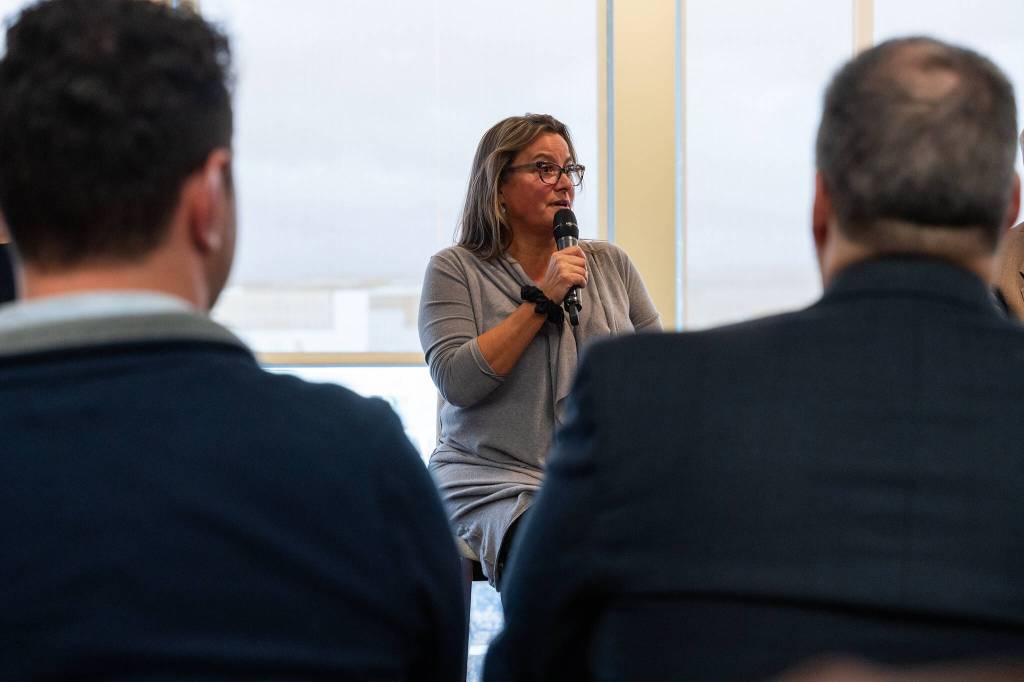
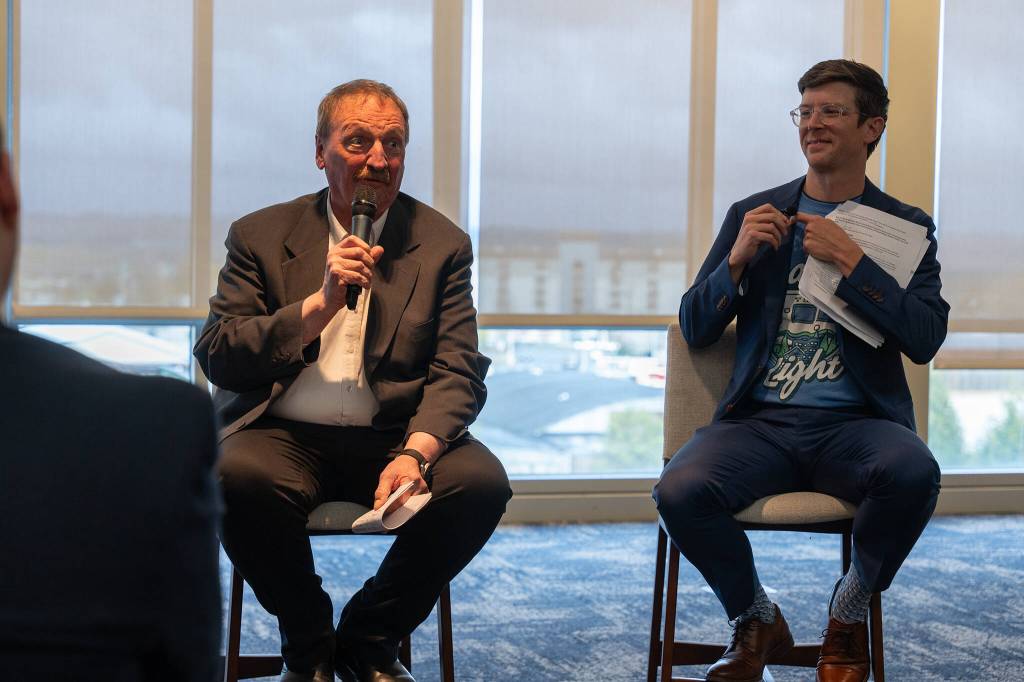


EVERETT — Snohomish County Executive Dave Somers and Everett Mayor Cassie Franklin had a simple message for attendees at a Tuesday town hall discussing how to address the financial challenges of Sound Transit’s massive light rail expansion.
Build the spine.
The spine is the term used to describe the north-south regional transit light rail system that will eventually connect Everett to Tacoma. That is priority No. 1 for Somers and Franklin, two of the three Snohomish County representatives on Sound Transit’s board of directors.
People packed the town hall Tuesday, hosted by the nonprofit Transportation Choices Coalition as Sound Transit is considering deferring or delaying light rail projects voters approved in 2016 as part of the Sound Transit 3 ballot measure. The agency faces a multi billion-dollar shortfall to fund that measure thanks to rapid inflation, tariffs, labor shortages, supply chain disruptions and added right-of-way costs.
At a March board retreat, Sound Transit presented three illustrative ideas as to how the regional transit agency might close the funding gaps. One of those three options would not complete the spine between Tacoma and Everett, stopping construction at the Southwest Everett Industrial Center without continuing to the Casino Road area or downtown Everett.
By June, the 18-member board is expected to vote on which cost-cutting options to take. But failing to complete the spine is not even a consideration for Franklin and Somers, the two said Tuesday.
“Citizens of Snohomish County have been paying for a system for a long, long time,” Somers said. “And it’s time for them to get the light rail into Everett.”
That $34.5 billion shortfall is across all of the Link light rail extension projects voters approved in 2016. The most significant cost increases come from the Ballard Link Extension; its estimated costs nearly doubled from about $12 billion to as much as $22.6 billion. The West Seattle light rail extension nearly doubled as well, from $4.1 billion to as much as $7.9 billion. (Those numbers assume no cost saving measures are taken. The agency has identified some significant potential savings for West Seattle extension, The Urbanist reported in March, a project further along in the design process).
In contrast to the Seattle projects, the Everett Link Extension did not see as significant cost increases. Its original bill of $6.5 billion has increased to as much as $7.7 billion. Tacoma’s extension also saw a less extreme increase than the Seattle projects, which will likely see higher property acquisition costs because of the denser built environment.
In August 2025, Sound Transit told its board of directors that the agency could find the savings needed to make the Everett Link Extension affordable, largely through changes to the extension’s design. No stations would be cut.
Those changes could include moving some parts of the line closer to existing rights-of-way along I-5 and Highway 526, while building more of the line at ground level, rather than elevated. (Those ground-level sections wouldn’t require at-grade crossings, the agency said).
“The cost increases for the Everett segment has been significantly lower than the Seattle segment,” Franklin said. “They’ve only gone up five to ten percent, and as I’ve said, we’ve been able to identify significant cost reductions that don’t include cancelling stations. Option three on that slide (not completing the spine) is simply not an option in my mind.”
Somers said that even though completing the spine is a top priority, building out the entire Sound Transit 3 network is essential, even if it takes longer or costs more than originally expected. The Ballard Link Extension, for example, is projected to carry the most daily riders — possibly up to about 150,000 per day — compared to any of the other light rail expansion projects, The Urbanist reported.
Sound Transit could explore options to pay for the other projects that face more extreme affordability challenges, including a new levy measure in the regional transit district’s North King County subarea or seeking private investment.
“That ST3 package that was passed by voters 10 years ago now is an excellent vision for the region,” Somers said. “Every part of it has value.”
Getting the light rail to Everett should be a priority, Franklin said, as Everett has lower incomes than other areas in the county and is home to many who commute to Seattle because they can’t afford higher housing costs there. But it’s also a city that deserves a robust transportation network of its own, she said, as Everett has upzoned significant areas of the city through its latest comprehensive plan update to encourage denser housing construction and mixed-use development.
Current plans show Everett would have three stations, possibly four if the city annexes the Mariner region of unincorporated Snohomish County. It will also include a large operations facility needed for the light rail system to function.
“A lot of our friends in King County seem to think that the goal of the system is to get people to Seattle, and that is not the goal of the system. We are a jobs center, and we are a place that people come as well,” Franklin said. “The goal is to really connect the entirety of the region, and we need to hear loud and clear that all of you care about the system and care about it getting to every single station in the Everett Link Extension.”
Sound Transit’s board of directors is hoping to vote on an updated Sound Transit 3 system plan by June, Somers said. The agency is conducing a survey to hear from residents about the potential cost-cutting options: tinyurl.com/yc5jz7hc.
As chair of the regional transit agency’s board, Somers said Tuesday he would bring forward a plan that is “affordable, both throughout the region and also within the sub areas.”
“The big changes are on the West Seattle, Ballard and the Issaquah lines,” he said. “Those are where the real questions are, because our segment going from Lynnwood to Everett, we can make it affordable, get it done. No debate.”
Sound Transit expects light rail to reach Everett near Paine Field by 2037, and reach downtown Everett by 2041. This fall, the agency plans to publish a draft environmental impact statement studying the potential impacts of the various station locations.
Will Geschke: 425-339-3443; william.geschke@heraldnet.com; X: @willgeschke.