Commentary
Published 1:30 am Saturday, April 25, 2026
Science begins with observations. These include the natural world we inhabit, and the heavens above. Here are some recent observations worth noting.
According to federal weather data, March was the hottest on record in 132 years of keeping such records. As reported by Seth Borenstein of Associated Press, not only was it the hottest March on record for the U.S., but the amount it was above normal beat any other month in history for the lower 48 states.
“What we experienced in March across the United States was unprecedented,” said Shel Winkley, meteorologist with Climate Central a nonprofit science research group.
“One reason that’s so concerning is just the sheer volume of records, all-time records that were set and broken during that time period,” Winkley said.“ “But also this is coming on the heels of what was the worst snow year. And the hottest winter on record.”
The World Meteorological Organization (WMO) issued “State of the Global Climate 2025” in March. The report finds that more of the sun’s energy is being trapped in the atmosphere, oceans and frozen regions. “The earth’s climate is more out of balance than at any time in observed history.” WMO confirms 2015-2025 were the hottest 11 years on record, the oceans are absorbing over 90% of the energy, and extreme weather impacts millions and costs billions.”
In 1980 concentrations of carbon dioxide were 338 ppm. Today they are in excess of 429 ppm. What is more, as noted by the WMO study, the rate of carbon pollution has been accelerating, warming the atmosphere with sever consequences.
As reported in the April 9 Herald, Washington’s Department of Ecology announced a statewide drought emergency. Despite a wetter than normal winter, warmer temperatures, increased melting and limited snowpack are contributing factors. The result is less water for utilities, homes, businesses, agriculture, habitat and increased wildfire risk.
Record-warm temperatures in many western states have resulted in almost no snow. Much of the western U.S. is facing water restrictions and increased wildfire risks. Reporting in the New York Times, Noah Molotch, a professor of hydrology at the University of Colorado, Boulder said: “scientists in many parts of the west found a snow drought this month unlike any they had seen.”
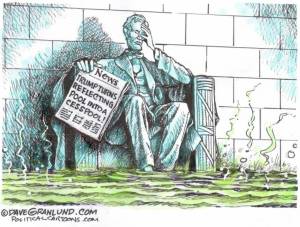
By contrast, President Trump calls climate change a hoax. His administration is eliminating observations – science and data reporting related to climate change. Examples include: canceling the National Climate Assessment, closing the National Center for Atmospheric Research (NCAR), ending NOAA’s reporting on financial impacts of climate disasters, and closing Forest Service research stations that study wildfires, droughts and global warming.
EPA Administer Lee Zeldin has overseen a systematic unraveling of climate change protections. Last week he delivered the keynote address at the Heartland Institute, a conservative think tank funded with dark money that rejects mainstream climate science and promotes disinformation. Referring to the repeal of the endangerment finding – EPA’s authority to limit greenhouse gases under the Clean Air Act – Zeldin said: “Today is a moment to celebrate vindication.”
Some of the most insightful observations come from one spaceship looking back on another.
Christina Koch, Mission Specialist onboard Artemis II, described the Troposphere from space. The Troposphere is the extraordinarily thin layer of gases surrounding the planet. She said: “What you realize is every single person that you know is sustained and inside of that green line, and everything else outside of it is completely inhospitable.”
In an interview on CBS News, Artemis Pilot Victor Glover said: “You guys are talking to us because we’re in a spaceship really far from Earth. But you’re on a spaceship called Earth that was created to give us a place to live in the universe, in the cosmos.”
The observations between these two spaceships underscores how fragile we are. Both Artemis and Earth have systems providing life support – air, water and temperature – the goldilocks zone essential for survival.
On Artemis we have expended great effort to engineer, protect and nurture life-sustaining systems beyond Earth’s atmosphere. On Earth we practice willful ignorance, pretending we can exist outside of life-sustaining systems. Perhaps the observations between these two spaceships will help us realize we are not separate from nature. Rather, we are part of it.
Paul Roberts is retired and lives in Everett. His career spans five decades in infrastructure, economics and environmental policy including former Chair of the Puget Sound Clean Air Agency Board and advising Washington cities on climate change.
Eco-nomics
“Eco-nomics” is a series of articles exploring issues at the intersection of climate change and economics. Climate change (global warming) is caused by greenhouse gas emissions — carbon dioxide and methane chiefly — generated by human activities, primarily burning fossil fuels and agricultural practices. Global warming poses an existential threat to the planet. Successfully responding to this threat requires urgent actions — clear plans and actionable strategies — to rapidly reduce GHG emissions and adapt to climate-influenced events. The Eco-nomics series focuses on mitigation and adaptation strategies viewed through the twin perspectives of science and economics. Find links to the series thus far at tinyurl.com/HeraldEco-nomics.