Who will carry the load for UW football in 2026?
Published 10:12 am Tuesday, May 19, 2026
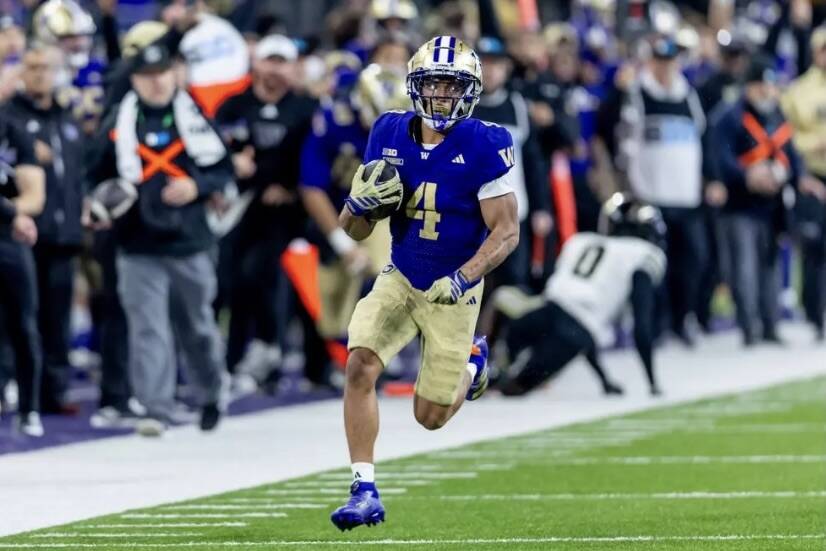
When the Washington Huskies football team opens the 2026 season with the Sept. 5 Apple Cup, quarterback Demond Williams Jr.’s first handoff to a running back will likely invoke a question from casual fans.
“Who is that guy?”
The answer at the end of spring football appeared easy: That guy was Quaid Carr. Who it will be in September, and how carries are distributed among a new-look running back room, may still be a question Washington coaches are asking each other a few games into the season.
For the past two years, it was an easy answer. Jonah Coleman followed Jedd Fisch from Arizona to Washington to be the lead back, and it was determined relatively quickly in 2024 that Adam Mohammed would be his running mate.
That won’t be the case in 2026. Coleman is a rookie with the NFL’s Denver Broncos, and Mohammed entered the transfer portal before landing at Cal.
This season, there are a couple of obvious candidates, but no certain leading ballcarrier. Based on Jedd Fisch’s five seasons as a head coach, it would seem that Bishop Sankey’s school-record 327 carries set in 2013 is safe. Under Steve Sarkisian, the Huskies logged 610 rushing attempts that year, 144 more than Fisch’s highest mark of 466 set last season.
Carr seems in line to lead the team in carries, but senior transfers Jayden Limar (Oregon) and Trey Cooley (Troy-Georgia Tech-Louisville) are expected to be healthy this summer after missing spring while recovering from surgeries. Highly-touted true freshman Brian Bonner Jr. could factor in, as could fellow big back Ansu Sanoe, who impressed in the spring game.
The status of sophomore Jordan Washington, who suffered a neck injury during an April 4 scrimmage, may not be known until July. Washington, whose 27 carries last season is most among returning running backs, wore a neck brace while attending UW’s May 1 spring game.
Coleman’s 193 attempts in 2024 stand as the most by one player under Jedd Fisch, who typically spreads carries among 2-3 running backs. Add in the wrinkle of Williams rushing ability from the quarterback position — he had 112 carries last year, not including 31 sacks taken — and there are only so many carries to spread around.
Of the 466 official running plays in 2025, running backs toted the ball 271 times. Coleman led the team with 156 rushes for 758 yards, compiling 57.6% of attempts by running backs.
Coleman established himself as a clear lead back in 2024, taking 193 carries, which was 65.6% of running back attempts. He was on a similar pace last season before missing a game and being limited in four others after suffering a knee injury Nov. 8 at Wisconsin.
At Arizona, Fisch spread the carries out among four running backs, with no back going over the 43% mark.
So, what does that mean this season?
It seems unlikely any running back will hit the 200-carry mark, and 150 would be a mild surprise. Williams’ 143 rushes (including 31 sacks taken) last season were by far the most by a quarterback under Fisch. His rushing attempt total seems unlikely to decrease, meaning there are only so many handoffs available to backs.
Early on, this could be like Fisch’s 2023 Arizona team. Coleman led the way with 128 attempts, and four backs received meaningful carries.
Though Carr carried the ball just four times as a true freshman last season, he showed some wiggle in practices and during spring ball this year. Caution should be used, though, when evaluating running backs in practice situations. Full contact is rare, which eliminates opportunities for big hits by defenders and broken tackles by runners.
So, it’s not just that you don’t know who will carry the load, or that I don’t know. I don’t think the coaches are sure yet. And it may take the first three games against Washington State, Utah State and Eastern Washington — or beyond — to sort it out.
The Main Candidates
Heights and weights as listed on the 2026 spring roster.
Quaid Carr
RS freshman, 5-11, 189 pounds
Carr and Washington seemed locked into the top two spots before Washington went down with the injury. Carr, who ran a 10.7 in the 100 meters as a high school sprinter, has shown excellent burst and instincts in practices. He seemed poised to get some carries late last season, but was held out with an injury. Carr rushed for 1,102 yards and 12 touchdowns on just 81 carries as a senior at Servite High School (Calif.)
Projection: 145 carries, 700 yards
Jayden Limar
Senior, 5-10, 205 pounds
The Lake Stevens, Washington native carried the ball 95 times across three seasons at Oregon, including a career-high 46 rushes last season. Limar gives the Huskies some much-needed Big Ten game experience. He should play a major role this season, and could take on a larger role if Carr struggles early.
Projection: 80 carries, 365 yards
Trey Cooley
Senior, 5-10, 208 pounds
Similar in stature to Limar, Cooley is coming off an ACL injury that wiped out his entire 2025 season. A sixth-year senior, Cooley amassed 209 carries for 983 yards in his first three seasons — two at Louisville and one at Georgia Tech. Cooley was brought in on March 17, which is relatively late in the process, as Fisch and running backs coach Scottie Graham looked to get more experience in the RB room. I expect him to get a few meaningful carries per game, and his role could expand if warranted.
Projection: 40 carries, 180 yards
The Wildcards
Jordan Washington
RS Sophomore, 5-10, 181 pounds
Washington possesses elite speed, with a 10.30 100-meter time on his Long Beach Jordan H.S. (Calif.) resume. If cleared to play this season, it would seem Washington would factor in to take at least a handful of carries each game once fully in game shape. Washington doesn’t possess the instincts or wiggle of Carr, but is a major home run threat.
Brian Bonner Jr.
Freshman, 5-11, 196 pounds
The electric four-star recruit out of Valencia (Calif.) was a threat as a runner and a pass catcher in high school, compiling 113 carries for 1,051 yards and 18 catches for 525 yards and 20 touchdowns his senior season. Fisch said Bonner was held out of the spring game with a minor soft-tissue injury to make sure a setback was avoided.
It was easy to think Bonner might be a threat to start in a wide-open competition. That could still be the case, but it seems like the staff wants to put more weight on him before he jumps in regularly against Big Ten defenders. Bonner possesses perhaps the highest ceiling in the running back room, and could be a factor in the second half of the season. I would not expect to see him much early on.
Ansu Sanoe
Freshman, 6-2, 241 pounds
While Bonner needs to gain a few, that is not a concern for Sanoe, a massive true freshman who ran over prized sophomore linebacker Zaydrius Rainey-Sale in the spring game. Again, it’s hard to fully evaluate running backs in a spring game, but Sanoe’s four carries for 29 yards looked solid. He could work his way into a short-yardage role during fall camp, but I’m not sure he’ll get double-digit carries this season.
This story originally appeared at emeraldcityspectrum.com.