10th District candidates discuss affordability, electric ferries and housing
Published 1:30 am Thursday, July 9, 2026
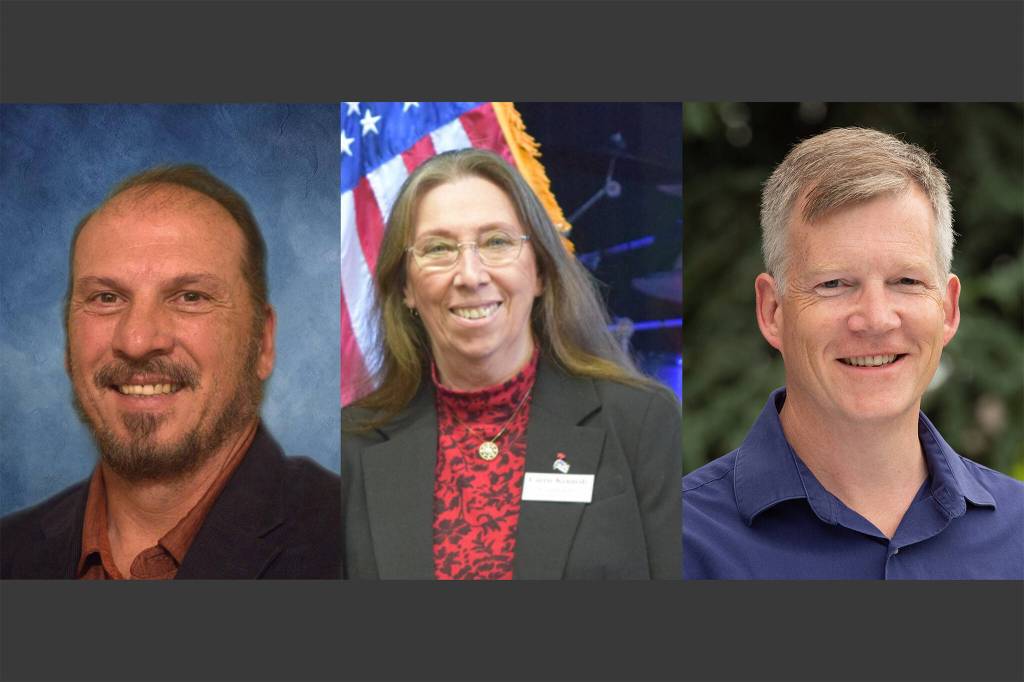
EVERETT — Five candidates are competing for the two open seats in District 10 for the State House of Representatives. While two will automatically go to the general election, three candidates are vying for position 2.
The 10th district encompasses Island County and parts of Skagit and Snohomish counties, such as Stanwood, parts of Arlington and Mount Vernon.
Incumbent Clyde Shavers and Robert “Chili” Hicks, who are going after position 1, will automatically advance to the general election ballot. As for position 2, incumbent Dave Paul, the lone Democrat, is up against two republicans, Tim Hazelo and Carrie Kennedy.
State representatives earn $72,494 per year.
The county will mail ballots out July 14. The two with the most votes for position 2 will advance to the Nov. 3 general election.
Tim Hazelo
Hazelo, 58, was in the military for two decades before retiring. Now, he lives in Oak Harbor, where he works as a truck driver. He also runs a small farm where he raises animals and grows fruit and vegetables.
Hazelo first ran for office in 2020 to represent the state’s 2nd Congressional District, ultimately losing the race to incumbent Rick Larsen. Previously, he was the Island County Republican Party Chairman, and he currently serves as the organization’s state committeeman.
He was inspired to run for the District 10 seat after seeing rising costs at the gas pumps and new taxes. Hazelo said he decided someone needed to stand up for the middle guy.
“Who better to do it than somebody who comes from that class themselves?” He said.
His priorities include limiting taxes, increasing affordability, working on judicial reform, and infrastructure, such as pushing against the electrification of the ferry system.
Hazelo said he is running against any taxes the population doesn’t vote on, such as the state’s new “Millionaires’ Tax,” which Governor Bob Ferguson signed into law in March.
The bill created a 9.9% tax on income over $1 million in a single year, with the revenue going towards funding free meals for K-12 students, expanding the Working Families Tax Credit and reducing certain sales taxes and business & occupation taxes.
The new tax also included a “necessity clause” that shields it from a referendum. Toward the end of the bill, lawmakers wrote that the tax is “necessary for the support of the state government and its existing public institutions.”
Hazelo argued that if an emergency clause was necessary, why doesn’t the tax not take effect until the beginning of 2028? Hazelo also expressed concerns that the bill could be expanded to non-millionaires because of what he claimed is sparse language specifying the tax applies to earnings of more than a million.
The bill specifies that “Washingtonian households with an annual adjusted gross income of less than $1,000,000 will not owe this tax.”
If elected, Hazelo said his number one priority would be to reverse that taxation policy, he said.
“I think we can do that with good legislation about how we spend rather than taking more money from the people,” Hazelo said.
When it comes to housing affordability, over-regulation and high costs of building are driving up median housing prices, Hazelo said.
Groups such as the National Association of Home Builders say that “excessive” building regulations contribute to housing affordability issues, with government regulations accounting for nearly 25% of the price to build a single-family home and more than 40% for a typical multifamily development.
Hazelo said he would need to discuss with staff and other policymakers, if elected, on how to approach judicial reform. But he stated the need to “end this catch and release.” He also claimed there needs to be more accountability for how funds from social programs are allocated.
“Why is it that we spend all this money on all these social programs, and yet we can’t help anybody?” he said.
Hazelo has also taken a stance against electric ferries.
As part of a push to limit their greenhouse gas emissions, Washington State Ferries plans to transition to hybrid-electric power by 2040, according to the Washington State Department of Transportation. Washington State Ferries burns approximately nineteen million gallons of diesel fuel each year.
The hybrid-electric fleet will include up to 16 new vessels and add shore charging at up to 16 terminals. The Clinton ferry terminal and the route between Edmonds and Kingston are among those to be electrified, The Daily Herald previously reported.
Florida-based Eastern Shipbuilding Group will build three new 160-vehicle hybrid-electric ferries, announced Ferguson last year.
For Hazelo, diesel electric is the way to go.
“We’re spending tons of money we don’t need to spend on ferries, electric ferries that are built outside of the state of Washington that aren’t going to do the job,” he said. “They’re going to be less dependable, and they’re going to cost more money.”
If elected, Hazelo would try to find a way out of the current out-of-state contract and work to find a local boat builder to “build a ferry that actually works for Washington,” he said.
In 2024, Hazelo refused to wear a mask while observing the ballot-counting process. Prosecutors charged him with disorderly conduct, first-degree criminal trespass and the felony charge of unauthorized access to a voting center, according to court documents.
Prosecutors later dropped the disorderly conduct charge.
In July 2025, a jury found Hazelo guilty of both counts, but court filings show a judge vacated the criminal trespass conviction.
Hazelo avoided jail time, with a judge sentencing him to 40 hours of community service and fees totalling $700. The current sentence status is marked as fully satisfied, according to court filings. The case is currently on appeal.
“This auditor put in a mask mandate in one room in one building all by herself, did not consult with the Department of Health,” Hazelo told The Daily Herald in May. “There was no COVID emergency. This was in 2024, November of 2024.”
As of Tuesday, Hazelo has not added his campaign contributions to state filings. He received endorsements from the Snohomish, Skagit, Island and Pierce counties’ republican parties and the Snohomish County LD 10 Committee.
Carrie Kennedy
Kennedy, 68, has run in multiple past elections, including running for District 10’s position one against Clyde Shavers in 2024. She also ran for the state’s 2nd Congressional District in 2020 and 2022, but did not advance from the primary.
Kennedy currently resides in Coupeville and is retired after working a variety of jobs while traveling as a Navy wife. Due to her husband’s and father’s military backgrounds, she said politics have always played a role in her life.
“Our moves and transfers were predicated on political events that were going on in the world, so I grew up with two political parents, and then, being an adult, I’ve always been political.”
A need for fiscal responsibility within the state is what Kennedy said called her to run in the 2026 election.
“We need people that are going to just say, ‘Let’s have some accountability.’ Let’s do some audits,” she said. “Let’s figure out where the money’s going.”
Accountability would be her top priority if elected, she said, especially when it comes to taxes.
“It’s kind of like running our households,” she said. “We cannot go out and buy things if we don’t know what our budget is.”
When it came time for her family to settle in one location, she said the choice to stay in Washington was easy because it didn’t have an income tax. Kennedy expressed concern that the millionaire tax would cause military retirees in the state “to vacate in droves.
“And it’s because of the income tax,” she added. “Granted, it’s not going to be happening right away, but I personally don’t think it’s a millionaire tax, I think it’s an everybody tax, and it’s coming to all of us.”
Among her other priorities is transportation. Kennedy also expressed concern about the new electric ferries being made out of state. Tied to her main priority of accountability, Kennedy suggested an audit to understand how transportation funds are being used.
“I think that we needed to keep that here in the state,” she said.
Another concern for Kennedy when it comes to the electrification of ferries is the potential increase in electric bills.
“There are a lot of people that don’t use the ferries, but they’re going to be impacted, so that’s a concern,” she said.
Other areas Kennedy said legislators should be looking into are regulations and building codes for houses to identify what is hiking up the costs.
“How many people can afford an apartment or even to buy a home?” she said. “It’s getting out of reach for young people.”
If elected, Kennedy would seek more federal funding for trade schools. She claimed some of the trades needed in the construction industry have “gotten put off.”
While Kennedy said she can’t know the details of policies the way someone in office can at this time, it wouldn’t take long to learn them if elected.
“All I can look at is what’s going on in my community, and we’re suffering,” she said.
In 2024, The Daily Herald published an article on a series of social media posts Kennedy made calling for the release of people imprisoned for the Jan. 6 storming of the U.S. Capitol, claiming the U.S. representative from California, Eric Swalwell, “should be front of a firing squad for your treason,” and other posts about far-right groups.
Kennedy claimed some of the article’s points were taken out of context, such as the statement she identified as an Oath Keeper, a far-right militia group. The alleged association stemmed from business cards where Oath Keeper was included in bullet points, she said.
“That context meant I keep my oaths,” she told The Daily Herald in June. “When I take an oath, I keep an oath. It didn’t say I was a member of the Keeper organization.”
Kennedy added that she goes to events on both sides of the aisle, but it doesn’t mean she is supporting the organization.
“I’m getting information like I think most people do,” she said.
As of Tuesday, Kennedy has not added her campaign contributions to state filings. She is endorsed by the Island County Republican Party on her website.
Dave Paul
Paul, 58, is running for his fifth term as a District 10 representative. The Oak Harbor resident works as the director of community relations for the Skagit Valley College in addition to teaching American government during the fall and spring quarters.
Currently, he is the chair of the Postsecondary Education & Workforce committee, in addition to serving on the Transportation and Technology, Economic Development & Veterans committees.
Paul wanted to run for reelection to continue his educational work by keeping college affordable in the state and “making sure that everything we’re doing in terms of workforce training is leading to a living wage job,” he said.
Part of this goal is improving Career and Technical Education Dual Credit programs, which allow students to earn high school and college credit simultaneously, and continuing to ensure K-12 classes align with community college and other workforce training programs.
“We’re going to continue trying to facilitate those conversations and making sure that any state resources we use at the state level are helping to get folks to collaborate and work together better,” he said.
He also wants to continue his work with the North Sound Behavioral Health Administrative Services Organization, county officials, healthcare professionals and law enforcement to improve the Designated Crisis Responder program in the region.
Designated Crisis Responders evaluate and work with individuals experiencing mental health or substance abuse crises.
Paul said he has heard from community members that the program is not working well in areas like Whidbey Island.
“I do think now we were starting to get some traction on fixing that issue,” he said. “I want to make sure I’m keeping attention on that, and bring those folks together to collaborate to get that solution implemented.”
College affordability is another priority for Paul. One way he plans to achieve that is by protecting funding from the Workforce Education Investment Act, which created the Washington College Grant. The grant covers or subsidizes costs for post-secondary education.
Language changes in the 2025 budget would allow money to be diverted out of the act, Paul said.
“I’m trying to prevent that because we want to make sure that we’re using the money that was intended when industry voted, or supported, having their B&O tax increased; we also want to make sure we’re keeping tuition low.”
Transportation, specifically finding funding for the three out of six electric ferries that are not already budgeted for, is a priority for Paul.
“If we don’t, we run the risk of having a half dozen ferries or 10 ferries that are going to need to come out of service around 2035,” he said.
Losing the ferries without a replacement could be “detrimental to ferry communities,” Paul said.
As far as affordability, Paul said the state will have to recognize that sometimes its policies contribute to the rising costs individuals are facing.
“Are there things the state can do to reduce regulations that are driving up costs?” He said. “That’s just something we’re going to have to look at.”
As of Tuesday, Paul has raised $111,412 in campaign funds, according to state filings. He is endorsed by the Skagit County Democrats, the Washington Housing Alliance Action Fund, Planned Parenthood, the Sierra Club and others.
Jenna Millikan: 425-339-3035; jenna.millikan@heraldnet.com; X: @JennaMillikan