Win-win situation
Published 9:00 pm Tuesday, June 5, 2007
Yell at him.
Go ahead. Let him have it.
He can take it.
Thrives on it, in fact.
“I’m used to intense baseball,” Mason Tobin says. “The more you’re into it, the more you get yelled at, the more you care.”
He cares a lot about winning. Witness what he did this spring.
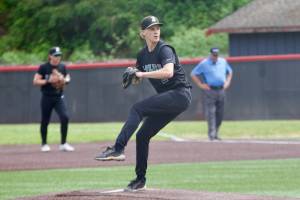
The 6-foot-3, 210-pound right-handed pitcher was 9-0 with a 1.20 earned-run average for the Everett Community College baseball team.
It was his first – and last – season as a Trojan, after transferring from Western Nevada CC last fall. And it might have been his final season as an amateur.
Though he has earned an athletic scholarship to play baseball for Embry-Riddle University in Daytona Beach, Fla., Tobin – a graduate of Kentridge High School – might be donning a uniform in the minor leagues this summer. A 48th-round selection of the Atlanta Braves in the 2006 draft, Tobin was taken as what is called a draft-and-follow prospect. That is, the Braves owned his rights and could monitor him for a year. They had until midnight last Thursday to sign him, and when they didn’t, he became eligible for this year’s draft, which begins Thursday.
His college coach expects Tobin to be drafted considerably higher than he was last year. “I think he’s a top-five-round pick,” Trojans boss Levi Lacey.
And Lacey knows something about high draft picks. Three of his players were chosen in the first 10 rounds of the 2005 draft – pitchers Zach Simons (second round, Colorado) and JT Zink (eighth round, Boston), and outfielder Aaron Cunningham (sixth round, Chicago White Sox).
Like those three, Tobin hopes to go straight from community college to the pros. “I’d really like to get a contract,” he said. And while he’d have preferred it be with the Braves, his favorite team as a kid, he knows that he has a good chance to land a nice bonus by going back into the draft.
However, if that doesn’t happen, he still has a cushion to fall back on: the college scholarship. “I’m not opposed to going to college,” he said. “The way I look at it, if I get to go for free, that’s still a plus.”
That it is. Yet …
“He wants to play (professional) baseball,” Lacey said. “He knows he’s worth something.”
And Lacey thinks once he signs, Tobin can have a good career in the pros. And he isn’t talking about minor league baseball. “I do” think he can pitch in the majors, the coach said. “He’s very competitive. He wants to be successful. He makes good decisions. He worked hard this year and made some mechanical changes. Good athletes can do that if they’re coachable, and his attitude was, ‘I’m going to listen to my coaches.’”
A lot of kids are listening to Lacey and his staff. And they’re benefiting from it. Twelve players off this year’s team earned scholarships to four-year schools, including Jake Hammons of Snohomish.
Hammons, the Trojans’ catcher, has a full ride to New Mexico State and will likely enroll there … unless something really good happens in the draft. What would it take for him to sign? “I have no clue,” he said.
He has already been drafted once (in 2005, Oakland took him in the 32nd round, but he enrolled at EvCC), and Lacey wouldn’t be shocked if he’s selected again this year. “He definitely has the ability to play at the next level,” the coach said.
Tobin certainly enjoyed having Hammons as his catcher. When a pitcher doesn’t have to constantly be shaking off signals, it makes his job a whole lot easier. And Tobin said he and his catcher were almost always in sync.
“I could just grip it and throw it,” Tobin said. “He knew the hitters well and he called the pitches.”
Another thing that made Tobin’s job easier was the hefty offense the Trojans provided. The team batted .309 and averaged better than six runs a game in winning 31 of 43 regular season games.
“I knew I was going to do well,” Tobin said, “because I knew I was going to get run support, a pitcher’s best friend.”
A major supplier was the left-handed swinging Hammons, who led the team in hitting during the regular season with a .407 average and in hits with 57. How he got his average over .400 was a remarkable stretch of efficiency – 14 hits in 14 official at-bats near the end of the season.
“When you get 14 hits in a row,” Lacey said, “someone is looking out for you.”
Scouts not only like Hammons’ bat, but his actions behind the plate, his arm, and his intelligence. As for Tobin, scouts have been impressed with the improvement he’s show since high school.
Long before high school, Mark Tobin said he knew that his son had “this gift” to excel at baseball.
“When he was three years old, he could throw a plastic baseball up and hit it with a plastic bat,” the father said. “When he was four, we said he was five to get him into (organized) baseball because he was so good.”
Without his father pushing him, Mason said he wouldn’t be where he is today. “I pretty much owe everything to my dad,” he acknowledged.
Some kids rebel when pushed by their parents, and Mason was no exception. “I did a little bit,” he admitted. “Once I got to a certain age, I bought into it.”
As a youngster living in Montana, Tobin was an outstanding freestyle wrestler, winning five state championships in AAU competition. He was playing baseball at the same time, and sometimes would leave a game early to get to a wrestling match, wearing his wrestling singlet underneath his baseball uniform.
He got his aggressiveness from wrestling. “It’s just you and the other guy on the mat,” he said, “just as it’s the pitcher against the batter in baseball.”
The big difference between the sports: if you hit it big, baseball pays a heckuva lot better.