Editorial: Wildfire smoke season calls for caution, preparation
Published 1:30 am Tuesday, June 13, 2023
![FireDanger-EDH-230606 [story]
Back
BasicDetailedUsage
P-FireDanger-EDH-230606.jpgdownload
Source
attached
Description
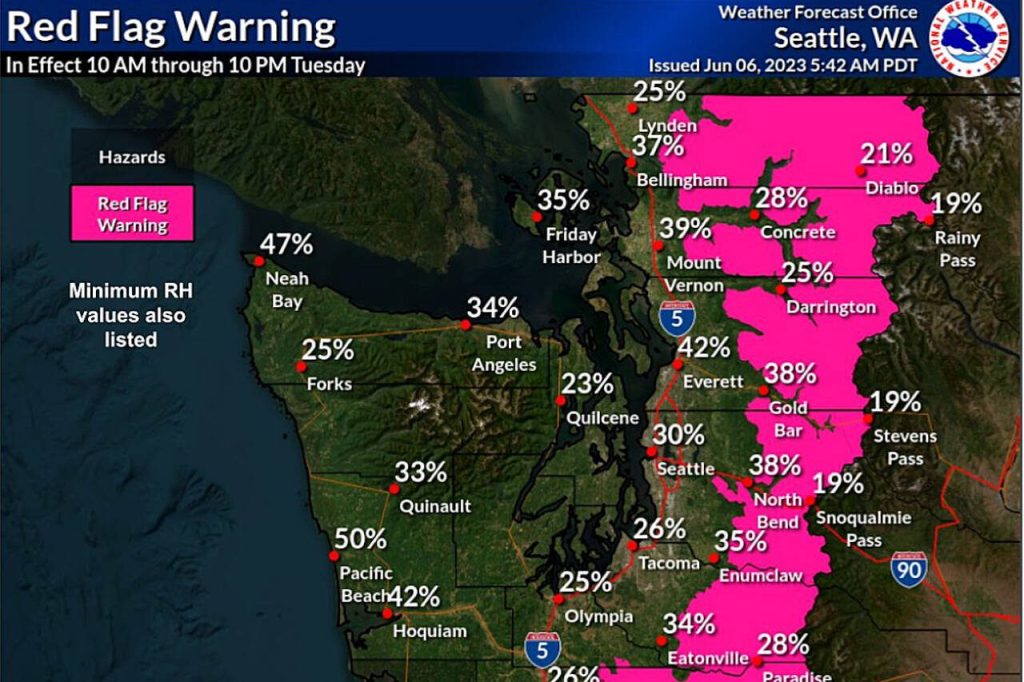
The Red Flag Warning has been expanded northward across the western Cascades through 10 PM this Tuesday due to continued dry conditions. (Photo provided by National Weather Service Seattle)
Tags
edit
Created 6/6/2023 1:59 pm
Uploaded 6/6/2023 1:59 pm
→↩](https://www.heraldnet.com/wp-content/uploads/sites/8/2023/06/32994285_web1_TSR-230613-edh-wildfireRedFlag.jpg?w=1024)
![FireDanger-EDH-230606 [story]
Back
BasicDetailedUsage
P-FireDanger-EDH-230606.jpgdownload
Source
attached
Description
The Red Flag Warning has been expanded northward across the western Cascades through 10 PM this Tuesday due to continued dry conditions. (Photo provided by National Weather Service Seattle)
Tags
edit
Created 6/6/2023 1:59 pm
Uploaded 6/6/2023 1:59 pm
→↩](https://www.heraldnet.com/wp-content/uploads/sites/8/2023/06/32994285_web1_TSR-230613-edh-wildfireRedFlag.jpg?w=150&h=150&crop=1)

By The Herald Editorial Board
Northwesterners might have felt a mix of smugness and sympathy last week as denizens of the East Coast complained — as if this were a calamity unique to them — about their wildfire smoke-choked skies, irritated eyes and scratchy throats; conditions and symptoms to which we’ve been regularly exposed in recent summers.
Been there. Done that. Kept the face mask.
We’re already veterans of “wildfire smoke season,” as recently as last fall when a rare but persistent wildfire consumed forestland in the Cascade foothills of Snohomish County. The Bolt Creek fire forced evacuations in the county’s eastern communities along U.S. 2 last September, and the heavy smoke from the fires canceled classes for the Index and Sultan school districts.
Also last year, as in 2018 and 2020, wildfire smoke drifting from huge fires elsewhere in Washington state, Oregon, Idaho and Canada’s provinces of British Columbia and Alberta left us with hazy skies, orange sunsets, poor air quality and an uneasiness about what we were breathing in.
Any respite for Western Washington since last fall may soon go up in smoke.
Already, the National Weather Service has issued the year’s first red-flag warning, indicating warmer temperatures, lower humidity and stronger winds — ideal conditions for wildfires — for the western slopes of the Cascades, the earliest such warning for the region since 2006, The Herald’s Jordan Hansen reported Monday. The National Interagency Fire Center, likewise, is predicting “above normal” fire potential and a greater likelihood of significant fires for most of the state.
A wet early spring that encouraged the growth of underbrush, a drier than normal May that has dried that vegetation and the return of the El Niño weather pattern’s expected warmer temperatures are creating a combustible mix in Western Washington, Reid Wolcott, a meteorologist with the National Weather Service’s Seattle office told The Herald.
“We’re kind of getting into unique territory as far as how dry the spring and now early summer are looking,” Wolcott said. “And there’s really no significant chance of widespread precipitation at all on the horizon.”
Those warnings — and smoky memories — call for precaution and preparation.
Washington residents should watch for alerts regarding air quality, and can check resources for advisories such as the Puget Sound Clean Air Agency and wasmoke.blogspot.com, which includes an interactive map of the state with current air quality reports.
Where the smoke comes from and your amount of exposure can matter in terms of the potential for ill effects. Wildfire smoke commonly contains particulate matter of 2.5 microns or smaller, small enough to get deep into the lungs.
Generally, your lungs can deal with reasonable doses of smoke, writes Christopher T. Migliaccio, an assistant professor at the University of Montana, in a recent article for The Conversation.
The problem, Migliaccio says, is the amount of exposure.
“As with a lot of things, the dose makes the poison; almost anything can be harmful at a certain dose,” he writes.
The more days of smoke exposure and the more time spent outdoors can add up.
One reason that children and the elderly are of particular concern with exposure is that their quicker breathing can mean more air intake in relation to the size of their bodies, and thus, “more poison.”
Also of concern, he said, are recent studies that show that wildfire smoke that has traveled over greater distances, and been exposed for longer periods to sunlight’s ultraviolet rays, can change its chemistry and create more oxidation and free radicals that have a greater potential to harm health.
Migliaccio recommends keeping N-95 masks — those that many of us used during the covid pandemic — handy. Cloth masks, he said, don’t do much to block the tiny particulates in wildfire smoke.
A reminder from Smokey Bear — that only you can prevent wildfires — also is worth repeating.
While it’s now recognized that there are times and places for prescribed burns that can limit the fuels and potential for wildfires, the start of wildfire season isn’t one of them, and those of us venturing into fields and forests need to take extra care to limit the potential to start fires.
While information released was not specific, authorities with the Department of Natural Resources determined last year that the Bolt Creek fire was human caused.
That shouldn’t happen again.
It should go without saying to follow directives regarding burn bans and to take care — when and where fires are allowed — to put them out — cold — after cooking or before bed or leaving a camp or picnic site. The same goes for backyard debris burning.
Check vehicles for dragging chains and other parts that can cause speaks and light fires along roadsides. And avoid parking on dry grass or brush that can be ignited by hot exhaust pipes. Spark arresters should be used on all gasoline-powered equipment in wildland areas.
And how about taking a holiday from the consumer fireworks — and their property damage and injuries — this Independence Day?
Without adding to the debate about whether the increased frequency of wildfires and their smoke is a result of climate change — and it’s hard not to draw that conclusion observing the trends for earlier wildfire seasons — what’s clear is that wildfires no longer are a concern only for our Central and Eastern Washington neighbors.
As they now expect to prepare and take precautions, we now have to do the same.