As offices reopen, some former ‘super commuters’ aren’t happy
Published 1:30 am Thursday, September 9, 2021
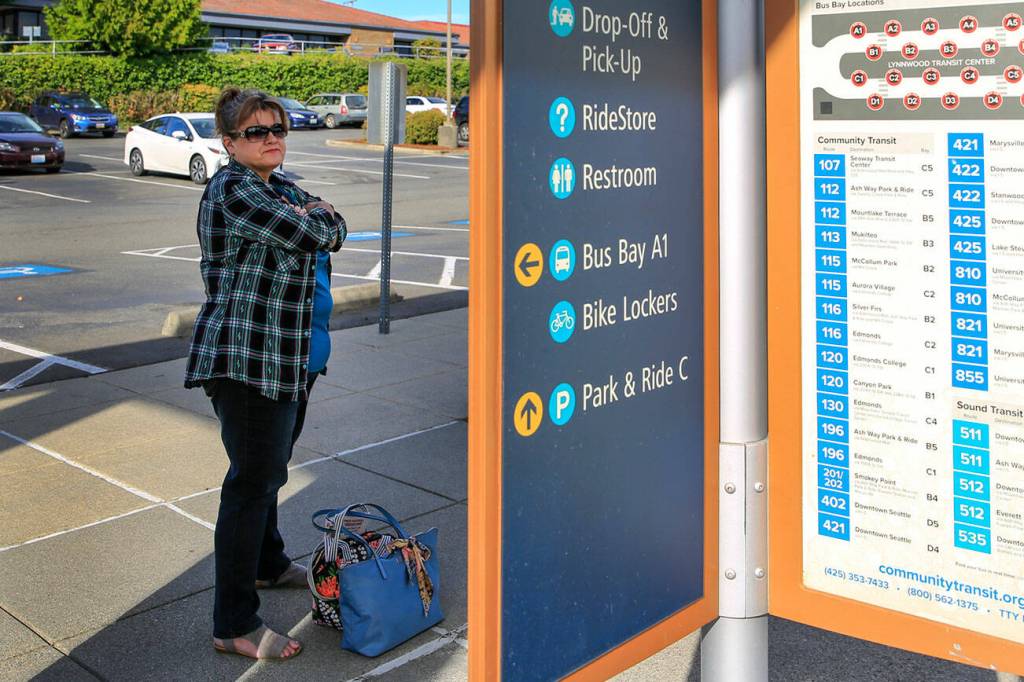
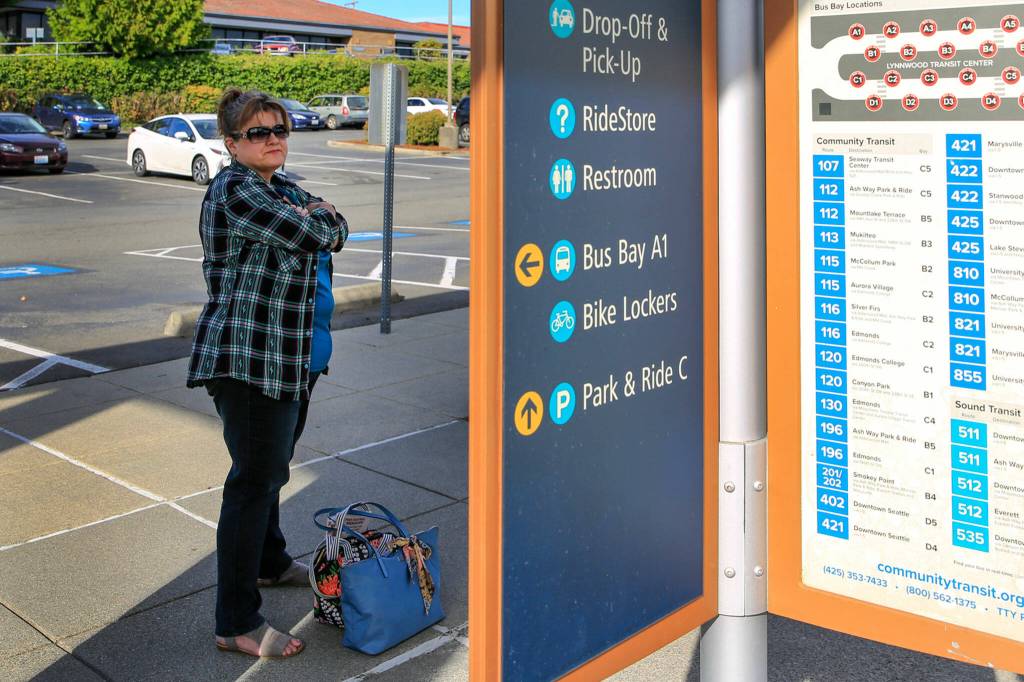
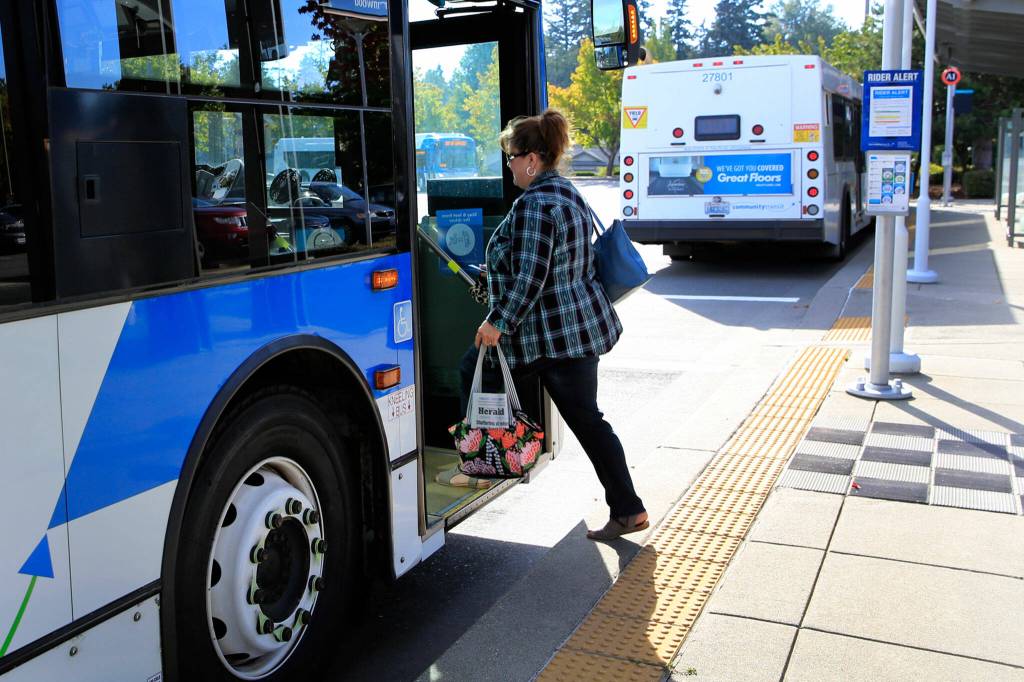


EVERETT — For years, Sarah Hartwell, an environmental scientist, willingly commuted from Everett to her job in downtown Seattle.
The round trip bus ride ate up a three- to four-hour chunk of each weekday. Readying her four kids for school or daycare consumed another two to three hours a day, she said.
“I barely saw my husband,” said Hartwell, 38.
Since March 2020, when the COVID-19 pandemic closed the office where she works, Hartwell has worked from home. It’s been an eye-opener, she said.
“I didn’t realize what the commute was costing me until I stopped,” Hartwell said.
In 2019, some 15,700 Snohomish County residents commuted 90 or more minutes to work each way, according to a recent analysis by ApartmentList.com. The report calls them “super commuters.”
That’s more than 4% of Snohomish County’s workforce. That year their numbers were up from 3%, or 9,800, in 2010, the report said. By comparison, the average commute for most in the county is a little over 30 minutes each way, according to U.S. Census data.
The past decade has witnessed the rise of the super commuter: From 2010 to 2019, their numbers increased 87% in the Puget Sound region — to 94,000. Nationally, the percentage ticked up 45% in the same period.
Super commuters are generally concentrated in the nation’s most expensive housing markets, which include the Puget Sound region, said Chris Salviati, a senior housing economist with ApartmentList. “These are areas that have rapidly added jobs but haven’t built enough homes to keep pace,” Salviati said. As a result, “some people have to move farther out from the urban core to find something that works for them.”
Some say that’s the case here — they can’t find affordable housing that’s closer to work. Others say the desire to live in a specific town or take home a healthy paycheck they can’t find elsewhere figured in their decision to super-size their commute.
But now, super commuters are an unknown quantity. From all appearances, since that last tally in 2019, their ranks have thinned.
Since the COVID-19 pandemic struck, droves of former marathoners have stayed home and worked remotely.
These days, they measure their commute in seconds, or the footsteps it takes to shuffle from the kitchen to the den.
Meanwhile, they’ve saved on gas, bus fare, lunch and frayed nerves.
Some continue to commute long hours, but only part time. They make the journey a few days a week instead of four or five, Salviati said.
Will these former super commuters resume their trek when the boss beckons, or will we see a revolt of super commuters?
Hartwell’s employer recently told her and her co-workers that they should plan to return to the office in October.
She bristles at the idea.
The daily commute left little time for herself, her husband, her kids or family dinners.
“I can see going in two days a week,” Hartwell said. Should her employer demand more days, she’ll consider looking for another job.
“We’ve proven to ourselves and our employers that we can work this way,” Hartwell said. “The pandemic has opened the Pandora’s box of remote work.”
Three-county commutes
In a few months, Adnane Ettayeby’s twice-weekly commute from Everett to Tacoma will stretch to three days a week.
The round trip takes anywhere from two hours a day to nearly four hours on Fridays, “when everyone gets on I-5 at the same time,” said Ettayeby, an engineer at Tacoma Power.
“It would be really hard to do five days,” Ettayeby said, “Even three days a week, I dread it.”
A few years ago, Ettayeby and his wife hoped to shorten their commute and buy a home in Mountlake Terrace. At the time, both worked in Seattle. But their effort was unsuccessful. Homes were being bid up $100,000 over list price, putting most properties out of their reach.
“To find affordable housing, we had to keep moving north,” Ettayeby said. “Everett was the limit — that was the maximum commute we would consider,” he said, “and then I got a job in Tacoma.”
“Commuting from Everett to Tacoma is probably the maximum I can do before I lose my mind,” he said. “Five days a week and we might consider moving to Tacoma.”
Ray Hansen says he’ll gladly resume his former commute from Camano Island to Seattle when the office reopens.
“When I tell people that I commute an hour and forty minutes each way, their eyeballs fall out of their heads, but it’s a choice we made to live on Camano Island,” Hansen said.
“We wanted to live in a rural area, and the price you pay is a long commute,” said Hansen, a project manager at Milliman, an actuarial firm in downtown Seattle.
For the past 18 months, Hansen has worked from home.
“I love that my commute is now only 30 seconds, but I miss the interaction at the office,” Hansen said. “I really miss swinging by someone’s office to talk about work-related items.”
His employer may return to a hybrid model in the fall. “Two or three days I wouldn’t mind,” he said. But if it becomes five days a week, he’s ready for that, too.
However, Hansen sees a future where geography is not a condition of employment. Depending on the survey, a majority of remote workers say they’d like to continue to work remotely.
“I just hired somebody in Dallas,” Hansen said. “She’s 100% remote.”
Remote work is a solution, Salviati said, “but I don’t think remote work is going to alleviate” the need for some to super-commute.
Miles or minutes?
Super commutes aren’t always measured in miles. Even short commutes can turn into 90 minutes or more when traffic turns to molasses.
“My morning commute isn’t 90 minutes, but the way home is,” said Heather Van Slageren, senior account manager at Benefits West, a Lynnwood insurance agency.
The Stanwood resident alternates between hopping the bus and driving, depending on the day’s schedule.
“When I ride the bus, I meet it at 6:25 a.m. and it gets to Lynnwood at 7:40 a.m,” Van Slageren said. Fellow passengers include a worker who lives north of Mount Vernon and rides the bus to downtown Seattle, she said. Van Slageren passes the time drinking coffee and reading the newspaper.
The return trip is the bugaboo. The 46-mile trip can turn into a two-hour slog during the evening rush.
“If I could have a choice, I would prefer to work at home at least three days a week,” Van Slageren said.
Why not find a job that’s closer to home? “I grew up in Arlington. I like this area,” Van Slageren said. “I’ve never found jobs that pay enough north of Everett.”
100 miles or more
Christopher Alexander commutes 112 miles, one way, from Everett to Centralia. Fortunately, it’s a once-a-week trip.
“I’ve been doing it for two years now,” said Alexander, a Walmart truck driver. After picking up his rig in Centralia, he’s on the road for five days. At night, he beds down in the cab of the truck.
“I’m doing this because it pays a six-figure salary,” Alexander said. “It’s far and away the best paying job I’ve ever had. But I would prefer I had this job in Everett.”
Kathleen Arnold, a Snohomish resident, puts 228 miles on the odometer twice a month.
Arnold commutes 114 miles each way from Snohomish to a hospital in Morton, in Lewis County near Mount St. Helens, where she is a pharmacist at a critical access hospital.
“I go down on a Sunday, work four or five days and go home Friday night,” Arnold said.
The hospital offers her and other traveling staff free housing.
“It really helps to have a place to stay and not be in a hotel. We stay in a house with a full kitchen. There is absolutely no night life, no movies, no place to eat. You need to like to cook for yourself and like to hike — do outdoor stuff,” Arnold said. “I do like it. I like knowing all the nurses by their first names — it’s only a 25-bed floor.”
On the other hand, “if this were a weekly commute, I don’t think I could do it,” Arnold said. “I wouldn’t take a job like this if I wasn’t confident in my driving and I didn’t like driving.”
Janice Podsada; jpodsada@heraldnet.com; 425-339-3097; Twitter: @JanicePods