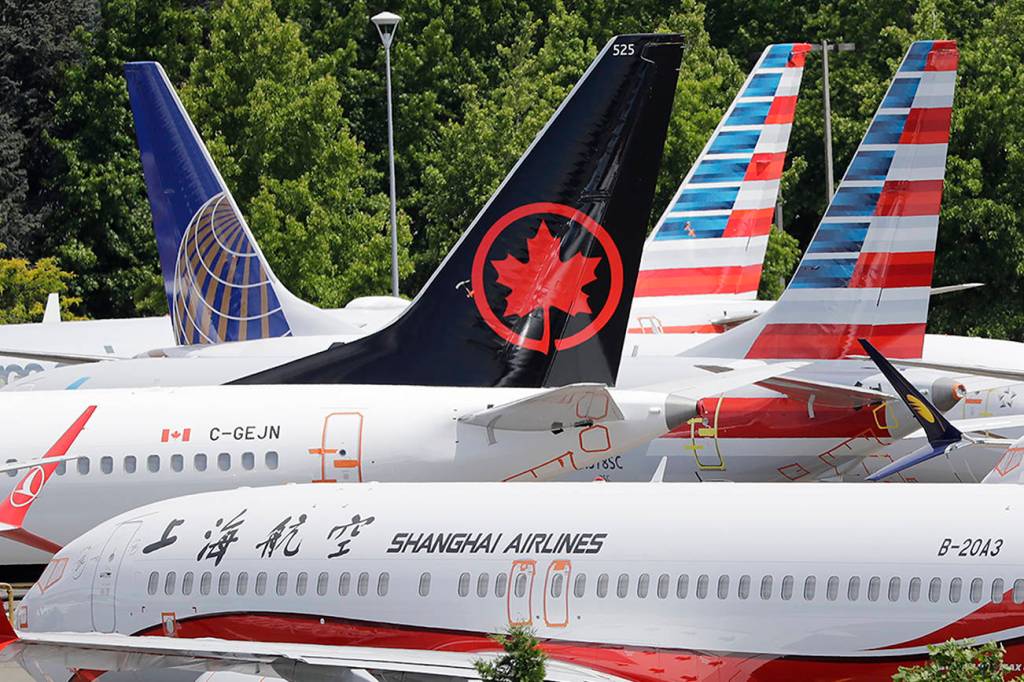
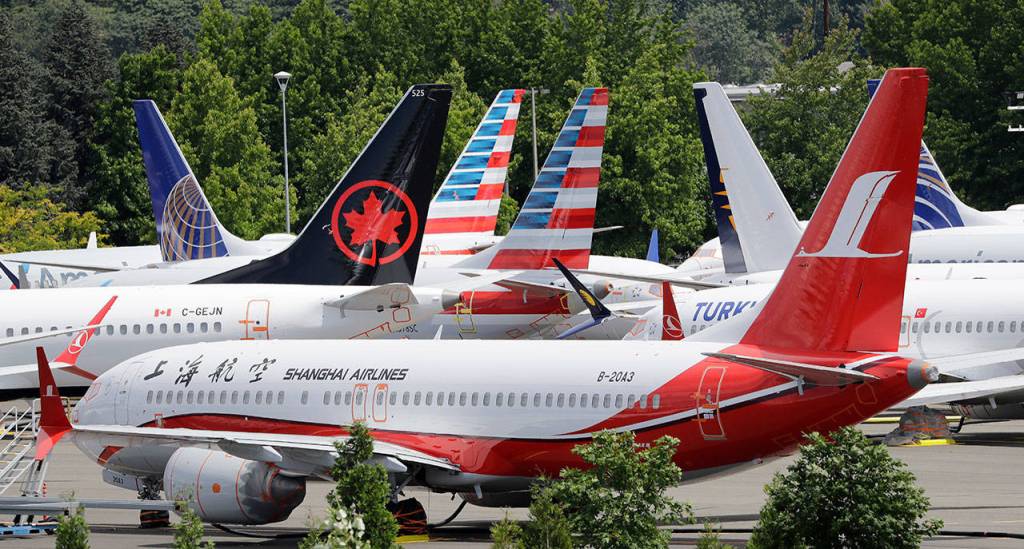
In this June 27 photo, dozens of grounded Boeing 737 Max airplanes crowd a parking area adjacent to Boeing Field in Seattle. Safety regulators want to fine Boeing nearly $4 million, saying that the company installed critical wing parts on 133 planes even though it knew the parts were faulty. (AP Photo/Elaine Thompson, File)

In this June 27 photo, dozens of grounded Boeing 737 Max airplanes crowd a parking area adjacent to Boeing Field in Seattle. Safety regulators want to fine Boeing nearly $4 million, saying that the company installed critical wing parts on 133 planes even though it knew the parts were faulty. (AP Photo/Elaine Thompson, File)

FAA seeks to fine Boeing $3.9 million for faulty jet parts

The action covers critical parts on Boeing 737s that were “more prone to fatigue and failure.”

By Michael Laris and Ian Duncan / The Washington Post

WASHINGTON — The Federal Aviation Administration proposed a rare $3.9 million civil penalty against Boeing on Friday, alleging the company “knowingly submitted aircraft” to the agency for safety certification even after learning that crucial wing components “could not be used due to a failed strength test.”

The FAA alleged in a statement and enforcement letter to Boeing on Friday that the company installed parts on some of its 737s that were “weakened” and “more prone to fatigue and failure.” The so-called “slat tracks” are critical, serving to guide the slats that slide out from the front of wings and add stability and lift during takeoff and landing.

The agency said the weakened components could allow the slats “to depart and potentially strike the aircraft, resulting in injury to aircraft occupants and/or preventing continued safe flight and landing.”

The FAA alleges that Boeing certified to the agency that at least 85 of its Next-Generation 737s were airworthy, despite having been informed by one of its suppliers that there were problems with the wing parts. The company made earlier safety pledges on dozens more of the aircraft, the FAA said.

Boeing “failed to adequately oversee its suppliers,” then presented the resulting planes to the FAA as safe despite those known problems, according to the allegations. Boeing gave those safety assurances on paperwork required for planes to fly in the United States, on export certificates, and in one case a statement that the planes conformed with military requirements, the FAA alleges.

In a statement, Boeing said the “nonconforming batch of slat track assemblies” were put on both Next-Generation 737s as well as 737 Max jets. The Max has been grounded since March, after a flawed flight control feature contributed to two crashes in five months, killing 346 people in Ethiopia and off the coast of Indonesia.

“We are working closely with our customers to take the appropriate corrective actions,” the company statement said. A Boeing spokesman said he could not immediately provide the number of Max jets affected, but the company said Boeing “will ensure that all inspections and any necessary part replacements are performed on all 737 MAXs before they return to service.”

Boeing said it has “not been informed of any in-service issues related to the slat tracks themselves.”

The FAA said Spirit AeroSystems, Inc. supplied the slat tracks to Boeing. Spirit contracted with Kencoa Aerospace, LLC to provide the tracks. Kencoa, in turn, contracted with Southwest United Industries, Inc. to perform a metal plating process that was associated with the weakening of the wing parts, according to the FAA.

Representatives for the three suppliers did not immediately respond to requests for comment on Friday.

In 2015, Boeing agreed to pay a $12 million penalty as part of a settlement agreement with the FAA. The FAA said safety lapses with Boeing planes were repeatedly identified, and the company would agree to fix them but then fail to do so.

As part of that agreement, Boeing agreed to make significant changes in its internal safety systems and practices for “ensuring compliance” with regulations, and it remains subject to the terms of that agreement through Dec. 31, 2020.

In the case of the slat tracks, the FAA on Friday gave Boeing 30 days to “submit the suggested amount in settlement” or provide additional information.

Asked if the company planned to pay, a Boeing spokesman, Chaz Bickers, said, “We’ll review the penalty.”


Talk to us

> Give us your news tips.

> Send us a letter to the editor.

> More Herald contact information.

More in Business

Tommy’s Express Car Wash owners Clayton Wall, left, and Phuong Truong, right, outside of their car wash on Friday, Jan. 16, 2026 in Everett, Washington. (Olivia Vanni / The Herald)
Clayton Wall brings a Tommy’s Express Car Wash to Everett

The Everett location is the first in Washington state for the Michigan-based car wash franchise.

Robinhood Drugs Pharmacy owner Dr. Sovit Bista outside of his store on Tuesday, Dec. 30, 2025 in Everett, Washington. (Olivia Vanni / The Herald)
New pharmacy to open on Everett Optum campus

The store will fill the location occupied by Bartell Drugs for decades.

Liesa Postema, center, with her parents John and Marijke Postema, owners of Flower World on Wednesday, Dec. 31, 2025 in Snohomish, Washington. (Olivia Vanni / The Herald)
Flower World flood damage won’t stop expansion

The popular flower center and farm in Maltby plans 80 additional acres.

Mike Fong
Mike Fong will lead efforts to attract new jobs to Everett

He worked in a similar role for Snohomish County since Jan. 2025 and was director of the state Department of Commerce before that.

Washington State Governor Bob Ferguson speaks during an event to announce the launch of the Cascadia Sustainable Aviation Accelerator at the Boeing Future of Flight Aviation Center on Thursday, Jan. 8, 2026 in Everett, Washington. (Olivia Vanni / The Herald)
Gov. Ferguson launches sustainable jet fuel research center at Paine Field

The center aims to make Snohomish County a global hub for the development of green aviation fuel.

Flying Pig owner NEED NAME and general manager Melease Small on Monday, Dec. 29, 2025 in Everett, Washington. (Olivia Vanni / The Herald)
Flying Pig restaurant starts new life

Weekend brunch and new menu items are part of a restaurant revamp

Everett Vacuum owners Kelley and Samantha Ferran with their daughter Alexandra outside of their business on Friday, Jan. 2, 2026 in Everett, Washington. (Olivia Vanni / The Herald)
‘Everything we sell sucks!’: Everett Vacuum has been in business for more than 80 years.

The local store first opened its doors back in 1944 and continues to find a place in the age of online shopping.

A selection of gold coins at The Coin Market on Nov. 25, 2025 in Lynnwood, Washington. (Olivia Vanni / The Herald)
Lynnwood coin shop doesn’t believe new taxes on gold will pan out

Beginning Thursday, gold transactions will no longer be exempt from state and local sales taxes.

Snohomish County unemployment reaches 5.1%

It’s the highest level in more than three years.

Sultan-based Amercare Products assess flood damage

Toiletries distributor for prisons had up to 6 feet of water in its warehouse.

Senator Marko Liias speaks at the ground breaking of the Swift Orange Line on Tuesday, April 19, 2022 in Lynnwood, Washington. (Olivia Vanni / The Herald)
The Transportation Committee Chairman says new jobs could be created fixing roads and bridges

Senator Marko Liias, D-Edmonds, wants to use Washington’s $15 billion of transportation funding to spur construction jobs

Lynnwood Police Officers AJ Burke and Maryam McDonald with the Community Health and Safety Section Outreach team and City of Lynnwood’s Business Development Program Manager Simreet Dhaliwal Gill walk to different businesses in Alderwood Plaza on Wednesday, June 25, 2025 in Lynnwood, Washington. (Olivia Vanni / The Herald)
Lynnwood advocate helps small businesses grow

As Business Development Program Manager for the city of Lynnwood, Dhaliwal Gill is an ally of local business owners.

Support local journalism

If you value local news, make a gift now to support the trusted journalism you get in The Daily Herald. Donations processed in this system are not tax deductible.