After engagement, surveys show proposed Gold Line is popular
Published 1:30 am Saturday, October 25, 2025

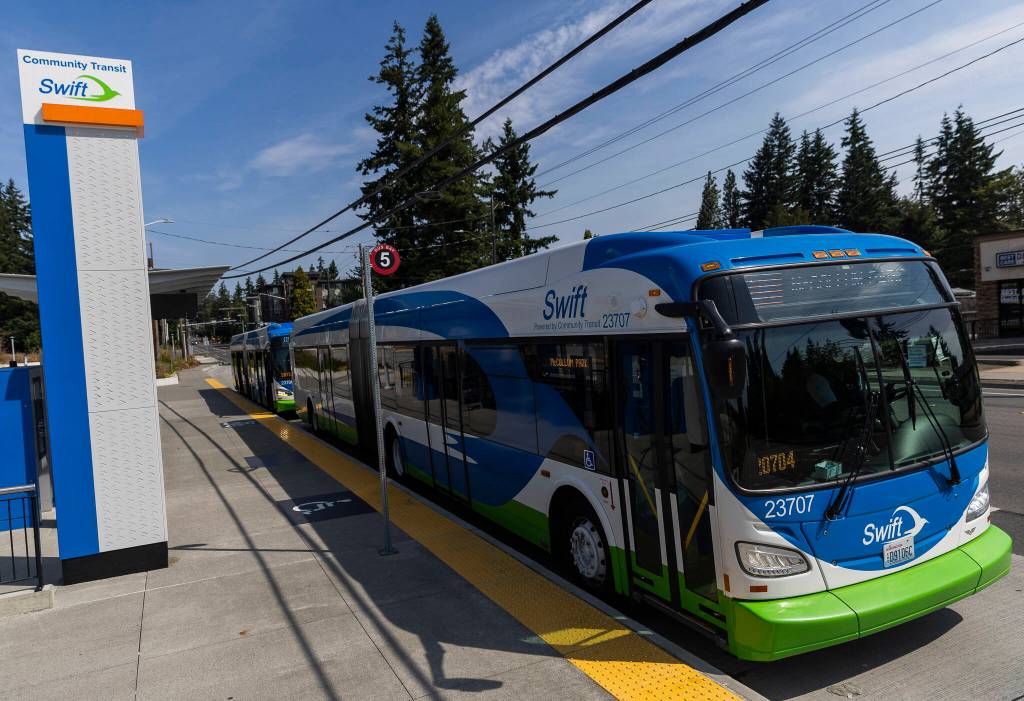


EVERETT — Community Transit’s Swift Gold Line, set to connect Everett, Marysville and Smokey Point, is resoundingly popular with Snohomish County residents, new research from the transit agency and consultants showed.
There’s just one hitch: respondents were less enthusiastic about potential impacts to parking and left turns that would arise if the new bus rapid transit line’s most transformative feature — center-running bus lanes — comes to fruition.
About 85% of respondents to a Community Transit survey said they were in favor of the project, engagement manager Chelsea Ongaro said at a work session Thursday. In another survey conducted by research consulting firm EMC, a random sample of Snohomish County residents in the Gold Line’s footprint were 75% in favor of the project.
EMC’s survey gave information about the project to respondents as many of them were likely unfamiliar with the project, researcher Ian Stewart said at Thursday’s work session. Initially, about 83% of respondents supported it, eventually growing to 85% as they learned more about the Gold Line.
But that number dropped after learning about the center-running bus lanes, which the transit agency has recommended adding in parts of Everett and Marysville. The lanes, if built, would improve the safety, speed and reliability of the buses while retaining the two existing lanes for drivers to use, freeing up space for traffic to flow. The transit agency predicts that building the bus lanes will improve travel times for both drivers and transit riders.
Those lanes will come at a cost, however. As many as 339 on-street parking spaces along Broadway in Everett could be lost to make way for the construction. Drivers would also only be able to turn left or make U-turns at intersections rather than anywhere along the streets where center-running lanes are used.
After hearing that information, 75% of respondents said they supported the project, compared to 85% prior, Stewart said.
Marysville Mayor Jon Nehring said that from his city’s standpoint, there’s been concerns over the center-running lanes due to concerns over accessing businesses if left turns and U-turns are only available at intersections. No parking spaces would be lost in Marysville if the center-running lanes were to move forward, as there’s no on-street parking on the sections of State Avenue where Community Transit is considering the lanes.
After hearing the feedback from residents, Community Transit will continue studying the effects of the possible bus lanes. The agency’s bus rapid transit manager, Morgan McGrath, said the agency will continue to conduct parking studies and traffic analysis along the areas where the lanes could be implemented.
Deciding against the center-running bus lanes could hurt the new route’s chance at success. Leaving the buses to operate with other cars could see the buses crawling along in congested traffic, Community Transit has said. Using curbside bus lanes, on the other hand, would take away a lane for car traffic, slowing travel times for drivers. Community Transit has also said the bus lanes would make the project more competitive when seeking federal funding.
Building dedicated bus lanes speeds up transit service and makes it more reliable, which in turn, can boost ridership. King County Metro’s new RapidRide G Line, which uses center-running bus lanes for much of its route, slashed travel times between downtown Seattle and the Madison Valley and made trips more reliable. In April 2025, a few months after it opened, the route saw about 5,600 riders a day, The Urbanist reported, about double the ridership compared to other routes operating in the corridor the year before it opened.
More people taking the buses would mean less people in cars. Stewart said it was important for Community Transit to make this known as Everett, Marysville and Arlington are projected to grow significantly over the coming years. Investing in effective alternatives to driving will be key to keeping congestion levels down.
“One of the big themes you’re going to want to talk about with the Gold Line is how much of an advantage this is going to give to people who don’t actually ever get on board,” Stewart said. “The ability for us to move other people out of their way is an important component in support for this project.”
The Swift Gold Line will be the Snohomish County transit agency’s fourth bus rapid transit line. Bus rapid transit mimics some qualities of rail service, like separated travel lanes and off-board fare collection, without the higher costs of building passenger rail. Buses along the Gold Line would arrive about every 10 minutes on weekdays.
The project is expected to cost between $137 million and $150 million, mostly paid for by state and federal grants. The rest would be funded by Community Transit’s existing revenue sources, so no additional local funding or new taxes would be required to build the project.
The Swift Gold Line is expected to open in 2031.
Will Geschke: 425-339-3443; william.geschke@heraldnet.com; X: @willgeschke.