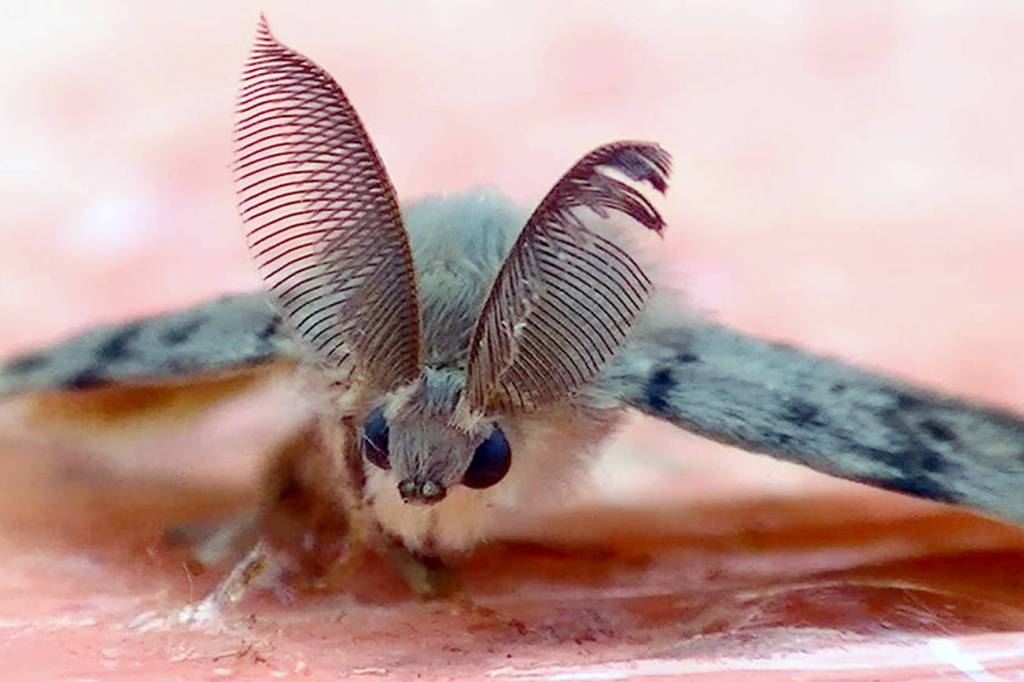
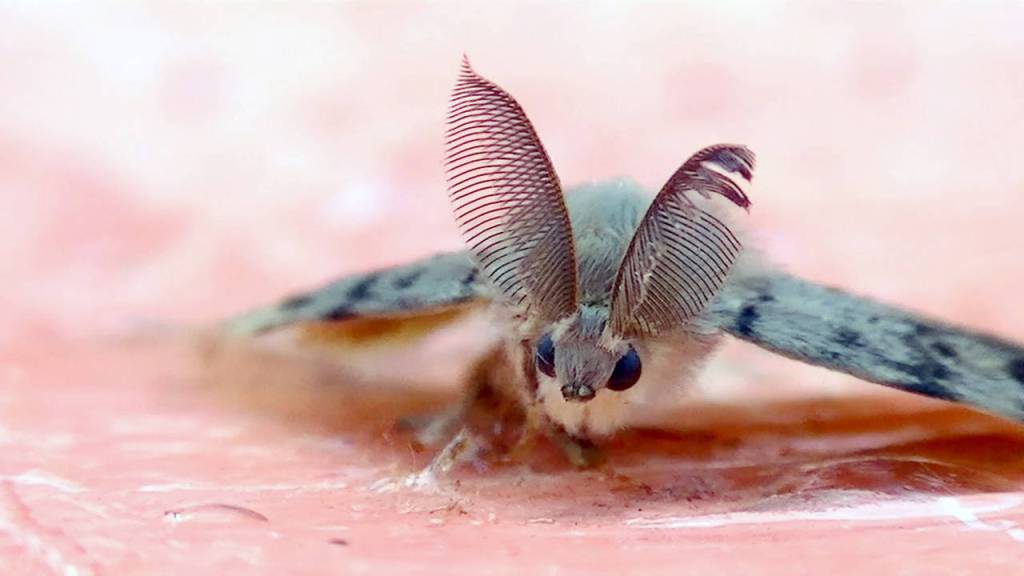
Trapped gypsy moth. (Washington State Department of Agriculture)

Trapped gypsy moth. (Washington State Department of Agriculture)

Aircraft to spray 1,300 acres for moths in Everett, Woodway

Gypsy moths can devastate forests. The state Agriculture Department plans to stop them from getting a foothold.

WOODWAY — They’re the worst of tenants. They’re destructive, they eat everything in sight and they don’t know when it’s time to leave.

Gypsy moths native to Asia have set up camp in some Snohomish County forests, and they’re getting evicted this spring.

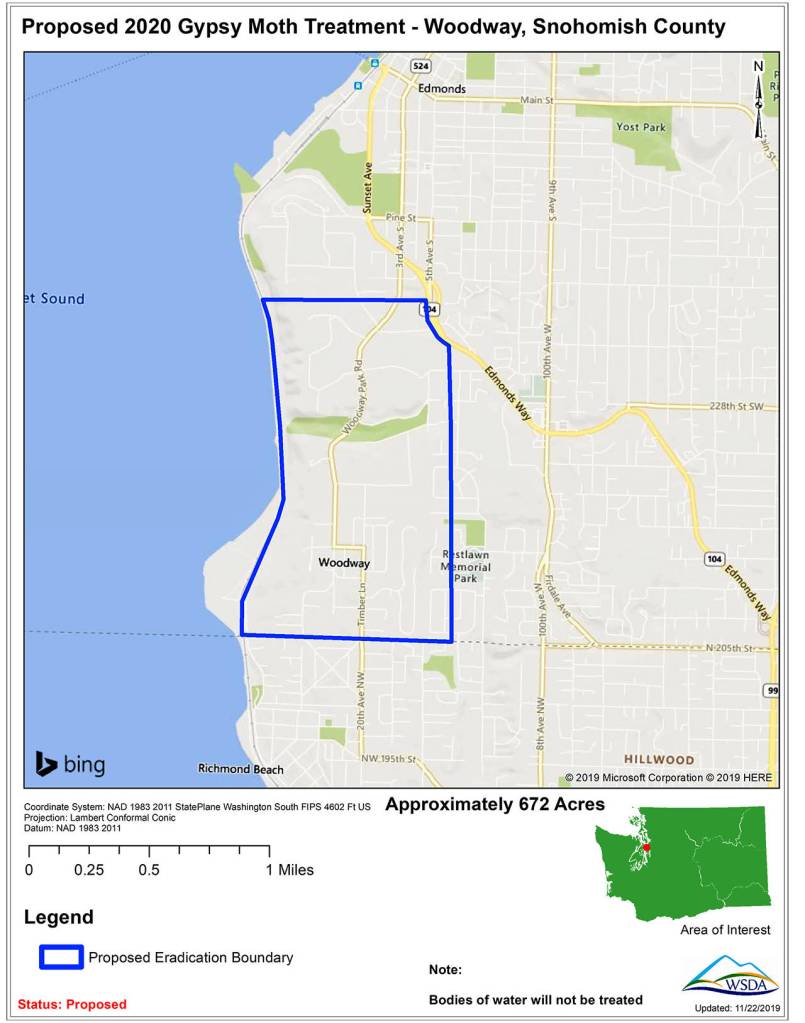
Nearly 1,300 acres in Woodway and an Everett neighborhood south of Mukilteo Boulevard will be sprayed with insecticide — dropped from a height of 100 to 200 feet by an airplane — to stop the moths from spreading and to prevent them from gobbling up forest foliage.

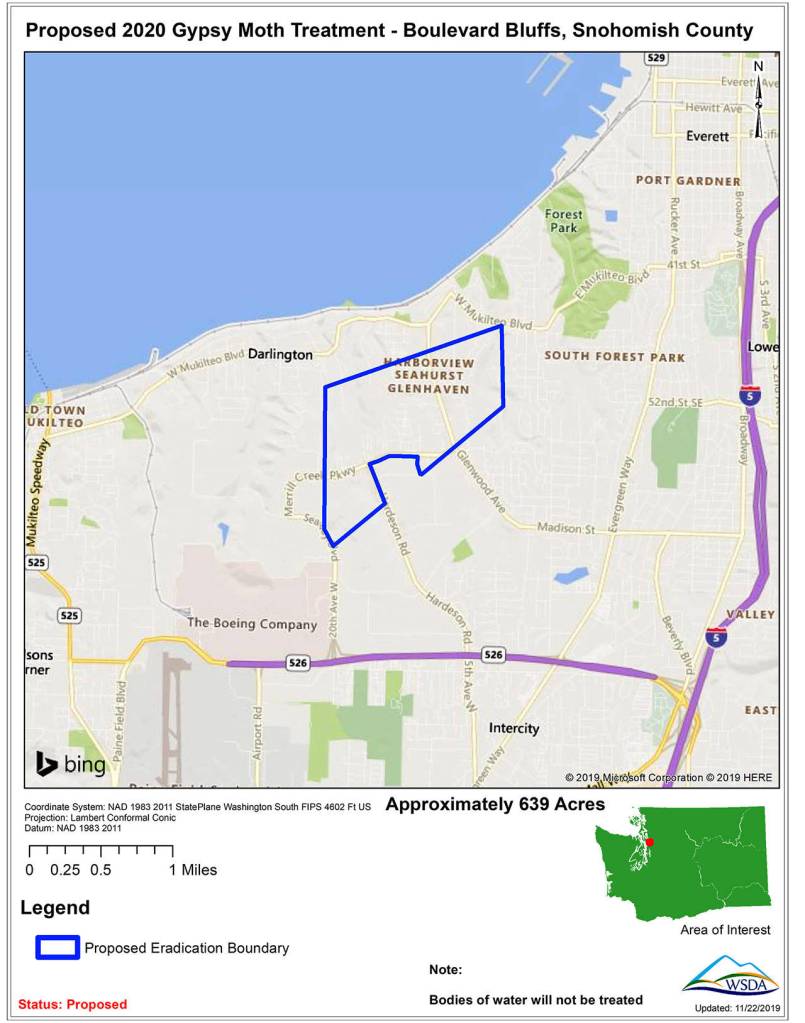
The first Hokkaido gypsy moth showed up in Woodway last year. It was reportedly the first of that type of moth found in the United States. Moths near the Boulevard Bluffs neighborhood have also tested positive for both European and Asian genetic traits, and the state Department of Agriculture intends to eradicate them.

“This is really bad because they’re very destructive to environment in the U.S.,” department spokesperson Karla Salp said.

When there’s a moth outbreak, they can strip entire forests of their leaves.

Their favorite trees are oak, but they feed on up to 500 species.

“They’ll basically eat anything that is around,” Salp said.

Proposed 2020 gypsy moth treatment in Woodway. (Washington State Department of Agriculture)

Proposed 2020 gypsy moth treatment in Woodway. (Washington State Department of Agriculture)

Deciduous trees (the ones that drop and regrow their leaves every year) can potentially survive. But repeated defoliation will kill even a deciduous tree.

The Pacific Northwest’s iconic evergreen trees aren’t as resilient to the moths. Once stripped of foliage, the tree dies, Salp said.

A Hokkaido moth could have stowed away on a bulk cargo ship from an infested area across the Pacific Ocean.

The gypsy moth is considered the worst forest pest insect ever to find its way into the country, according to the state Department of Agriculture. It has defoliated millions of acres of trees and shrubs since first arriving in the United States in 1869, when a naturalist brought over a bunch of its eggs to crossbreed with silk worms.

The silk business didn’t work out, and some of those gypsy moths escaped.

More than 150 years later, 20 Eastern and Midwestern states have permanent infestations of the European gypsy moth. In 2015, the damage was so bad in Rhode Island that it could be seen from space. A year later, a third of the state of Massachusetts was defoliated by gypsy moths.

Proposed 2020 gypsy moth treatment in Boulevard Bluffs. (Washington State Department of Agriculture)

Proposed 2020 gypsy moth treatment in Boulevard Bluffs. (Washington State Department of Agriculture)

The gypsy moth was first detected in Washington in 1974. Since then, a few have have been trapped almost every year.

“The good news is that we have been trapping for over 40 years and we’ve prevented them thus far from getting established in Washington,” Salp said.

Last year, the state Agriculture Department used 20,000 traps and caught 14 moths.

A permanent population does not seem to have gained a foothold. Washington has sprayed for moths almost annually since 1979.

In recent years, the moths have been trapped locally on Camano Island, in Martha Lake, Mukilteo, Oak Harbor and Snohomish. The moth trapped near Martha Lake resulted in aerial spraying over about 700 acres last May.

Treatment for the 1,300 acres in Woodway and in Everett could take place anytime between now and June. It all depends on the weather, Salp said, and on when the moths hatch.

The state Department of Agriculture will spray a soil bacteria called Bacillus thuringiensis var. kurstaki, or Btk, one to two weeks after the insects’ eggs hatch. The insecticide is approved for use in organic agriculture, according to the state.

Treatment will cost nearly $300,000, with federal funds covering about 80%.

Julia-Grace Sanders: 425-339-3439; jgsanders@heraldnet.com.

Spraying when?

People who would like to know exactly when the treatment will occur can sign up for notifications on the state Department of Agriculture’s website at agr.wa.gov/gypsymoth.


Talk to us

> Give us your news tips.

> Send us a letter to the editor.

> More Herald contact information.

More in Local News

Carlos Cerrato, owner of Taqueria El Coyote, outside of his food truck on Thursday, Jan. 29, 2026 in Lynnwood. (Olivia Vanni / The Herald)
Everett proposes law to help close unpermitted food carts

The ordinance would make it a misdemeanor to operate food stands without a permit, in an attempt to curb the spread of the stands officials say can be dangerous.

An Everett Transit bus drives away from Mall Station on Monday, Dec. 22, 2025, in Everett, Washington. (Olivia Vanni / The Herald)
Everett Transit releases draft of long-range plan

The document outlines a potential 25% increase in bus service through 2045 if voters approve future 0.3% sales tax increase.

Lake Stevens robotics team 8931R (Arsenic) Colwyn Roberts, Riley Walrod, Corbin Kingston and Chris Rapues with their current robot and awards on Thursday, Jan. 29, 2026 in Lake Stevens, Washington. (Olivia Vanni / The Herald)
Lake Stevens robotics team receives world recognition

Team Arsenic took second place at the recent ROBO-BASH in Bellingham, earning fifth place in the world.

Leslie Wall in the Everett Animal Shelter on Jan. 6, 2026 in Everett, Washington. (Will Geschke / The Herald)
Everett Animal Shelter gets $75k in grants, donations

The funds will help pay for fostering and behavioral interventions for nearly 200 dogs, among other needs.

Everett
One man was injured in Friday morning stabbing

Just before 1 a.m., Everett police responded to a report of a stabbing in the 2600 block of Wetmore Avenue.

x
Paraeducator at 2 Edmonds schools arrested on suspicion of child sex abuse

On Monday, Edmonds police arrested the 46-year-old after a student’s parents found inappropriate messages on their daughter’s phone.

South County Fire Chief Bob Eastman answers question from the Edmonds City Council on Tuesday, Dec. 3, 2024 in Edmonds, Washington. (Olivia Vanni / The Herald)
South County Fire chief announces retirement

The Board of Commissioners has named Assistant Chief Shaughn Maxwell to replace Chief Bob Eastman in February.

One dead, four displaced in Lynnwood duplex fire Monday

More than three dozen firefighters responded to the fire. Crews continued to put out hot spots until early Tuesday.

With the warm atmosphere, freshly made food and a big sign, customers should find their way to Kindred Kitchen, part of HopeWorks Station on Broadway in Everett. (Dan Bates / The Herald)
Housing Hope to close cafe, furniture store

Kindred Cafe will close on Jan. 30, and Renew Home and Decor will close on March 31, according to the nonprofit.

Everett
Everett Fire Department announces new assistant chief

Following the retirement of Assistant Chief Mike Calvert in the summer, Seth Albright took over the role on an interim basis before being promoted to the position.

Logo for news use featuring Snohomish County, Washington. 220118
Snohomish County voters largely approving school levies, bonds

Levies in Darrington and Monroe were failing Tuesday, and bonds in Monroe and Mukilteo were just short of the 60% threshold.

Logo for news use featuring the municipality of Lake Stevens in Snohomish County, Washington. 220118
Police investigate fight during Lake Stevens protest

A video shows an altercation between Lake Stevens High School students during a walkout on Thursday.

Support local journalism

If you value local news, make a gift now to support the trusted journalism you get in The Daily Herald. Donations processed in this system are not tax deductible.