Community colleges to streamline credit transfers
Published 11:53 pm Saturday, June 26, 2010
Local community colleges are embarking on an effort to share more functions and make it easier for students to move between campuses.
While the door is being opened a bit wider to a touchy subject — consolidation — don’t expect any big-splash changes.
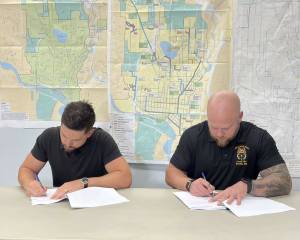
Leaders at Everett, Edmonds, Cascadia, Shoreline and Lake Washington community colleges have signed on to form what’s dubbed the Five Star Consortium. The goal is to come up with a seamless system that allows students to start at one college and finish at another without any bureaucratic roadblocks.
As early as this fall, students could see common admissions forms. Course credits earned at one college would be accepted at the other four colleges.
The colleges also will look to more concretely identify each others’ program strengths — such as nursing in Everett, automotive in Shoreline — and encourage students pursuing those careers to go where the program is best offered.
“We’ve been doing those kinds of things for years,” said Bill Christopher, president of Cascadia Community College in Bothell. “I think this formalizes what we’ve always tried to do.”
Eventually, the work of the five colleges could influence how the rest of the state’s two-year colleges meet lawmakers’ demands to become more efficient.
“They’re asking the right questions in our minds,” said Charlie Earl, executive director of the State Board for Community and Technical Colleges.
There are different ideas about how far such efforts could go, however.
“You do get into whether — and I’m going to say something controversial. You’ve got Edmonds and Everett. Why can’t you manage both of those together? That’s an issue that I think makes a lot of sense,” said Tom Gaffney, an Everett businessman who sits on the Everett Community College board of trustees.
The Five Star Consortium is set against the backdrop of a legislative push to make the state’s community colleges more efficient.
A new state law requires the State Board for Community and Technical Colleges to take a hard look at ways colleges can better coordinate their efforts. It also charges the board with re-examining district boundaries and looking for possible mergers.
Work to form the Five Star Consortium began more than a year ago, long before public hearings on the so-called efficiency bill.
Leaders at the five colleges can agree on much. Maybe a common payroll system. Some shared software. Beyond that? Gaffney says what is being done is “low-hanging fruit” — at least, for now.
But combining top administrative functions at Everett and Edmonds is an example of reaching higher, as Gaffney sees it.
“Whether you end up with one president, one board and certain positions — it’s not that you’d save a lot of salary-type costs. What you’d get is a common approach to serving Snohomish County, for example, and long-term I think that’d create better efficiencies and better use of the limited dollars we have.”
It’s a monumental shift for stodgy educational institutions, he said. Maybe a place to start is by combining the two colleges’ boards of trustees, which have the most power to affect change.
“Would that help start the process? A lot of us here in Everett would certainly be open to exploring those possibilities,” Gaffney said.
Fourteen miles south at Edmonds Community College, board Chair Jeannette Wood has a quick response to that idea: “No. No. No. No. No, no, no, no!”
“I would never agree with that,” Wood said. “We both have very different ideas. We’re not the same as boards of trustees; we’re not the same as colleges. … It would never work.”
No boundaries
At the heart of the issue is identity.
Folks like Gaffney see little need for such things as college district boundaries, pointing to his experience as a businessman. “Most larger businesses really just think globally. We have offices, stores, whatever and we don’t get limited by a city or county boundary.”
Shoreline Community College president Lee Lambert underscored the point.
The college is geographically the state’s smallest. But speaking from a Skype line while in China to showcase the college’s automotive program, Lambert said he thinks of his college’s boundaries as anything but tied to a small slice of north King County.
“It’s national. It’s global. I’m here in China. I don’t operate only talking to the dealers in Shoreline. I talk to them across the state, the country and now the globe. That district boundary is irrelevant to me,” he said.
Folks like Wood counter that keeping a strong sense of individuality is key for colleges.
“That makes for more conversation and ideas,” Wood said. “We do get different ideas, and those ideas help us all in keeping our colleges moving.”
Edmonds Community College president Jack Oharah agreed that a local sense of place is still invaluable.
“Each of these community colleges were designed to serve a particular community and we have relationships in those communities. If you decentralize that — if we were combined with Lake Washington, for example, and all the administrative functions were out of Kirkland — then the community of Edmonds no longer has a strong need to support the college,” Oharah said.
“You lose that strong identity we’ve spent decades building.”
You also may lose an entrepreneurial spirit that, on its own, has made community colleges plenty efficient, Oharah said. He points to state statistics that show Edmonds Community College as the least dependent on state funds, thanks to its success attracting grants and contracts.
Consolidating certain academic programs, streamlining admissions, accepting credits from neighboring colleges — those are the kinds of changes that might be seen as small but whose impacts are anything but, Oharah said.
“Those are the kinds of things we think are going to make a bigger difference than, say, arbitrarily saying we’re going to combine our IT departments … and certainly any of the consolidations that are being tossed around,” he said.
Targeted changes
For now, that’s the approach the state board is taking, as well.
“There are bigger questions than whether there are two presidents or not,” said Earl, at the state board.
Though consolidations and mergers could happen, they remain complex questions that should come only after colleges look at other forms of collaboration, he said.
There are specific areas in the state that will get attention under the efficiency bill.
Colleges in Pierce County as a group are looking at similar ways to collaborate as those in the Five Star Consortium. Colleges in the southwest Puget Sound region are investigating whether to combine information technology and institutional research functions.
An attempt to boot Cascadia Community College from the campus it shares with the University of Washington Bothell was withdrawn with assurances that the idea would be looked at as part of the efficiency study.
But while the study will look at the idea, those involved have already expressed opposition.
Even Earl is reluctant: “Cascadia has grown very quickly and has actually become a star in the two-year college mission. … I don’t think any of us in higher education ought to walk away from it lightly.”
It may be up to lawmakers to further push change, something Sen. Paull Shin, D-Lynnwood, a sponsor of the efficiency bill, says he’s ready to do once the state board’s reports are filed.
Sen. Derek Kilmer, D-Gig Harbor, said community colleges should be commended for how efficient they already are.
But the budget times are what they are.
“What we’ve seen over the past year is a lot of people with a lot of ideas. … ‘Have you thought about merging these two colleges? Have you thought about doing a college district with the colleges in Pierce County?’” said Kilmer, who chairs the Higher Education Committee. “Certainly in this budget environment there are opportunities to ask tough questions about that. But if you’re going to make decisions on being more efficient, they should be based on data and analysis.”
Most local community college leaders are in favor of blurring college district lines in some way, and with state board support, much of it is likely to chug forward.
The state board’s first report is due Dec. 1. A more focused look at possible consolidations and mergers isn’t required until 2012. Any cost savings colleges find, they will be able to keep.
Everett Community College president David Beyer sits on the steering committee: “Nothing’s been determined. It’s a process to look at ways we can do business together,” he said.
College leaders across the board say their focus will be not so much on cost savings as on what’s best for students — and students don’t pay much attention to boundaries.
As much as 8 percent of Everett Community College’s students, for example, come from outside Snohomish County, according to college statistics. A transportation study commissioned by the state board showed some students travel up to 75 minutes to reach an Everett or Edmonds campus.
“District boundaries are kind of artificial boundaries,” said Roger Olstad, chair of Shoreline Community College’s board of trustees. “At the very least, it should be easy for students to leap across them.
“It’s a great idea whose time has come — in fact, it should have come a long time ago.”