Mukilteo City Council votes to read land acknowledgement less often
Published 2:32 pm Tuesday, May 5, 2026
MUKILTEO — The Mukilteo City Council voted Monday to read its land acknowledgement, a formal statement that recognizes indigenous people, less often before its council meetings.
The council had considered removing the statement from its regular order of business, potentially reading it as little as once per year, as part of a number of changes it sought to make to its council rules and procedures. After making an amendment to a proposed motion, the body eventually voted 4-3 to read the statement at the first council meeting of each month, rather than at the start of each meeting.
Mukilteo Mayor Joe Marine broke a 3-3 tie — which occurred because the council has a vacant seat after council member Mike Dixon’s resignation in April — to vote in favor of reading the statement once per month. He said that he felt the statement should be read once per year, but supported the once-per-month option to give the council time to work on potential changes to the statement’s language.
Land acknowledgements are a traditional custom that dates back centuries for native communities, according to Washington Tribes, a nonprofit made up of tribal leaders from across the state. In recent years, reading the statements has become common practice at city council meetings, school board meetings and public events. Proponents say the goal is to educate attendees and remind them of the original stewards of the land before settlers arrived.
Hazen Shopbell, the recently elected chair of the Tulalip Tribes, wrote in a statement to The Daily Herald on Monday that “land acknowledgments are a good faith reminder, a way to educate and remember the indigenous people and the history of this land.”
“Sovereign Indigenous nations have always existed and governed here,” Shopbell wrote.
The proposed change to the practice of reading the land acknowledgement drew debate from members of the public. Some argued the land acknowledgement was divisive and political; others said the statement was an important way to recognize indigenous communities.
“Repetition leads to remembrance,” said Penelope Ross, a member of the Yakama Tribe who attends Kamiak High School. “The land acknowledgement works the same way. It is a consistent reminder of history. If we reduce the amount of times it is said, we are also reducing the how often we ask people to remember.”
Sharon Damoff, a Mukilteo resident who has often spoken out against the city’s land acknowledgement, told the council Monday that city council meetings are not the proper place for the statement to be made, and suggested that a statement be made in a once-a-year proclamation.
“Land statements are part of a broad movement to undermine America, and more broadly, the west,” Damoff said. “That’s why there are also problems in Canada. Please stop reading this divisive statement and instead read a proclamation once a year honoring the tribes, the same as we do with all other proclamations.”
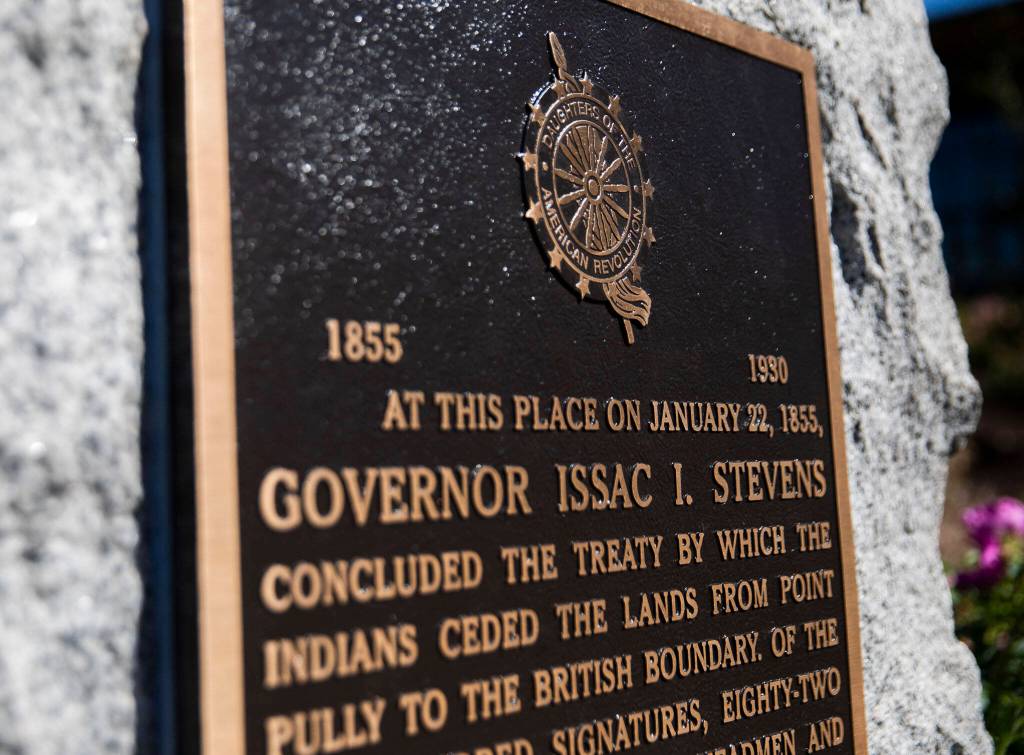
The statement carries a significant weight in the city because in 1855, multiple Native American tribes signed the Treaty of Point Elliot in what is now Mukilteo, a treaty that saw the tribes cede millions of acres of land so they could retain their right to self-government, as well as retain fishing and hunting rights. It also promised, education, medical assistance and housing to the tribes. Thirteen tribes then moved onto the Tulalip Reservation, west of what is now Marysville.
From 1857 to 1932, thousands of indigenous children were subjected to forced labor, neglect and abuse at a federal boarding school on the Tulalip Reservation, with the intention of preventing the children from speaking their own language or retaining their own cultural heritage.
Shopbell wrote that the land acknowledgement is a starting point for more meaningful interactions and government-to-government relationships.
“Mukilteo is where the Treaty of Point Elliott was signed. The name Mukilteo is a Snohomish word. The city is in the heart of our Snohomish ancestors’ territory,” Shopbell wrote in the statement. “Tulalip will continue to work towards good interactions with the governments and communities in our territories.”
Council members were divided on the land acknowledgement. Council member Donna Vago said she opposed the statement because it was not city business, and said the city should do more to honor the history of the tribes.
“We could do more, and we should do more, and I agree with that, but I don’t think this statement is going to get us there,” Vago said. “It doesn’t belong on our agenda because we are a non-partisan body.”
Council member Bob Champion said he was in favor of keeping the land acknowledgement, stating that part of the job of the council was to build bridges.
“I believe that if you change this ruling now, we will burn a bridge,” Champion said. “And I think that’s the wrong direction.”
Council member James Sterba said he was concerned about the property rights of Mukilteo citizens, fearing that the land acknowledgement could amount to a legal admission that the city’s land was stolen.
Another council member, Richard Emery, said he had asked a legislative liaison at the Tulalip Tribes about the possibility of the land acknowledgement being used as a legal basis for private and public lands being returned to the tribes, and the response he got was “outright laughter at the absurdity of that kind of concept,” he said. The Treaty of Point Elliot had ceded the native lands to the United States government and the treaty remains in effect to this day.
Tuesday marks Missing and Murdered Indigenous Persons Awareness Day, which highlights the fact that Native people are disproportionately affected by violence, homicide and domestic abuse.
The city’s land acknowledgement statement reads as follows:
“We acknowledge the original inhabitants of this area, the Snohomish people, and their successors, the Tulalip Tribes. Since time immemorial, they have hunted, fished, gathered and taken care of these lands. We respect their sovereignty, their right to self-determination, and honor their sacred spiritual connection with the land and water. We understand the cultural and historic significance that the city of Mukilteo holds in respect to the signing of the Point Elliot Treaty of 1855. As a city, we commit to being honest about the legacy of colonization on our indigenous predecessors, and commit to bringing about a future that includes their people, stories and voices to form a just and fair society.”
Will Geschke: 425-339-3443; william.geschke@heraldnet.com; X: @willgeschke.
Correction: A previous version of this article misspelled the name of an indigenous nation. It is the Yakama Tribe, not the Yakima Tribe.