Dan Evans, governor, U.S. senator, dies at 98
Published 8:40 am Monday, September 23, 2024


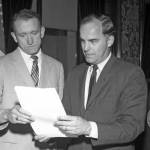
By Adam Clymer and Robert D. McFadden / © 2024 The New York Times Company
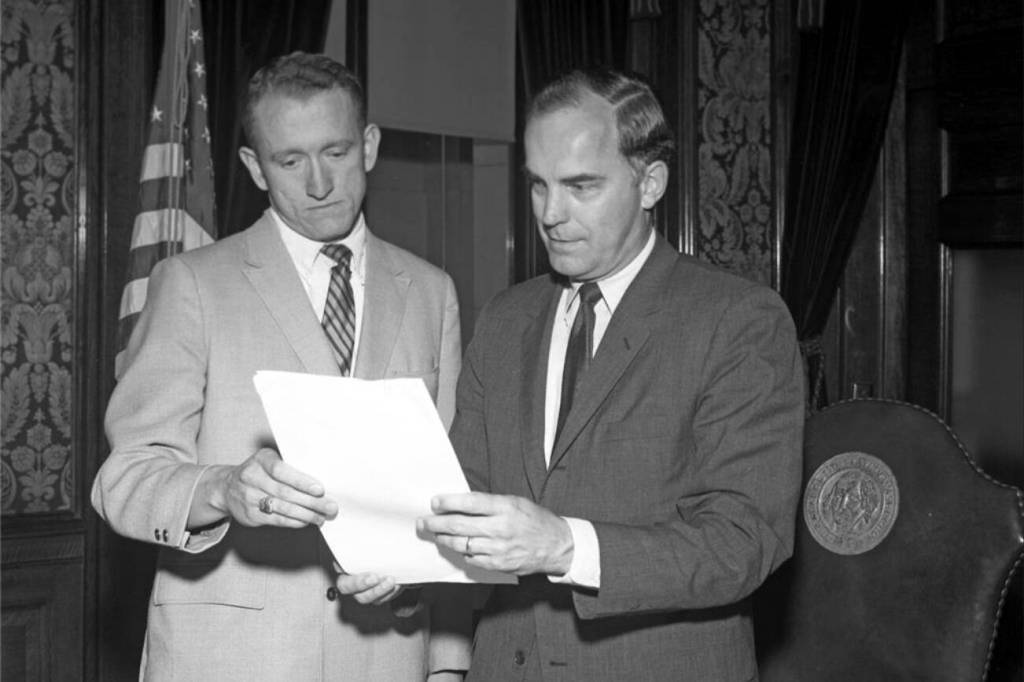
Daniel J. Evans, a moderate Republican who dominated Washington state politics as a three-term governor and a U.S. senator and who was repeatedly considered for the vice presidency, died Friday night at his home in Seattle, about five blocks from where he grew up. He was 98.
His son Dan Evans Jr. confirmed the death.
Descended from seafarers who founded a Puget Sound shipping business in the 19th century, Evans championed education, civil rights and environmental causes as Washington’s 16th governor from 1965-77. He served in the Senate, with some frustration, from 1983-89.
He was a mountain climber and skier, a master yachtsman, an eloquent speaker and, in his first term as governor, a fresh face in national politics at a time when Republicans were reeling from Sen. Barry Goldwater’s crushing defeat in the 1964 presidential election.
At the Republican National Convention in Miami Beach, Florida, in 1968, where Richard Nixon was nominated for president, Evans was chosen to deliver the keynote address. Instead of the usual oratorical exercise in party self-congratulation, Evans, a rising Republican star, challenged America to face its problems: the Vietnam War, urban decay, civil rights and unemployment.
Frequently mentioned as a potential running mate for Nixon, Evans had taken himself out of consideration by backing Nixon’s progressive rival, Gov. Nelson Rockefeller of New York, incurring the wrath of conservatives, many of whom had backed Gov. Ronald Reagan of California.
Evans resisted the designation of moderate Republican, saying in a 2010 speech to the Rotary Club of Seattle: “I am tired of hyphenated Republicanism. ‘Moderate,’ ‘conservative,’ ‘mainstream’ are all adjectives which divide us.” But the term fit him, starting in 1965, his first year as governor, when he sought to purge members of the far-right John Birch Society and their allies from the state Republican Party.
“Let those who are false prophets, the phony philosophers, the professional bigots, the destroyers, leave our party,” he told the Republican state committee.
He challenged many of the central causes of conservatives. He favored abortion rights, opposed a constitutional amendment requiring a balanced federal budget and argued that while “profligate spending” could lead to disaster, tax increases were sometimes necessary. “Fiscal integrity,” he said, “is not encompassed in the famous words of George H.W. Bush, ‘Read my lips, no new taxes.’”
President Gerald Ford considered Evans twice for the vice presidency, first in 1974 when he succeeded Nixon, who had resigned in the Watergate scandal, and again in 1976, when Ford won the Republican presidential nomination. But Ford ended up naming Rockefeller as vice president in 1974 and picked Sen. Bob Dole of Kansas as his running mate in 1976, when Jimmy Carter won the presidency.
As governor, Evans increased aid for higher education and was instrumental in the creation of a state community college system. He also achieved laws for cleaner air, water and beaches, and for the protection of endangered species. In 1970, Washington became the first state to create a Department of Ecology.
When urban riots convulsed the nation, Evans went into Seattle’s poor neighborhoods and set up centers to deliver state services. Using executive powers, he established the Washington State Indian Affairs Commission in 1967 and the State Women’s Council in 1971. In 1969, he named the first Black members to the boards of the University of Washington and Seattle Community College. He also endorsed nuclear power, tax reforms and abolition of the death penalty.
Throughout his career, he formed alliances with Democrats. In 2011, Thomas Foley, the former Democratic speaker of the House who served in Congress from Washington from 1965-95, said that Evans “was one of the most thoughtful and effective governors in the country and one whose advice the largely Democratic congressional delegation always listened to and often followed.
“He had our respect and admiration,” Foley said.
Reelected in 1968 and 1972, Evans promoted the state’s economy and created jobs as unemployment rose sharply. He went to the Soviet Union and China to attract business, and helped resettle Vietnamese refugees after the Vietnam War.
In 1977, he became president of Evergreen State College in Olympia, an innovative four-year school he helped create as governor.
In September 1983, Gov. John Spellman appointed Evans to the vacancy created by the death of Sen. Henry Jackson. Two months later, Evans won a special election for a six-year term.
Daniel Jackson Evans was born in Seattle on Oct. 16, 1925, to Daniel Lester Evans, a civil engineer, and Irma (Ide) Evans.
He graduated from Roosevelt High School in Seattle in 1943, enlisted in the Navy and was deployed as an ensign on an aircraft carrier in the Pacific shortly after the end of World War II. After earning bachelor’s and master’s degrees in civil engineering at the University of Washington, he became a structural engineer in Seattle. In the Korean War, he was recalled as a lieutenant from 1951-53, serving on a destroyer and as an aide at armistice talks at Panmunjom.
In 1959, he married the former Nancy Ann Bell, who died in January at age 90. In addition to his son Dan, he is survived by two other sons, Mark and Bruce, and nine grandchildren.
Evans resumed engineering from 1953-65 and became a partner in a Seattle firm. He also entered politics. He was elected to the state House of Representatives in 1956 and served four terms before running for governor in 1964. Nationally, that was an overwhelmingly Democratic year as Lyndon Johnson crushed Goldwater in the presidential race. But Evans upset a two-term Democratic governor, Albert Rosellini, winning with 56% of the vote. He was reelected in 1968 and in 1972, when he again defeated Rosellini.
In 1972, long before his serial killings became known, Ted Bundy, a University of Washington graduate, joined Evans’ campaign for a third term. For a time, he followed Evans’ opponent, Rosellini, around the state, recording his speeches and reporting back to Evans. It was a minor scandal when Bundy’s past was exposed.
After leaving politics, Evans founded a Seattle-based political consulting firm and served on many corporate, cultural, civic and environmental boards. He was a regent of the University of Washington from 1993 to 2005 and president of the Board of Regents in 1996-97. In 1999, the university’s school of public affairs was named after him.
Evans’ mountain-climbing passions stayed with him his whole life. As president of Evergreen in 1973, he rappelled down the face of the college’s 122-foot clock tower. Later, in his 80s, he explained to a friend from the college that he had a hip replaced so that he could go hiking with his grandchildren. That goal was fulfilled in 2010 when Daniel Jackson III joined his father and grandfather for a multiday hike in the Olympic Mountains.
In 2017, a 1.5-million-acre wilderness area of Olympic National Park was renamed in his honor. In 2022, “Daniel J. Evans: An Autobiography,” was published. “I would like to have picked a sexier title,” he told KIRO Newsradio in Seattle, “but it’s not the title that makes any difference. It’s what’s in it.”
This article originally appeared in The New York Times.