Providence will grow; only question is where
Published 9:00 pm Saturday, February 12, 2005
EVERETT – It will be, essentially, a battle for the block.
But to those on both sides of the issue, the battle represents a campaign for northwest Everett’s future: Will it be a bustling health care center, or a residential neighborhood? Can it be both?

Jennifer Buchanan / The Herald Stella Holmquist stands with her husband, Marlen, last week at Providence Everett Medical Center’s emergency room. The Holmquists had to wait in the hall because all of the crowded ER’s beds were occupied.
|
Providence Everett Medical Center has proposed a $400 million expansion to be completed in stages over 15 to 20 years. The project would double the hospital’s current work force, adding 2,200 high-paying jobs, and allow it to keep up with population growth in Snohomish County.
Providence officials say the expansion plan they have prepared for city approval is the only feasible one, and if they can’t go through with it, the hospital would be forced to explore other options in Snohomish County. Those options could include leaving Everett.
That is not meant to be a threat, merely a demonstration of what’s at stake, hospital spokeswoman Teresa Wenta said.
“It would be a disservice not to let people know what the implication is,” she said. “It would be irresponsible not to lay it all out.”
At planning commission, historical commission and City Council meetings over the next several weeks, Providence officials will demonstrate the hospital’s need for growth. They’ll say the hospital has exhausted all other options except to clear a block of historic homes, which it owns and rents out month-to-month.
Opponents of Providence’s plans will urge city leaders to protect the homes, which are part of a city historic district, and to spare the neighborhood from what they call medical sprawl.
‘Build for the future’
Providence, in the midst of its centennial year, will be simultaneously celebrating its history and working to secure its future.
“We do have to build for the future. That’s what we’re trying to do,” said Patty DeGroodt, the hospital’s chief strategic officer.
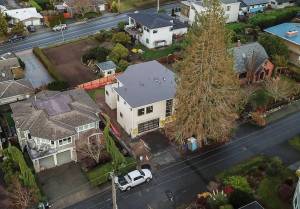
As Snohomish County is projected to grow more than 50 percent in the next two decades, few dispute the nonprofit hospital’s need to grow with it. The controversy is in the part of the hospital’s plan that involves moving eastward, where it wants to displace 21 homes on Rockefeller and Oakes avenues between 13th and 14th streets.
The hospital owns all the property on the block except for one home, that of longtime resident Pauline Kerney. She has refused to sell.
To the east, where Kerney lives, the hospital is planning two new buildings for single-bed hospital rooms and a parking garage. To prepare for future health care demands, the hospital also wants to build a new cancer center and parking garage to the north of its Colby Avenue campus.
Providence further plans to renovate its existing structure, including its emergency and surgery departments, and add a third parking garage on the southwest side of the campus.
DeGroodt said she hopes the community benefits of Providence’s plans won’t be obscured by the debate over those 21 homes in the approximately 80-home Donovan District.
“We are saying we want to improve north Everett. We want to create an environment that’s neighbor-friendly to the greatest extent possible,” DeGroodt said. “I know that’s hard to understand, but that’s what we’re trying to do.”
Providence is the second-largest private employer in Snohomish County, behind the Boeing Co., and has an annual budget of more than $358 million. The hospital paid more than $12 million in taxes 2004, said Gail Larson, Providence’s chief executive.
Most of Providence’s inpatient services are provided at the Colby Campus, including its heart institute, vascular institute and trauma center. Its Pacific Avenue campus has outpatient and women and children’s services.
The Colby Campus beds are frequently full, forcing the hospital to transfer patients to other area hospitals on an almost daily basis. The expansion would increase Providence’s available beds to 500 from 363, and all would be single rooms.
The Colby Campus emergency room is one of the busiest in the Puget Sound region, with 56,019 visits in 2003. The overflowing department is currently forced to place beds in the hallways – often not a pleasant or private experience for patients in trauma.
Because it doesn’t turn anyone away, the hospital spent $38.6 million on uncompensated health care in 2003.
“We treat anyone, regardless of their ability to pay,” Larson said. “We are the place where a homeless person comes, and we are the place where people who live in mansions come. And we do have both. It’s the broad spectrum of humanity we care for … that’s part of our mission. That’s why we’re here.”
For years, residents have complained about hospital employees and patients taking up street parking in the neighborhood, DeGroodt said. The expansion project would more than double the number of parking spots at the Colby Campus to 1,800 from 809, freeing up parking for area residents.
Hospital officials say that in a five-year period, two separate consulting firms have arrived at the same conclusion for the hospital’s long-term growth. Eastward expansion is the most feasible option, rather than in other directions or at other sites.
To pick an entirely new site would require at least 40 acres of land, DeGroodt said. It would also require spending $400 million all at once, rather than over a period of time.
“We didn’t just sit down and decide to do this,” she said. “We spent lots and lots of time and money to prepare. It’s the best possible plan for Providence and Everett.”
By expanding east, the hospital could connect new buildings with old ones, she said.
“The fact of the matter is, we need the property. The best we can do is move those houses,” DeGroodt said. “The time has arrived, and it’s not making people happy.”
Providence is asking city leaders to remove the block from the historic Donovan District and change the residential zoning to allow for its expansion.
“It’s 25 percent of a historic district versus serving the needs of 1 million people,” Wenta said. “To be honest, that’s the decision that needs to be made.”
Last one on the block
Shortly after the end of World War II, Pauline Kerney’s husband came home from work one day with a surprise.
“He told me he’d bought a home. I’d never seen it,” Kerney said. “Can you imagine if a man did that these days?”
The former Navy man had to snap up a house while he could; at that time, there were very few available in the city. The couple soon came to love their small home in northwest Everett.
“For some reason, we just stayed,” Kerney said. “The neighbors took care of each other. We all got here at the same time. We aged at the same time.”
For 60 years, until her husband, Kenneth, passed away a few years ago, the couple watched the city change from the windows of their butter-colored cottage on the corner.
In 1981, Providence, already thinking ahead, bought a home on Kerney’s block. For two decades, as residents moved on or died, the hospital purchased the homes on the block one-by-one.
In December, as it prepared to move forward with its 20-year growth plan, Providence bought the second-to-last house on the block for $230,000. It was appraised at $143,300 by the Snohomish County Assessor’s Office.
Kerney is now the only homeowner on a block of month-to-month renters.
“Really, once you’re past 80 – well past 80, as I am – to just uproot yourself and leave everything that you have carefully tended to over these years and try to find a new place to live – it’s not easy,” Kerney said. “It’s not easy at any age.”
Her hope is not only that her home will be saved, but also the others on the block. She’d love to see a new generation move in and experience what she did – growing old together as neighbors.
Neighborhood rallies
Residents in the Donovan District don’t want to be labeled as anti-hospital or anti-progress, any more than the hospital wants to be labeled as anti-neighbor. But they consider Providence’s mention of leaving town a low blow.
“They pulled out the biggest gun possible – they threatened to leave the city,” said Hilary Hager, who moved from Seattle to a home near the hospital two years ago. “The hospital is taking advantage of being the only game in town.”
When Donovan District residents learned of the hospital’s growth plans last fall, they immediately rallied. They made lawn signs and opened their homes for public tours.
For most of the nearby residents, their houses aren’t at stake, but the character of their neighborhood is.
Some are afraid the Donovan District, which neighbors worked hard to have listed as historic, will lose its character. Others are concerned with having to endure 15 years or more of construction, and that the outcome will resemble a high-traffic business park rather than a neighborhood.
“Everyone says health care is a priority, and it is, but I don’t think that means carte blanche,” Hager said. “I really don’t.”
More than anything, residents are worried that their objections are futile and that the hospital’s expansion is a done deal. The matter has become a political football similar to the controversy surrounding the destruction of historic buildings to make way for the Everett Events Center, they say, and they have found few allies in high places.
“We’re voices in the wilderness. We don’t exist in this world,” said Jeanne Wohl, a 25-year resident of Lombard Avenue. “We don’t attend the mayor’s Vision 20/20 meetings, we don’t know a planning commissioner. That isn’t our circle.”
The group of neighbors has spent hundreds of hours building their case, researching the hospital’s plans and city ordinances.
“Yes, we all knew there was a hospital when we moved into the neighborhood, but we moved into a … residential area, not a business park,” Hager said.
To them, fighting for their neighborhood is nothing new.
For years, the battle was for safety, as residents wrestled with drug trafficking, prostitution, theft and other crime that crept up the three blocks from Broadway into their neighborhood.
Neighbors never really worried about the hospital, Wohl said.
She said the neighborhood has turned a corner, and that in the past year alone, more than a dozen new families have moved into Donovan homes.
“We used to be the poor stepchildren of the neighborhood,” Wohl said. “That isn’t how it is anymore. There are dentists, architects and teachers living here – the whole place has changed.”
The last resort?
With approval, Providence would like to begin construction on its cancer center in January, which means it would need to clear the Donovan block before that for temporary parking.
For several years, the block would serve as a parking lot and construction staging area. Eventually, a parking garage and bed tower would occupy the block, along with a greenbelt on the side closest to the neighbors.
Everett City Council member Drew Nielsen said that before any homes are moved or demolished, the hospital should look at resuming a discussion with Everett Community College about a possible land trade to spare some or all of the Donovan homes.
Providence owns the Rite-Aid property on Broadway, and at one time discussed swapping that land for the college’s 9-acre athletic field across from the hospital. But because the field is across the street diagonally, the new wings wouldn’t be able to connect to the main hospital, DeGroodt said.
“I don’t know if that’s possible at all,” she said of the trade. “It’s a discussion we’re having (with the college) on and off.”
DeGroodt said the hospital is interested in the land not for its current expansion but for possible medical office buildings and outpatient care.
Nielsen has recused himself from the upcoming City Council discussion because of his longtime involvement with the northwest neighborhood and issues of hospital growth.
“I thought the hospital had many strong points in (its) presentation. The one not-so-strong point was the explanation as to why it could not expand into the athletic field,” he said.
He said viable, historic starter homes should only be lost as a last resort. Nielsen said the homes may belong to the hospital, but they also belong to Everett’s history.
“You still have to sort out how you’re going to fit things into a growing city, but it seems to me you should do everything you possibly can to keep the historical fabric,” Nielsen said.
Mayor Ray Stephanson said preserving history and maintaining the city’s stock of affordable homes are both priorities. So, too, is having comprehensive health care available to residents, he added.
“I’m in support of the hospital staying in Everett and expanding their operations in our community,” Stephanson said. “Our role as the public entity in this process is for us to listen to all the concerns and do our level best to try to find solutions to what those parties need and want.”
Larson said the hospital wants to try to iron out the issues.
“We’re hoping to be able to work with the city, work with the neighborhood and to continue to provide services here,” she said. “We’ve spent 100 years here, and we’d like to spend at least another 100 years here.”
Reporter Jennifer Warnick: 425-339-3429 or jwarnick@ heraldnet.com.