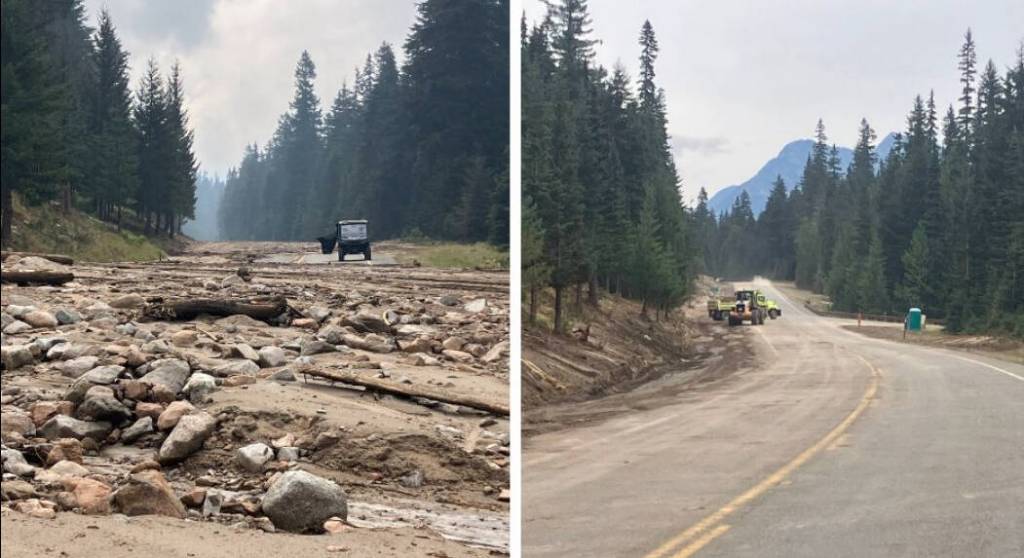
Washington transportation officials say a lack of funding means dollars intended for preservation and maintenance are the ones diverted to deal with emergency situations. Before (left) and after (right) photos of the mudslide and cleanup on State Route 20 following an Aug. 11 mudslide. (Washington State Department of Transportation)

Washington transportation officials say a lack of funding means dollars intended for preservation and maintenance are the ones diverted to deal with emergency situations. Before (left) and after (right) photos of the mudslide and cleanup on State Route 20 following an Aug. 11 mudslide. (Washington State Department of Transportation)

‘Early stages of critical failure’: Outlook grim for road upkeep

Billions more dollars are needed for preserving highways and bridges, WSDOT says. The agency’s leader didn’t request more maintenance money for 2026.

  • By Jerry Cornfield Washington State Standard
  • Thursday, October 16, 2025 9:46am
  • Local NewsNorthwest

State transportation officials say they are making the limited dollars for highway and bridge preservation stretch as far as they can — but it’s not far enough.

There’s too little money to keep up with repaving roads, repairing aging spans and responding to emergency fixes.

“We are in the early stages of critical failure due to lack of funding,” Troy Suing, director of capital program development and management for Washington State Department of Transportation, told a state panel Tuesday.

“We are doing everything we can to squeeze out as much service life as we can,” he told members of the Washington State Transportation Commission. “We are underfunded. We are forced to be reactive when we look at our assets right now.”

It’s going to take billions of dollars to handle the maintenance and preservation backlog, and “significant additional investment” to get ahead, Suing said in a sobering presentation echoing past messages of agency leaders.

Two years ago, Roger Millar, then department secretary, warned the state transportation system was “on a glidepath to failure” due to continued underfunding of preservation of highways and bridges. Former Gov. Jay Inslee voiced similar concerns, saying lawmakers dumped too much money into new projects in recent years and too little into preserving existing roads.

Earlier this year, the Legislature approved a two-year $15.5 billion budget with $900 million for preservation for the next two years, well shy of the $1.6 billion transportation officials estimated is required to keep pace with regular wear and tear.

Suing, the transportation department official, cataloged some of the challenges.

He said 40% of the state’s lane miles, about 7,900, were due or overdue for paving in 2024. Of those, 670 miles got paved.

This year, the agency decided to spend most of its paving budget in the first half of the biennium, creating a gap when the 2026 construction season arrives. It is preparing to carry out $170 million of additional paving next year, but the work hinges on getting additional funding in the preservation program.

Bridges are another story. Of Washington’s 3,427 spans, 10% are more than 80 years old.

Suing emphasized that “if they’re open, they’re safe” to drive on. That doesn’t mean they don’t need attention. For example, of the roughly 100 steel bridges due for painting, fewer than 10 got done in 2024.

When an emergency occurs that potentially requires closure, the effects ripple through communities.

A semitruck crash in August caused millions of dollars in damage to the White River Bridge connecting eastern King and Pierce counties. As repairs began, the span was entirely closed for weeks, then reopened to alternating traffic. It is expected to fully reopen in the coming weeks.

On the other hand, the Carbon River Bridge won’t reopen anytime soon. In April, the state permanently closed the 103-year-old structure on State Route 165 due to severe, unexpected deterioration of its steel supports. It provided access to Mount Rainier National Park’s Mowich Lake Entrance, Carbon River Ranger Station and other outdoor recreation areas.

“When we don’t preserve the system, it affects everybody,” Suing said. “This is a long-term commitment. There is no short-term fix when it comes to bridges.”

Last month, Washington State Department of Transportation Secretary Julie Meredith sketched the agency’s multi-billion-dollar need in her formal submission for the 2026 supplemental budget. She didn’t ask her boss, Gov. Bob Ferguson, for more money to address unfunded and underfunded “critical needs.”

In a Sept. 15 letter, she explained that her budget request reflects “a constrained approach” that sought funds only for such things as fuel rate changes and utility and insurance cost increases that occurred since adoption of the biennial spending plan in April.

But she included two documents showing that nearly $1.5 billion more per year is needed for preservation, operations and maintenance, and safety programs collectively. And billions more on top of that are required to keep Washington State Ferries afloat and to remove or replace culverts that pose barriers for migrating salmon.

“Critical needs remain unfunded,” she wrote. In the area of preservation alone, she warned that decades of underfunding “put the health of our existing [transportation] system in jeopardy” and led to “more frequent and severe failures and diverting resources to emergency fixes.”

This story was originlly published in the Washington State Standard.

Talk to us

> Give us your news tips.

> Send us a letter to the editor.

> More Herald contact information.

More in Northwest

Gov. Bob Ferguson signing Senate Bill 5480, a bill exempting medical debt from credit reports, on April 22. (Photo by Jacquelyn Jimenez Romero/Washington State Standard)
WA’s new ban on medical debt in credit reports at risk of federal override

The Trump administration wants to reverse Biden-era guidance on the issue.

The U.S. Capitol building in Washington, D.C., on May 7, 2025. (Photo by Jennifer Shutt/States Newsroom)
End of shutdown ignites sparring among congressional lawmakers

Meanwhile, U.S. Rep. Marie Gluesenkamp Perez was among six Democrats who sided with Republicans in voting the legislation out of the House.

Attorney General Nick Brown has proposed new advice for locales on how to interpret state public records law, with a focus on providing records faster. (Stock photo)
Need for speed: Plan to unclog WA public records system gets mixed reviews

Washington’s attorney general is seeking to reduce public record backlogs as concerns… Continue reading

Washington state Commissioner of Public Lands Dave Upthegrove waves to the crowd during inauguration ceremonies at the Washington state Capitol, in Olympia, on Jan. 15, 2025. (Photo by Ryan Berry/Washington State Standard)
Dave Upthegrove on land sales, federal funding cuts and wildfire immigration raids

Washington state’s new public lands commissioner came into office with his own ambitious agenda. It’s playing out against a shifting backdrop in D.C.

The so-called “big, beautiful bill” that congressional Republicans approved in July included a total of $50 billion for the Rural Health Transformation Program. The money is meant to offset some of the expected damage to rural hospitals from the law’s steep cuts to Medicaid. (Olivia Vanni / The Herald)
Washington makes pitch to feds for $1B in rural health funding

The money was included in Republicans’ “big, beautiful bill.” The state’s goals include strengthening the rural health workforce and improving care in tribal communities.

Screenshot from the state Employment Security Department’s website at esd.wa.gov. (File photo)
Expected slide in WA unemployment trust fund balance could trigger new tax

Washington businesses would need to shoulder roughly $700 million in additional taxes… Continue reading

The Washington state Capitol. (Jerry Cornfield/Washington State Standard)
State Democrats mull imposing income tax on higher earners

The idea is brewing ahead of the 2026 legislative session. It would target those making above $1 million. The state is one of nine that does not tax wages.

Washington state Commissioner of Public Lands Dave Upthegrove speaks at a press conference on wildfire issues Monday in Tumwater. (Photo by Bill Lucia/Washington State Standard)
Climate dollars eyed to backfill WA wildfire funding

Washington’s lands commissioner, Dave Upthegrove, is on a mission to secure $60… Continue reading

Washington Gov. Bob Ferguson, left, shakes hands with Cowlitz Indian Tribe Chairman Bill Iyall after signing an executive order to improve the state’s relations with tribal governments on Wednesday. (Photo courtesy of Washington governor’s office)
WA governor moves to improve state consultation with tribes

A new directive expands tribal relations training for state workers among other actions. Tribal leaders voiced support.

New map tracks measles exposures across Washington

Afraid you may have been exposed to measles? Washington’s Department of Health… Continue reading

A combine at work in wheat fields in the Walla Walla region during 2018. (Washington State Department of Agriculture)
State halts rebates to farmers hit with fuel fees under WA climate law

Instead, a new online directory shows retailers who provide the farm fuel exemption by not imposing surcharges.

Washington transportation officials say a lack of funding means dollars intended for preservation and maintenance are the ones diverted to deal with emergency situations. Before (left) and after (right) photos of the mudslide and cleanup on State Route 20 following an Aug. 11 mudslide. (Washington State Department of Transportation)
‘Early stages of critical failure’: Outlook grim for road upkeep

Billions more dollars are needed for preserving highways and bridges, WSDOT says. The agency’s leader didn’t request more maintenance money for 2026.

Support local journalism

If you value local news, make a gift now to support the trusted journalism you get in The Daily Herald. Donations processed in this system are not tax deductible.